

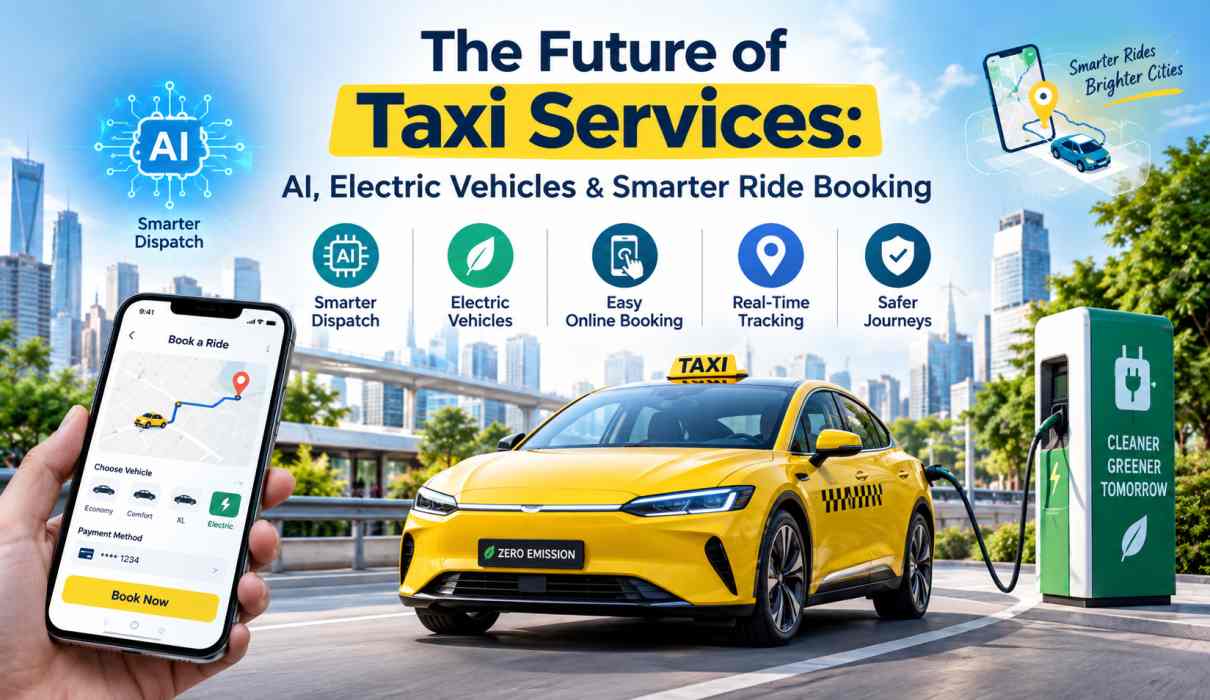
The Future of Taxi Services: AI, Electric Vehicles & Smarter Ride Booking
Taxi services are entering a new era. What was once a simple transportation service—calling a cab, getting picked up, and paying the driver—is becoming a technology-driven mobility experience. AI-powered dispatch, electric vehicles, real-time tracking, digital payments, smarter booking systems, and autonomous driving technology are changing how passengers and taxi operators think about urban transportation.
In 2026, taxi businesses are increasingly adopting technology to improve fleet management, reduce operating costs, provide more accurate arrival times, and deliver a smoother customer experience. At the same time, electric taxis are becoming more visible in major markets as cities and transportation companies look for cleaner mobility solutions.
The future of taxi services will not depend on a single technology. Instead, it will be shaped by the combination of artificial intelligence, electric mobility, connected vehicles, mobile apps, automated booking, and personalized transportation services.
How Technology Is Transforming Taxi Services
Traditional taxi operations depended heavily on telephone bookings, street pickups, radio dispatch, and manual fleet coordination. Modern taxi companies can now manage many of these processes through cloud-based platforms and smartphone applications.
Passengers can book rides, select vehicle categories, view estimated arrival times, track vehicles, receive digital receipts, and make cashless payments from their phones.
For taxi operators, technology can provide a centralized view of vehicles, drivers, bookings, customer requests, and fleet performance. This can make it easier to allocate vehicles and respond to changing demand.
A 2026 survey of more than 500 taxi and private-transport operators reported a substantial increase in AI-assisted dispatch adoption, with 47% of surveyed fleets using some form of AI-assisted dispatch compared with 19% in the previous year’s survey.
This illustrates an important shift: technology is moving from being an optional feature to becoming part of everyday taxi operations.
AI-Powered Taxi Dispatch
Artificial intelligence is likely to be one of the most important technologies shaping the future of taxi services.
Traditional dispatch systems generally assign vehicles based on availability and location. AI-powered systems can analyze considerably more information, including traffic conditions, historical demand, driver locations, booking patterns, weather, and estimated journey times.
This can help taxi companies make more informed dispatch decisions.
Predictive Demand
AI can analyze previous booking data to identify periods when demand is likely to increase. For example, a system might identify that airport demand rises during certain morning hours or that downtown bookings increase after major events.
Operators can then position vehicles closer to areas where demand is expected to increase.
Smarter Driver Allocation
Instead of simply sending the nearest available vehicle, an intelligent dispatch platform can consider factors such as traffic, estimated pickup time, vehicle type, destination, and upcoming bookings.
This can help reduce unnecessary vehicle movement and improve fleet utilization.
More Accurate ETAs
AI can also improve estimated arrival times by combining live traffic information with historical travel patterns. Better ETAs can give passengers a clearer idea of when their taxi will arrive.
Automated Customer Support
AI-powered chatbots and virtual assistants can handle common questions about bookings, fares, pickup locations, cancellations, lost items, and payment issues.
This allows taxi businesses to provide customer support outside traditional office hours while allowing human staff to focus on more complicated cases.
Electric Vehicles Are Changing the Taxi Industry
The transition from conventional fuel-powered vehicles to electric vehicles is another major development in the taxi industry.
Electric taxis can offer potential advantages including lower tailpipe emissions, quieter operation, and different maintenance requirements. For operators that run vehicles for many hours each day, fuel and maintenance economics can be important factors when evaluating fleet choices.
The growth of electric taxi services is already visible in different markets. In India, for example, Green SM launched an all-electric cab service in Delhi-NCR in September 2026, adding another EV-focused operator to the country’s evolving taxi market.
The adoption of electric taxis will depend on more than vehicle availability. Charging infrastructure, battery range, charging time, electricity costs, financing, local regulations, and fleet utilization will all influence how quickly operators can transition.
Fast and Convenient Charging
For a taxi driver, time spent charging is time that the vehicle may not be generating revenue. This makes charging speed and charging-network availability particularly important.
Future taxi fleets may increasingly use strategically located charging hubs where vehicles can recharge during driver breaks, shift changes, or periods of lower demand.
Fleet operators can also use software to monitor battery levels and schedule charging more efficiently.
Better EV Fleet Management
Connected electric taxis can provide operators with real-time information about battery status, vehicle location, charging requirements, mileage, and maintenance.
When combined with AI, this information could help operators decide which vehicles should accept longer trips and which should remain near charging facilities.
Smarter Taxi Booking Experiences
Modern passengers expect taxi booking to be fast and convenient. The future of ride booking will likely focus on reducing friction at every stage of the journey.
A modern taxi booking app can allow customers to enter a pickup and destination, choose a vehicle category, view an estimated fare, schedule a ride, track the driver, and pay digitally.
But smarter booking platforms can go further.
For example, a customer traveling to an airport could receive suggestions based on flight time and estimated road conditions. A business traveler could save preferred pickup locations and payment information. Regular customers could receive personalized booking options based on previous journeys.
The objective is to make the booking process feel simple while the technology handles the complexity in the background.
Real-Time Tracking and Better Passenger Safety
Safety remains an important part of the future taxi experience.
GPS tracking allows passengers and operators to see the location of a vehicle during a journey. Digital trip records can also provide information such as pickup location, destination, driver details, and journey time.
Modern taxi platforms may combine these features with emergency assistance, trip-sharing, driver verification, and automated alerts.
For taxi companies, connected systems can also help identify unusual vehicle behavior or unexpected route changes that may require attention.
Technology does not replace responsible driving, proper driver training, or effective regulation. Instead, it can provide additional tools for improving visibility and accountability.
Digital Payments Are Becoming Standard
Cashless payments are another important part of smarter taxi services.
Customers increasingly expect to pay through credit cards, debit cards, mobile wallets, QR payments, or stored payment methods. Digital transactions can also simplify accounting for taxi operators.
For businesses, electronic payment systems make it easier to generate receipts, track revenue, reconcile transactions, and manage corporate accounts.
A 2026 industry survey found that cash represented less than 10% of total fare value for 71% of the surveyed fleets, indicating how significantly payment behavior has shifted among those operators.
However, maintaining multiple payment options remains important because passengers have different preferences and access to financial services.
The Rise of Driver-Centric Taxi Platforms
The future of taxi services is not only about technology and vehicles. Business models are changing as well.
India’s Bharat Taxi provides an example of a different approach to app-based mobility. The platform is operated by Sahakar Taxi Cooperative Limited and uses a cooperative model in which drivers, known as Sarathis, participate as members and owners. The platform uses digital booking, real-time vehicle tracking, multilingual interfaces, and customer support.
By August 2026, the Indian government reported that Bharat Taxi had expanded into Delhi-NCR, Gujarat, Maharashtra, and Rajasthan, with 8.48 lakh registered drivers and 44.27 lakh registered customers as of August 4.
This demonstrates that innovation in taxi services can involve not only new technology but also new ways of organizing the relationship between drivers, platforms, and passengers.
Autonomous Taxis and the Robotaxi Future
One of the most discussed developments in transportation is the emergence of autonomous taxi services, commonly called robotaxis.
Unlike traditional taxis, robotaxis are designed to operate without a human driver under defined operating conditions. Companies are testing and expanding these services in several cities.
In September 2026, Waymo began public robotaxi service in Denver, San Diego, and Tampa, bringing its commercial operations to 14 U.S. cities according to TechCrunch. Its fleet had grown to more than 4,000 vehicles.
Other companies are pursuing similar developments. Uber and WeRide announced plans for commercial robotaxi operations in Zurich, subject to regulatory approval, while Uber, Wayve, and Nissan announced preparations for a Tokyo pilot planned for late 2026.
These developments suggest that autonomous taxis are moving beyond laboratory demonstrations into limited commercial operations.
However, widespread adoption will depend on safety validation, regulations, public acceptance, insurance, infrastructure, operating economics, and the ability of autonomous systems to handle complex real-world situations.
What Will the Taxi of the Future Look Like?
The future taxi may combine several technologies in one vehicle.
Imagine booking a ride through an app that understands your preferred vehicle type and destination. The system identifies nearby vehicles, analyzes traffic, calculates an efficient route, and provides an accurate pickup time.
The vehicle could be electric, connected to a central fleet-management system, and equipped with advanced driver-assistance technology.
Passengers could receive digital receipts automatically, while operators monitor battery levels, vehicle condition, demand patterns, and maintenance requirements from a centralized dashboard.
In some locations, the driver may remain an essential part of the experience. In others, autonomous vehicles may eventually handle certain types of trips.
The important point is that the future will likely involve multiple taxi models rather than one universal system.
Benefits for Taxi Operators
Technology can provide taxi businesses with several potential advantages.
Lower Operating Waste
AI-based routing and dispatch can help reduce unnecessary vehicle movement and improve fleet utilization.
Better Customer Retention
Convenient apps, transparent pricing, reliable ETAs, and digital payments can encourage customers to use the same service repeatedly.
Improved Fleet Management
Connected vehicles provide operators with more information about utilization, maintenance, location, and performance.
New Revenue Opportunities
Taxi companies can expand beyond traditional street-hail services into airport transfers, corporate transportation, scheduled rides, tourism, school transportation, and other specialized services.
Data-Driven Decisions
Booking and fleet data can help businesses understand peak periods, popular routes, customer preferences, and vehicle utilization.
What Passengers Can Expect
For passengers, the future of taxi services is likely to focus on convenience, transparency, personalization, and choice.
Customers may increasingly expect:
- Faster online booking
- More accurate pickup estimates
- Real-time vehicle tracking
- Digital payments
- Transparent fare information
- Multiple vehicle categories
- Scheduled rides
- Electric vehicle options
- Better airport transfer coordination
- Personalized travel preferences
- Easier customer support
The most successful taxi services will likely be those that use technology without making the customer experience complicated.
Challenges Facing the Future Taxi Industry
Despite rapid innovation, the taxi industry faces several challenges.
Electric vehicle adoption requires charging infrastructure and careful fleet planning. AI systems require reliable data and ongoing development. Digital platforms must protect customer and driver information.
Autonomous taxis introduce additional questions about regulation, insurance, liability, cybersecurity, and employment.
There is also the issue of accessibility. Technology should improve transportation without excluding people who are uncomfortable with mobile apps or do not have access to digital payment methods.
For this reason, the future taxi ecosystem will need to balance innovation with affordability, accessibility, safety, privacy, and human support.
How Taxi Businesses Can Prepare for the Future
Taxi operators do not necessarily need to adopt every new technology immediately. A practical strategy is to identify the areas where technology can solve real operational problems.
Businesses can start by upgrading online booking, digital payments, GPS tracking, and fleet-management systems. From there, they can explore AI-assisted dispatch, automated customer support, predictive maintenance, and EV adoption.
Taxi companies should also pay attention to customer expectations. A technically advanced platform is not useful if passengers find it difficult to use.
Training drivers and employees is equally important. Technology works best when the people operating the business understand how to use it effectively.
Conclusion
The future of taxi services will be shaped by a combination of AI, electric vehicles, smarter booking platforms, connected fleets, digital payments, and eventually autonomous transportation.
AI can help taxi companies make better dispatch and demand decisions. Electric vehicles can support the industry’s transition toward cleaner mobility. Mobile applications can make booking and payment more convenient, while real-time tracking can improve visibility throughout the journey.
At the same time, new business models such as cooperative ride-hailing are demonstrating that innovation can also change how taxi platforms work with drivers.
Autonomous taxis represent another potential transformation, although their wider adoption will depend on technology, regulation, safety, economics, and public acceptance.
For taxi businesses, the message is clear: the industry is becoming increasingly digital, connected, and data-driven. For passengers, that transformation could mean faster bookings, smarter routes, greater vehicle choice, improved transparency, and more personalized transportation experiences.
The taxi of tomorrow will not simply take passengers from one location to another. It will increasingly function as part of a connected mobility ecosystem designed around convenience, efficiency, sustainability, and smarter transportation.