

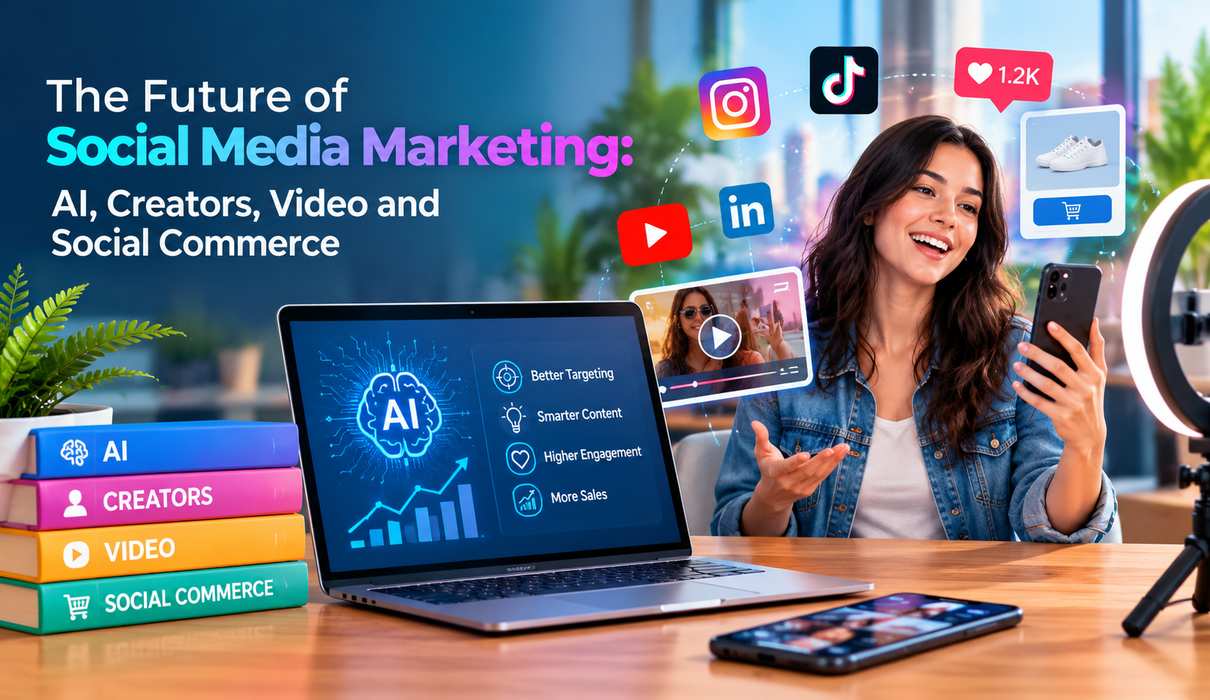
The Future of Social Media Marketing: AI, Creators, Video and Social Commerce
Social media marketing is entering a new phase in 2026. What once focused mainly on gaining followers, publishing posts, and running advertisements is becoming a much broader digital marketing ecosystem. Today, AI, creators, short-form video, social search, community engagement, and social commerce are changing how brands attract attention and turn that attention into business results.
Consumers are no longer using social media only to communicate with friends or watch entertaining content. They are discovering brands, researching products, watching reviews, communicating with businesses, and increasingly completing purchasing journeys through social platforms.
Recent 2026 research from HubSpot indicates that AI is already used by 94% of surveyed social media marketers in some capacity, while 77% say authenticity is more important than production value. The same research found that 60% of marketers plan to increase influencer investment in 2026.
In India, the connection between social media and shopping is particularly significant. Meta and the Retailers Association of India reported in 2026 that social media is increasingly influencing product discovery and that short-form video, creators, AI, and messaging are becoming interconnected parts of the customer journey.
So, what does the future of social media marketing look like?
AI Is Transforming Social Media Marketing
Artificial intelligence is becoming one of the most important technologies in modern social media marketing.
AI can help marketers generate content ideas, write initial drafts, analyze audience behavior, identify trends, personalize campaigns, automate repetitive tasks, and improve advertising performance.
Instead of spending hours analyzing large amounts of social media data manually, marketers can use AI-powered tools to identify patterns and opportunities more quickly.
For example, AI can help a brand determine:
- Which topics are generating engagement
- Which content formats perform well
- What times audiences are most active
- Which customer questions appear repeatedly
- Which advertising audiences are responding
- Which products are receiving increased attention
However, AI does not eliminate the need for human creativity.
In fact, authenticity is becoming more important as AI-generated content becomes easier to produce. HubSpot’s 2026 research found that 77% of surveyed marketers consider authenticity more important than production value.
The future is therefore likely to be less about replacing marketers with AI and more about using AI to help marketers work faster while keeping human ideas, experiences, opinions, and creativity at the center.
AI-Powered Content Creation Will Become Standard
Creating enough content for multiple social platforms can be challenging for small businesses and large brands alike.
AI can assist with brainstorming captions, creating content variations, generating scripts, summarizing customer feedback, and adapting one idea into multiple formats.
For example, one product demonstration could become:
- A short video
- An Instagram Reel
- A YouTube Short
- A carousel post
- A customer FAQ
- A blog article
- An email campaign
- A social advertisement
This allows marketing teams to build a more consistent content system without creating every asset from scratch.
The key, however, is quality control. Brands that publish large amounts of generic AI-generated content may struggle to stand out.
The strongest approach is likely to be AI-assisted rather than AI-only marketing: technology handles repetitive work while people provide the brand voice, expertise, storytelling, and originality.
Creators Are Becoming More Important to Brands
The creator economy is another major force shaping the future of social media marketing.
Consumers often respond differently to a recommendation from a creator they follow than to a traditional advertisement. Creators can demonstrate products in real situations, explain how they work, share personal experiences, and communicate with niche communities.
This has increased interest in influencer marketing and creator partnerships.
Importantly, brands are not only working with celebrities and creators who have millions of followers. Micro-influencers and niche creators can provide access to highly specific communities.
HubSpot’s 2026 research reports that 60% of marketers plan to increase influencer investment, while its findings also point to continued interest in smaller creator tiers.
For businesses, the focus is increasingly shifting from “How many followers does this creator have?” to questions such as:
- Does the creator reach the right audience?
- Is the content credible?
- Does the creator understand the product?
- Does their communication style fit the brand?
- Can their content generate meaningful engagement?
- Can results be measured?
This makes creator marketing a potentially valuable part of a broader social media strategy.
Short-Form Video Will Continue Driving Discovery
Video has become central to social media consumption, and short-form video remains particularly important.
Reels, Shorts, TikTok-style videos, product demonstrations, tutorials, behind-the-scenes clips, interviews, and customer testimonials allow brands to communicate information quickly.
In India, Meta reported in 2026 that 97% of surveyed users watch video on its platforms daily, while Reels has become a major environment for content, creator discovery, and product discovery.
This creates a major opportunity for businesses.
A company does not necessarily need a large production studio to create effective social videos. Simple, useful, authentic videos can work when they answer a question, demonstrate a product, solve a problem, or tell an interesting story.
For example, a local restaurant could publish:
- A 20-second kitchen video
- A chef introduction
- A customer reaction
- A new-menu announcement
- A behind-the-scenes clip
- A food preparation tutorial
The objective is not simply to make videos. It is to create content that gives people a reason to stop scrolling.
Social Commerce Is Connecting Content With Sales
One of the biggest developments in the future of social media marketing is the growing connection between content and commerce.
Previously, a customer might see an advertisement on social media, visit a website, search for the product, compare options, and eventually make a purchase.
The journey can now happen much closer to the original discovery moment.
A user may:
See a video → discover a product → read comments or reviews → message the brand → visit a product page → make a purchase.
This is the foundation of social commerce.
Shopify identifies shoppable content, creator content, user-generated content, conversational commerce, and AI-assisted engagement as important social commerce developments for 2026.
In India, Meta’s 2026 research also highlights the growing role of messaging in commerce, with WhatsApp increasingly connecting discovery, conversations, and purchasing journeys.
For businesses, this means social media can no longer be viewed only as a branding channel. It can also become part of the sales infrastructure.
Social Search Is Changing How People Discover Brands
Search behavior is also moving beyond traditional search engines.
People increasingly use social platforms to find recommendations, restaurants, products, tutorials, travel ideas, reviews, and local businesses.
This means brands need to think about social SEO.
Instead of optimizing only a website for search engines, marketers should also optimize social content for the way people search within platforms.
Useful practices include:
- Using descriptive captions
- Including relevant keywords naturally
- Creating videos that answer common questions
- Adding location information where relevant
- Using clear titles and on-screen text
- Responding to customer questions
- Publishing educational content
- Encouraging genuine reviews and discussions
The goal is to make useful content easy to discover, whether someone finds it through a recommendation, platform search, algorithmic feed, or creator.
Authenticity and User-Generated Content Matter
As AI makes polished content easier to produce, authentic human experiences may become even more valuable.
User-generated content, customer reviews, testimonials, unboxing videos, demonstrations, and real customer stories can help audiences understand how a product or service performs in everyday situations.
This does not mean every piece of content needs to look unprofessional.
Rather, brands should avoid making every social post feel like a traditional advertisement.
A combination of professionally produced content and authentic customer or creator content can make a social media presence feel more varied and relatable.
Transparency is important too. Paid partnerships and sponsored creator content should be disclosed appropriately according to applicable platform rules and advertising requirements.
Community Building Will Become a Bigger Priority
Social media algorithms and advertising can help brands reach audiences, but long-term relationships require more than impressions.
Community building is becoming an important part of social media strategy.
Brands can build communities by:
- Responding to comments
- Asking questions
- Creating discussions
- Hosting live sessions
- Sharing customer stories
- Creating niche groups
- Highlighting loyal customers
- Providing useful information
- Listening to audience feedback
A strong community can become a source of feedback, advocacy, content ideas, and repeat engagement.
This is particularly useful for businesses that serve specific interests or professional niches.
Social Media Is Becoming a Customer Service Channel
Customers increasingly expect brands to respond where conversations happen.
Instead of calling a support center or sending a traditional email, customers may send a direct message, comment on a post, or contact a business through a messaging platform.
AI-powered customer service can help answer routine questions and direct complex requests to human support teams.
For example, a customer could ask about:
- Product availability
- Opening hours
- Delivery status
- Booking information
- Return policies
- Pricing
- Service areas
Fast and useful responses can improve the customer experience.
However, automation should not make customers feel like they are talking to a machine when they need human assistance. The most effective systems are likely to combine automation with easy access to human support.
What Should Businesses Do in 2026?
Businesses do not need to adopt every new social media trend at once.
Instead, they should build a strategy around their audience and business objectives.
A practical 2026 social media marketing strategy can include five steps.
1. Use AI as a Productivity Tool
Use AI to research ideas, analyze performance, generate variations, and automate repetitive tasks while maintaining human oversight.
2. Build a Video-First Content Strategy
Create short videos that educate, entertain, demonstrate, or answer customer questions.
3. Work With Relevant Creators
Choose creators based on audience relevance, credibility, content quality, and engagement rather than follower count alone.
4. Connect Social Media With Commerce
Make it easy for interested users to move from discovery to product information, messaging, booking, or purchase.
5. Measure Meaningful Results
Track metrics that relate to actual objectives, such as engagement quality, leads, conversions, sales, repeat customers, and customer sentiment.
The Future of Social Media Marketing
The future of social media marketing will not be controlled by a single platform or technology.
Instead, several trends are converging.
AI will help businesses create and optimize content.
Creators will help brands communicate with communities through trusted voices.
Video will remain a major format for discovery and storytelling.
Social commerce will connect content with purchasing.
Social search will influence how people discover information and businesses.
Communities and conversations will help brands build longer-term relationships.
The biggest change may be that these elements will increasingly work together.
A customer might discover a product through a creator’s video, ask a question through messaging, receive an AI-assisted response, read customer comments, and complete the purchase without leaving the broader social ecosystem.
For businesses, this means social media should be treated as more than a place to publish content.
It can become a connected journey spanning discovery, trust, conversation, customer service, and commerce.
Final Thoughts
The future of social media marketing is becoming more intelligent, visual, creator-driven, and commerce-focused.
AI can make marketing operations faster, but human creativity remains essential. Creators can provide credibility and community connections. Video can capture attention and demonstrate products quickly. Social commerce can shorten the path from discovery to purchase.
At the same time, brands need to protect authenticity, respect customer privacy, disclose commercial relationships appropriately, and avoid relying entirely on automation.
The most successful social media strategies in 2026 are likely to be those that combine technology with genuine human connection.
For businesses preparing for the next stage of digital marketing, the opportunity is not simply to follow every trend. It is to understand how AI, creators, video, communities, and commerce can work together to provide customers with useful and engaging experiences.
Frequently Asked Questions
What is the future of social media marketing?
The future of social media marketing is expected to involve greater use of AI, creator partnerships, short-form video, social search, community building, personalized customer experiences, and social commerce.
How is AI changing social media marketing?
AI can help marketers with content ideation, creation, audience analysis, campaign optimization, personalization, customer service, and repetitive marketing tasks. Human oversight remains important for quality, accuracy, and brand authenticity.
Why are creators important in social media marketing?
Creators can help brands reach niche communities through content that feels more personal and relatable than traditional advertising. Their value depends on factors such as audience relevance, credibility, engagement, and content quality.
Will video remain important for social media marketing?
Yes. Short-form video continues to be a major content format in 2026, particularly for discovery, entertainment, education, and product demonstrations. Research from India also indicates strong daily video consumption across urban and rural audiences.
What is social commerce?
Social commerce is the use of social media platforms and their features to support product discovery, consideration, communication, and purchasing. It can include shoppable content, creator recommendations, messaging, product pages, and social advertising.
How can small businesses use social media in 2026?
Small businesses can focus on useful short-form videos, customer stories, local content, creator partnerships, community engagement, direct messaging, and AI-assisted content production. The most important step is to choose strategies that match their target audience and business goals.