

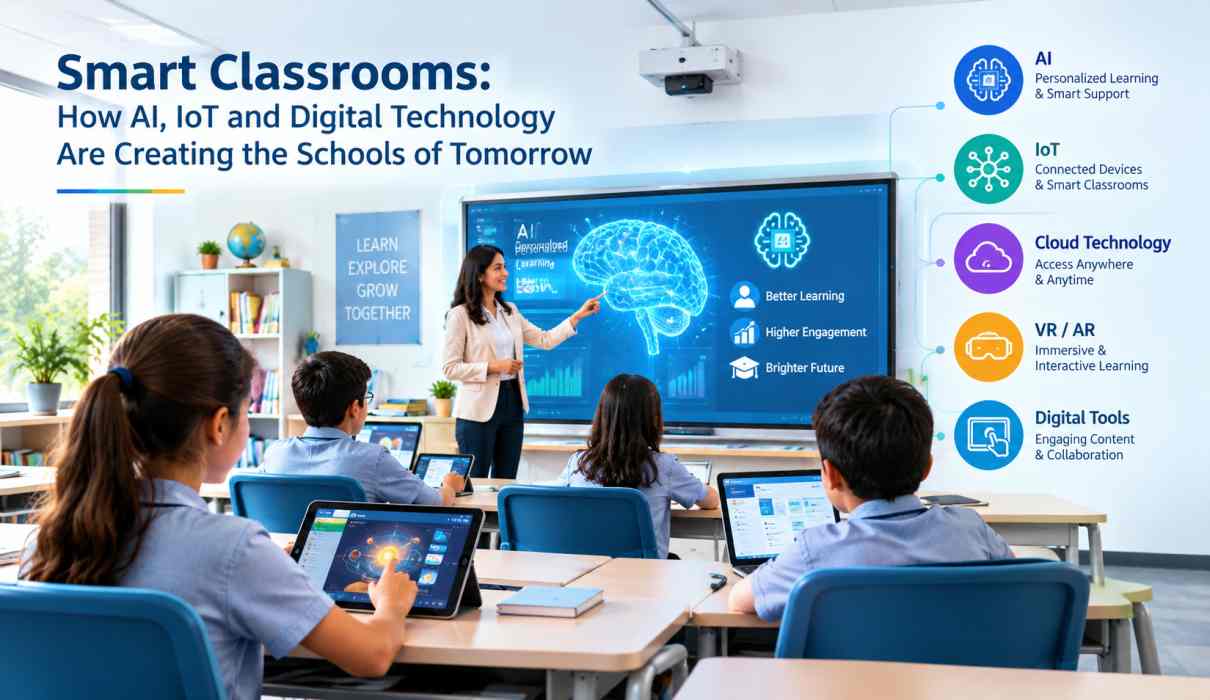
Smart Classrooms: How AI, IoT and Digital Technology Are Creating the Schools of Tomorrow
Education is entering a new era where technology is becoming an integral part of how students learn, teachers teach, and schools operate. Traditional classrooms built around textbooks, chalkboards, and one-way instruction are gradually evolving into connected learning environments powered by artificial intelligence (AI), the Internet of Things (IoT), cloud platforms, interactive displays, and digital learning tools.
These modern environments are commonly known as smart classrooms. They combine technology with teaching methods to create more interactive, personalized, efficient, and connected educational experiences.
The transformation is not simply about replacing traditional classroom equipment with computers or digital screens. The real opportunity lies in using technology to understand how students learn, support teachers with better information, automate routine tasks, and create learning experiences that can adapt to different needs.
As schools continue to adopt digital technologies, smart classrooms are likely to play an increasingly important role in shaping the schools of tomorrow.
What Is a Smart Classroom?
A smart classroom is a technology-enabled learning environment where digital devices, software, connectivity, and intelligent systems work together to support teaching and learning.
Instead of relying exclusively on traditional teaching methods, smart classrooms can use interactive displays, tablets, connected sensors, learning management systems, AI-powered educational software, virtual learning environments, and other digital tools.
For example, a teacher might use an interactive display to explain a science concept, while students use connected devices to complete an activity. An AI-powered learning platform can then analyze student responses and provide personalized exercises based on areas where additional practice is needed.
IoT devices can also help schools monitor classroom conditions such as temperature, lighting, air quality, and energy consumption.
The result is a more connected classroom where physical spaces, digital resources, teachers, and students can work together.
How AI Is Transforming Smart Classrooms
Artificial intelligence is one of the most important technologies influencing the future of education. AI can process large amounts of information and identify patterns that may help teachers and students make better decisions.
One of its biggest applications is personalized learning.
Students do not all learn at the same speed or in exactly the same way. An AI-powered learning platform can analyze performance and recommend different exercises, explanations, or learning materials depending on a student’s progress.
For example, if a student struggles with a particular mathematical concept, an intelligent learning system may provide additional examples and practice questions. A student who has already mastered the topic may receive more advanced challenges.
AI can also support teachers by helping with administrative activities, generating learning materials, organizing information, and providing insights into student performance.
Importantly, AI is most useful when it supports teachers rather than attempts to replace them. Teachers bring human understanding, creativity, empathy, classroom experience, and judgment that technology cannot fully reproduce.
Personalized Learning for Every Student
One of the biggest advantages of smart classrooms is the potential to move away from a one-size-fits-all approach.
In a traditional classroom, a teacher may need to deliver the same lesson to an entire group of students despite differences in ability, interests, and learning speed.
Digital learning systems can provide greater flexibility.
A student who needs additional help can access extra explanations and practice. Another student who learns quickly can move to more challenging material. This creates a more flexible learning environment where students can progress according to their individual needs.
Personalized learning can also make education more engaging. Digital platforms can incorporate quizzes, simulations, interactive exercises, videos, and educational games to give students multiple ways to explore a topic.
The goal is not simply to make learning more entertaining. It is to provide students with learning experiences that are more relevant, accessible, and responsive.
The Role of IoT in Modern Schools
The Internet of Things, or IoT, refers to connected physical devices that can collect and exchange information through networks.
In smart schools, IoT can connect classroom equipment, sensors, security systems, energy systems, attendance tools, and other devices.
For example, connected sensors can monitor classroom temperature and air quality. Smart lighting systems can automatically adjust lighting according to classroom conditions. Connected devices can also help schools monitor energy usage and identify opportunities to reduce unnecessary consumption.
IoT can therefore support both learning and school management.
A connected school environment may also make it easier for administrators to understand how classrooms and facilities are being used. This information can contribute to more efficient maintenance, resource management, and planning.
Interactive Digital Classrooms
Interactive displays are becoming an important component of modern classrooms.
Instead of presenting information on a conventional board, teachers can display videos, diagrams, animations, presentations, simulations, and interactive activities.
This can be particularly useful for subjects where visual demonstrations improve understanding.
For example, a science teacher can use an interactive simulation to demonstrate a chemical reaction. A geography class can explore digital maps and satellite imagery. History students can examine digital archives, photographs, timelines, and virtual museum resources.
Interactive technology can also encourage students to participate rather than simply listen.
Students may solve problems directly on a digital display, collaborate on shared documents, participate in live quizzes, or work together on digital projects.
Virtual Reality and Augmented Reality in Education
The future of smart classrooms may extend beyond screens and computers.
Virtual reality (VR) and augmented reality (AR) can create immersive learning experiences that allow students to explore subjects in new ways.
A VR lesson could allow students to explore historical locations, examine the human body, travel through space, or experience scientific environments that would otherwise be difficult or impossible to visit.
Augmented reality can overlay digital information onto the physical world. Students could use a compatible device to examine a 3D model of the solar system or explore an interactive representation of a machine.
These technologies can make abstract concepts more visual and experiential.
However, successful adoption requires appropriate educational design. Technology should be used when it genuinely improves understanding rather than simply because it is new.
Smart Attendance and School Management
Technology is also changing how schools manage everyday operations.
Digital attendance systems can reduce manual paperwork and make attendance records easier to organize. School management platforms can bring together information about students, classes, schedules, assignments, communication, and administrative activities.
AI and automation can potentially reduce repetitive administrative work, giving teachers and administrators more time to focus on students.
Parents can also benefit from digital communication platforms. Schools can share announcements, academic updates, assignments, event information, and other important communications through centralized systems.
This creates a more connected relationship between schools, students, teachers, and families.
Cloud Technology and Connected Learning
Cloud computing is another important part of the smart classroom ecosystem.
Instead of keeping educational resources exclusively on individual computers or physical storage devices, schools can use cloud-based platforms to access documents, learning materials, assignments, and applications from connected devices.
This can make learning more flexible.
Students may be able to access course materials from school, home, or another suitable location. Teachers can update resources without having to distribute physical copies.
Cloud platforms can also support collaboration. Multiple students can work on shared projects, while teachers can provide feedback digitally.
However, schools must ensure that cloud systems are properly secured and that access to educational data is carefully managed.
Smart Classrooms and Teacher Empowerment
Technology does not eliminate the importance of teachers. In many ways, it can increase their ability to support students.
A smart classroom can provide teachers with information about student progress, participation, and areas where additional instruction may be needed.
Teachers can use these insights to identify students who may require additional attention.
Digital tools can also help educators create presentations, quizzes, assignments, learning activities, and other educational materials more efficiently.
The teacher’s role is therefore evolving from being primarily a source of information toward becoming a guide, mentor, facilitator, and learning designer.
Human interaction remains essential because education involves much more than transferring knowledge.
Benefits of Smart Classrooms
Smart classrooms can offer several potential benefits for students, teachers, and schools.
1. More Personalized Education
Digital platforms can adapt learning activities to different levels of student performance and progress.
2. Greater Student Engagement
Interactive content, simulations, digital projects, and multimedia can provide students with more opportunities to participate.
3. Better Access to Resources
Online libraries, educational platforms, videos, simulations, and digital textbooks can expand the resources available to learners.
4. Improved Teacher Productivity
Automation and digital tools can reduce some repetitive administrative tasks and support lesson preparation.
5. Data-Informed Decisions
Schools can use educational data to understand learning patterns and identify areas that may require additional support.
6. Flexible Learning
Digital platforms can support learning beyond the physical classroom and provide students with access to resources at different times.
7. More Efficient School Operations
IoT and connected management systems can support energy monitoring, facility management, scheduling, and other operational activities.
Challenges of Building Smart Classrooms
Despite their potential, smart classrooms also present challenges.
One major issue is the digital divide. Not every student has equal access to reliable internet, modern devices, or suitable learning environments outside school.
Schools therefore need strategies that ensure technology expands educational opportunity rather than creating new inequalities.
Another challenge is data privacy and cybersecurity. Smart classrooms can generate significant amounts of information about students and teachers. Schools must establish strong policies for collecting, storing, accessing, and protecting educational data.
Teacher training is equally important. Purchasing advanced technology does not automatically improve education. Teachers need appropriate training and ongoing support to integrate digital tools into their teaching methods.
Cost is another consideration. Devices, connectivity, software, infrastructure, maintenance, and cybersecurity can require significant investment.
Finally, excessive dependence on technology can create its own problems. Students still need face-to-face communication, physical activities, creativity, collaboration, critical thinking, and real-world experiences.
The most successful smart classrooms will therefore balance technology with human-centered education.
The Future of Smart Schools
The future school is likely to be more connected, personalized, and data-informed.
AI systems may increasingly assist students with personalized explanations and learning recommendations. IoT devices may make school buildings more efficient and responsive. Digital platforms may connect classroom learning with home learning, while immersive technologies could provide students with experiences beyond the physical classroom.
We may also see greater integration between different educational technologies.
For example, an AI-powered learning platform could identify a student’s learning needs, recommend educational resources, track progress, and provide teachers with useful insights. IoT systems could simultaneously support the physical classroom environment.
However, the future of education should not be defined by technology alone.
The purpose of smart classrooms is to improve learning. Technology should remain a tool that supports educational goals rather than becoming the goal itself.
Preparing Students for a Digital Future
Smart classrooms are not only changing how students learn today; they can also help prepare them for an increasingly digital world.
Future careers are likely to require a combination of technical knowledge and human skills. Students need opportunities to develop digital literacy, problem-solving, communication, creativity, collaboration, adaptability, and critical thinking.
Schools can use technology to create project-based learning experiences where students research problems, analyze information, collaborate with classmates, and develop practical solutions.
This approach can help students understand how technology works while also teaching them how to use it responsibly.
Digital literacy will become increasingly important as students encounter AI-generated content, online information, automated systems, and rapidly changing technologies.
Conclusion: Building the Schools of Tomorrow
Smart classrooms represent a significant evolution in education. By combining AI, IoT, cloud computing, interactive technology, digital learning platforms, and immersive experiences, schools can create more flexible and connected learning environments.
AI can support personalized learning and teacher productivity. IoT can make school environments smarter and more efficient. Interactive digital tools can make lessons more engaging, while cloud platforms can make educational resources easier to access and share.
At the same time, successful digital transformation requires careful planning. Schools must address affordability, teacher training, cybersecurity, data privacy, accessibility, and the importance of human interaction.
The school of tomorrow will not simply be a classroom filled with advanced devices. It will be an environment where technology and teaching work together to help students learn more effectively.
Ultimately, the future of education is not about choosing between teachers and technology. It is about creating a partnership between human expertise and digital innovation.
As smart classrooms continue to evolve, schools that use technology thoughtfully and responsibly can create learning environments that are more personalized, collaborative, accessible, and prepared for the demands of the future.