

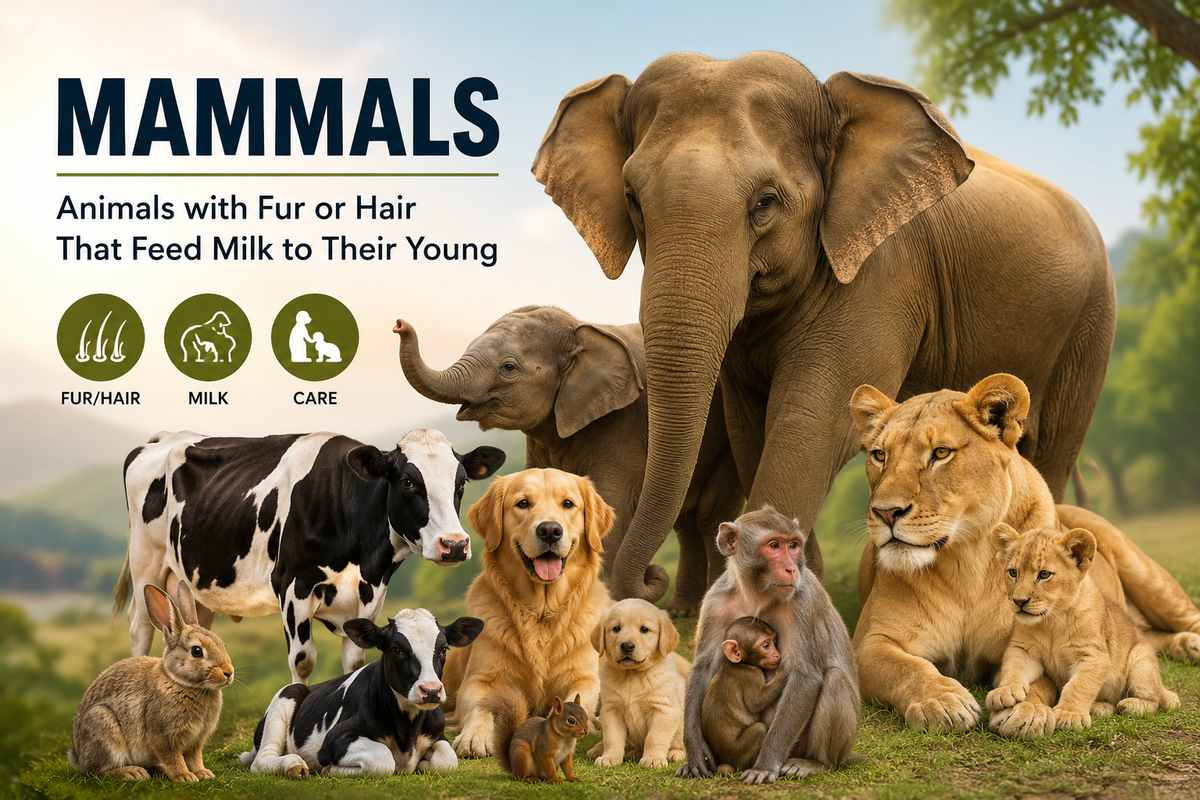
Mammals: Animals with Fur or Hair That Feed Milk to Their Young
Mammals are one of the most fascinating and diverse groups of animals on Earth. From tiny bats and mice to enormous elephants and whales, mammals live in almost every environment. They can be found on land, in the oceans, underground, and even in the air. Despite their huge differences in size, appearance, and lifestyle, all mammals share several important characteristics.
The most recognizable features of mammals are hair or fur, warm-blooded bodies, and the ability to produce milk for their young. Female mammals have mammary glands that produce milk, providing newborn babies with the nutrients they need during the early stages of life. This special way of caring for offspring helps young mammals grow and develop before they become independent.
In this article, we will explore what mammals are, their main characteristics, how they feed their young, where they live, and some interesting examples of mammals from around the world.
What Are Mammals?
Mammals are vertebrate animals belonging to the class Mammalia. Vertebrates are animals that have a backbone, and mammals are distinguished by several unique biological characteristics.
One of the most important mammal characteristics is that females produce milk to feed their babies. This process is known as lactation. Newborn mammals depend on their mother’s milk for essential nutrients, energy, and protection during early life.
Most mammals also have hair or fur at some point in their lives. Hair can serve several purposes, including keeping the body warm, protecting the skin, helping animals sense their surroundings, and sometimes providing camouflage.
Mammals are generally warm-blooded, meaning they can maintain a relatively stable internal body temperature even when the temperature of their surroundings changes. This ability allows many mammals to survive in cold, hot, or changing environments.
Main Characteristics of Mammals
Although mammals have evolved into thousands of different species, they share a number of important characteristics.
1. Mammals Have Hair or Fur
Hair or fur is one of the defining characteristics of mammals. While the amount and appearance of hair can vary greatly, all mammals have hair at some stage of their development.
For example, polar bears have thick fur that helps them survive in freezing Arctic conditions. Elephants have very little visible hair, while sea otters have extremely dense fur that helps keep them warm in cold water.
Hair can also perform other functions. Whiskers on cats, seals, rats, and many other mammals are specialized hairs that help animals detect movement and navigate their surroundings.
2. Mammals Feed Milk to Their Young
The ability to produce milk is perhaps the most important characteristic of mammals. Female mammals produce milk through mammary glands and use it to nourish their babies.
Milk contains important nutrients such as fats, proteins, carbohydrates, vitamins, and minerals. It provides young mammals with energy while their bodies develop.
The length of time mammals depend on milk varies widely. Some species nurse their young for only a short period, while others may continue feeding them milk for months or even years.
3. Mammals Are Warm-Blooded
Most mammals are endothermic, commonly described as warm-blooded animals. They generate heat internally and regulate their body temperature.
This adaptation allows mammals to remain active in a wide variety of climates. A fox can hunt in a snowy forest, while a camel can travel through a hot desert.
Maintaining body temperature requires energy, which is one reason mammals generally need a steady supply of food.
4. Mammals Have Lungs
Mammals breathe air using lungs. Even marine mammals such as whales, dolphins, and seals must come to the surface to breathe.
Whales and dolphins have adapted to life in the ocean, but they still need to inhale atmospheric oxygen. Their ability to hold their breath for extended periods allows them to spend significant amounts of time underwater.
5. Mammals Have Three Middle Ear Bones
Another distinctive mammalian characteristic is the presence of three tiny bones in the middle ear. These bones help transmit sound vibrations and contribute to mammals’ highly developed hearing abilities.
This feature is shared by mammals ranging from mice and bats to elephants and humans.
6. Mammals Have Specialized Teeth
Many mammals have different types of teeth that perform different jobs. Depending on their diet, mammals may have sharp teeth for tearing meat, flat teeth for grinding plants, or specialized teeth for particular foods.
Carnivorous mammals such as lions have prominent canine teeth for catching and eating prey. Herbivores such as cows have teeth adapted for processing plant material.
How Do Mammals Feed Their Babies?
One of the most remarkable aspects of mammalian reproduction is the way mothers nourish their young with milk.
After birth, a newborn mammal often has limited ability to find food or survive independently. Mother’s milk provides a ready source of nutrition and energy.
In many mammals, newborns instinctively search for the mother’s nipples and begin nursing. The milk is produced by mammary glands and released when the baby suckles.
Milk also provides more than calories. It contains substances that support growth and help young animals develop healthy immune systems.
As the baby grows stronger, it gradually becomes capable of eating other foods. The transition from milk to solid food is called weaning. The timing of weaning depends on the species and its lifestyle.
For example, many young herbivores eventually begin eating grass, leaves, or other vegetation, while young carnivores learn to consume meat. Some mammals receive extensive parental care even after they stop drinking milk.
Examples of Mammals
Mammals include an enormous variety of animals. Here are some common and interesting examples.
Lions
Lions are large carnivorous mammals known for living in social groups called prides. Lion cubs are born dependent on their mothers and drink milk during their early development.
As cubs grow, they gradually learn hunting and survival skills from adult members of the pride.
Elephants
Elephants are among the largest land mammals on Earth. They are highly social animals with strong family relationships.
Baby elephants depend heavily on their mothers and other members of their family group. They drink milk for an extended period while learning how to find food, use their trunks, and interact with other elephants.
Dogs
Dogs are familiar mammals that have lived alongside humans for thousands of years. Female dogs produce milk to feed their puppies after birth.
Puppies depend on their mother for warmth, nutrition, and protection during their earliest weeks. As they develop teeth and become more independent, they gradually transition to solid food.
Cats
Cats are mammals with soft fur and highly developed senses. Female cats nurse their kittens after giving birth.
Kittens are initially dependent on their mother for milk, warmth, grooming, and protection. Over time, they begin exploring their surroundings and eating solid food.
Whales
Whales are marine mammals that live in oceans around the world. Although they live underwater, they breathe air through blowholes.
Female whales feed their calves with milk that is particularly rich in fat. This helps calves grow rapidly and build energy reserves in the challenging marine environment.
Bats
Bats are the only mammals capable of sustained powered flight. They have hair and feed their young with milk.
Different bat species eat different foods. Some consume insects, while others feed on fruit, nectar, or other foods depending on the species.
Monkeys
Monkeys are mammals belonging to the order Primates. Many monkey species live in complex social groups.
Baby monkeys are often dependent on their mothers for milk, protection, transportation, and social learning. Their long childhood allows them to develop important skills by observing other members of their group.
Where Do Mammals Live?
Mammals have successfully adapted to almost every major habitat on Earth.
Land
Many mammals live on land, including elephants, lions, tigers, horses, dogs, cats, deer, bears, and rodents. They can occupy forests, grasslands, deserts, mountains, and polar regions.
Oceans
Marine mammals include whales, dolphins, seals, sea lions, walruses, and sea otters. These animals have developed adaptations that allow them to survive in aquatic environments.
For example, seals have streamlined bodies and flippers, while whales and dolphins have specialized bodies for efficient swimming.
Underground
Some mammals spend much of their lives underground. Moles, certain rodents, and other burrowing mammals dig tunnels that provide protection from predators and extreme weather.
Air
Bats are the most notable flying mammals. Their wings are formed from a thin membrane of skin stretched over elongated fingers and connected to their bodies and legs.
Different Types of Mammals
Mammals can be divided into three major groups based on how they reproduce and develop their young.
Monotremes
Monotremes are unusual mammals that lay eggs instead of giving birth to live young. The two living examples are the platypus and echidnas.
Even though they lay eggs, they are mammals because they produce milk for their young and have other mammalian characteristics.
Marsupials
Marsupials give birth to relatively undeveloped young. After birth, the baby continues developing while attached to a nipple, often inside a pouch.
Kangaroos, koalas, wombats, and many other Australian mammals are marsupials. Some marsupials also live in the Americas.
Placental Mammals
Placental mammals make up the largest group of mammals. Their young develop inside the mother’s uterus and receive nutrients through the placenta before birth.
Humans, dogs, cats, elephants, whales, bats, lions, and many other familiar mammals belong to this group.
Why Is Hair Important for Mammals?
Hair has played an important role in mammalian evolution. One of its primary functions is insulation.
Hair or fur can trap a layer of air close to the skin, helping reduce heat loss. This is especially useful for mammals living in cold environments.
However, hair is not always primarily used for warmth. Some mammals use hair for sensory purposes. Whiskers, for example, can detect changes in air movement and help animals understand their surroundings.
Hair can also provide protection and camouflage. The coloration and thickness of fur can help an animal blend into its environment or avoid detection by predators.
Why Are Mammals Important to Ecosystems?
Mammals play important roles in ecosystems around the world. Different species can act as predators, prey, herbivores, seed dispersers, pollinators, and scavengers.
Herbivorous mammals such as deer and elephants influence vegetation by eating plants. Predators such as wolves and lions can help regulate populations of other animals.
Some mammals also help spread seeds. Fruit-eating mammals may consume fruits and later deposit the seeds in different locations, helping plants reproduce.
Marine mammals contribute to ocean ecosystems as both predators and prey. Their activities can also influence the movement of nutrients within marine environments.
Interesting Facts About Mammals
Mammals have many fascinating adaptations. Here are a few interesting facts:
- The blue whale is the largest known animal ever to have lived.
- Bats are the only mammals capable of true sustained flight.
- The platypus is a mammal that lays eggs.
- Some mammals, including certain rodents and rabbits, have teeth that continue growing throughout life.
- Elephants use their trunks for breathing, smelling, touching, drinking, and handling food.
- Dolphins and whales use specialized sounds to communicate and navigate their underwater world.
- Some mammals hibernate or enter periods of reduced activity to survive times when food is scarce.
- Mammals can be found on every continent and in many different ocean environments.
Mammals and Their Young
Parental care is another important feature of many mammals. Mothers often spend considerable time protecting, feeding, grooming, and teaching their young.
The amount of parental care differs between species. Some young mammals become independent relatively quickly, while others remain with their parents for years.
Young mammals must learn important survival skills. They may need to learn how to find food, avoid predators, communicate with their group, and navigate their environment.
In social mammals, young animals may learn by watching adults. This is particularly important for species with complex behaviors and social structures.
Frequently Asked Questions About Mammals
What makes an animal a mammal?
A mammal is a vertebrate animal belonging to the class Mammalia. Mammals are characterized by features such as hair at some stage of development, mammary glands that produce milk, and three middle ear bones. Most mammals are also warm-blooded.
Do all mammals have fur?
All mammals have hair at some stage of their lives, but it may be very sparse or difficult to see. Whales and dolphins, for example, have hair during part of their development even though adult animals appear hairless.
Do all mammals give birth to live babies?
No. Most mammals give birth to live young, but monotremes such as the platypus and echidnas lay eggs.
Why do baby mammals drink milk?
Mother’s milk provides young mammals with nutrients and energy needed for growth and development. It also contains important substances that support the developing immune system.
Are whales and dolphins mammals?
Yes. Whales and dolphins are mammals. They breathe air with lungs, are warm-blooded, have hair during development, and females feed their young with milk.
Conclusion
Mammals are an incredibly diverse group of animals united by several important characteristics. They have hair or fur at some point in their lives, are generally warm-blooded, breathe using lungs, and most importantly, female mammals produce milk to feed their young.
From a tiny bat flying through the night to a massive whale swimming through the ocean, mammals have evolved remarkable adaptations for surviving in different environments. Their ability to care for and nourish their young has also contributed to the success of this animal group.
Understanding mammals and their characteristics helps us appreciate the incredible diversity of life on Earth. Whether they live in forests, deserts, oceans, mountains, or alongside humans, mammals play important roles in natural ecosystems and continue to fascinate people with their unique behaviors and adaptations.