

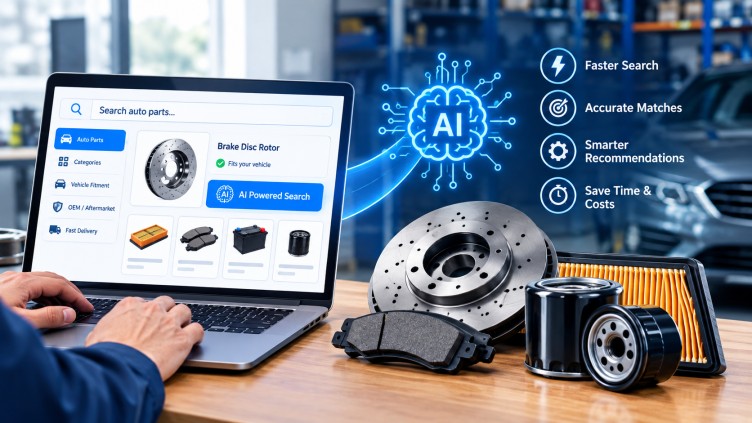
How AI Is Making Auto Parts Product Discovery Faster and Smarter
Finding the right auto part has traditionally been a time-consuming process. A customer may know that a vehicle needs a replacement component but may not know the exact part name, part number, compatibility details, or technical specifications. They may search through catalogs, compare product descriptions, contact suppliers, or visit multiple websites before finding the correct product.
Artificial intelligence (AI) is changing this process.
Today, AI-powered auto parts product discovery is helping customers, mechanics, retailers, distributors, and automotive businesses find relevant products faster and with greater accuracy. Instead of relying only on exact keywords or complicated product catalogs, modern AI systems can understand natural-language queries, vehicle information, product specifications, images, and customer intent.
This shift is particularly important as automotive e-commerce continues to grow and vehicle parts catalogs become increasingly complex. With thousands of products, multiple brands, compatibility requirements, and technical specifications, intelligent search can make the buying journey significantly easier.
So, how exactly is AI transforming auto parts product discovery? Let’s explore the major ways artificial intelligence is making automotive parts search faster, smarter, and more personalized.
What Is Auto Parts Product Discovery?
Auto parts product discovery refers to the process of helping a customer find an automotive product that matches their vehicle, needs, specifications, or intended use.
For example, a customer might search for:
- Brake pads for a 2021 Toyota Camry
- An alternator compatible with a specific engine
- A replacement headlight assembly
- An oil filter for a particular vehicle model
- A suspension component with a specific dimension
- A replacement part based on a product image
Traditional search systems often depend heavily on exact keywords. If the customer uses terminology that differs from the product catalog, relevant products may not appear.
AI can make this process more flexible by understanding what the customer actually means rather than simply matching words.
Why Finding the Right Auto Part Can Be Difficult
The automotive parts industry presents unique search challenges.
A single vehicle can have thousands of individual components. Many parts have similar names but different specifications. A small difference in model year, engine configuration, trim, dimensions, or manufacturer can determine whether a part is compatible.
Customers may also use different terms for the same product. Someone might search for “brake rotor,” while another person may use “brake disc.” A professional mechanic may use a technical part number, while a consumer may describe the component in simple language.
This creates a gap between how customers search and how products are listed.
AI helps bridge that gap.
1. AI Understands Natural-Language Searches
One of the biggest advantages of AI-powered search is its ability to understand natural language.
Instead of requiring customers to enter an exact product title, an AI-based system can interpret conversational queries.
For example, a user could type:
“I need front brake pads for my 2019 Honda Civic.”
Traditional keyword search may focus on individual terms such as “front,” “brake,” “pads,” “2019,” “Honda,” and “Civic.”
An AI-powered system can interpret the query as a complete request and identify the likely vehicle, component, position, and intended product category.
This makes automotive parts search more intuitive, particularly for customers who are not familiar with technical terminology.
2. AI Improves Vehicle-Part Compatibility
Compatibility is one of the most important factors in auto parts purchasing.
A visually similar component may not work with a particular vehicle. Engine type, production year, drivetrain, trim level, dimensions, and other specifications can affect compatibility.
AI can analyze large amounts of structured and unstructured product data to identify compatibility relationships.
For example, an intelligent product discovery system can compare:
- Vehicle make
- Vehicle model
- Model year
- Engine type
- Trim
- Part number
- Manufacturer information
- Product specifications
- Fitment data
This can help narrow down a large catalog to products that are more likely to fit the customer’s vehicle.
For retailers and distributors, better fitment discovery can also reduce incorrect orders and product returns.
3. AI Makes Part Number Searches More Powerful
Part numbers are extremely important in the automotive industry. However, customers may enter them with formatting differences, spelling mistakes, missing characters, or additional spaces.
AI-powered search can improve the handling of these variations.
For example, if a customer enters a slightly incorrect part number, an intelligent search engine may identify similar product records or suggest possible matches.
AI can also connect equivalent terms and related product information, making it easier to discover products across large catalogs.
This is particularly useful for automotive distributors and B2B platforms that manage extensive inventories.
4. AI Enables Image-Based Auto Parts Search
Another major development is visual search for auto parts.
Instead of typing a product name, customers can upload a photo of the component they need.
AI-based computer vision can analyze visual characteristics such as:
- Shape
- Size
- Design
- Mounting points
- Connector patterns
- Component structure
- Visible markings
- Product labels