

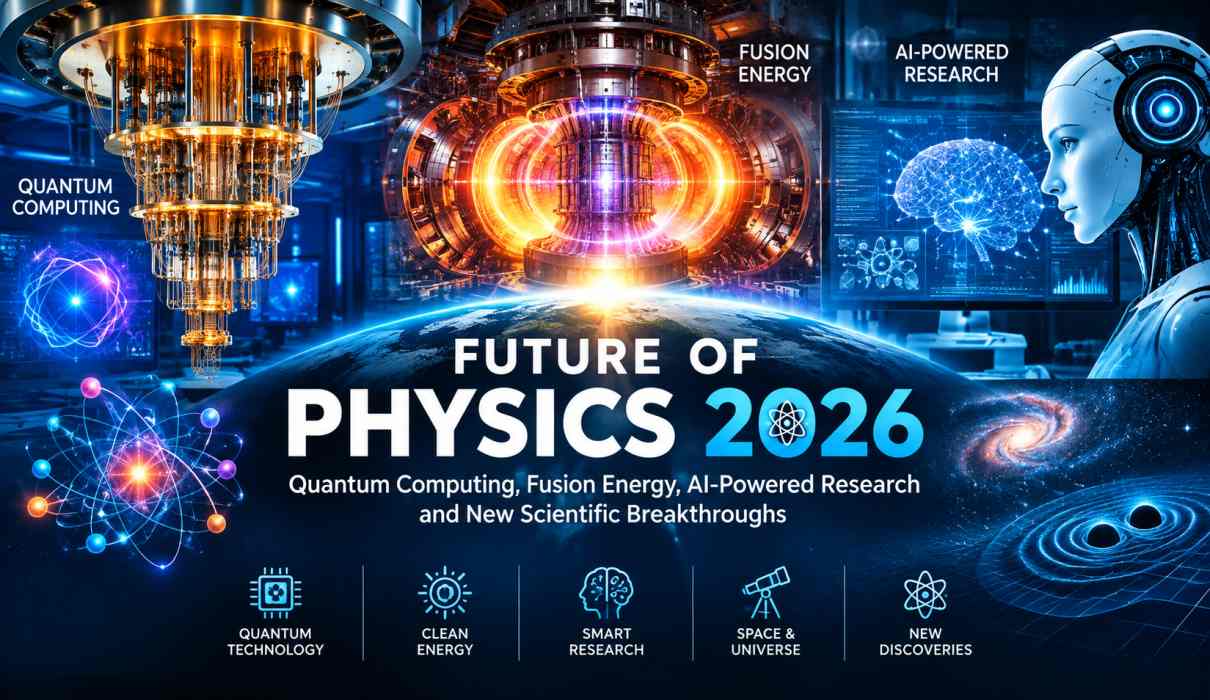
Future of Physics 2026: Quantum Computing, Fusion Energy, AI-Powered Research and New Scientific Breakthroughs
Physics has always been at the heart of scientific progress, helping humanity understand everything from the smallest particles to the largest structures in the universe. In 2026, the field continues to evolve rapidly as researchers combine traditional scientific principles with artificial intelligence, quantum technologies, advanced materials, high-performance computing and increasingly sophisticated experimental techniques.
The future of physics in 2026 is not limited to one particular area. Quantum computing is developing new approaches to computation and simulation, fusion research is exploring cleaner sources of energy, and artificial intelligence is helping scientists analyse complex datasets and accelerate research. At the same time, particle physics, astrophysics, materials science and gravitational-wave research continue to investigate fundamental questions about nature.
These developments are creating new opportunities for scientific discovery and technological innovation. This article explores the major physics trends in 2026, the technologies driving research and the potential impact of these developments on science and society.
The Changing Landscape of Physics in 2026
Modern physics increasingly depends on collaboration between different scientific disciplines. Problems that once belonged exclusively to physics now involve computer science, engineering, mathematics, chemistry, materials science and data science.
One of the most important changes is the growing role of computational methods. Powerful computers can simulate physical systems that are extremely difficult to reproduce experimentally. Machine learning can identify patterns in enormous datasets, while advanced laboratory equipment allows scientists to observe phenomena with increasing precision.
Several areas are particularly important in 2026, including:
- Quantum computing and quantum information
- Artificial intelligence in scientific research
- Nuclear fusion and plasma physics
- Quantum materials and advanced materials
- Particle physics
- Astrophysics and cosmology
- Gravitational-wave science
- Quantum sensing and precision measurement
- High-performance scientific computing
Together, these fields are shaping the next generation of physics research.
Quantum Computing and the Future of Physics
Quantum computing remains one of the most closely watched areas of modern physics. Unlike conventional computers, quantum computers use quantum states to process information. Their development is based on principles such as superposition, entanglement and quantum measurement.
In 2026, quantum computing research continues to focus on improving hardware reliability, reducing errors and developing useful applications. Researchers are investigating different approaches to building quantum processors, including superconducting systems, trapped ions, neutral atoms and photonic technologies.
One of the most important challenges is quantum error correction. Quantum states are extremely sensitive to environmental disturbances, making reliable computation difficult. Scientists are therefore developing methods to protect quantum information and create more stable systems.
Physics is particularly important to quantum computing because researchers need to understand and control quantum behaviour at an extremely precise level.
Potential applications include:
- Simulating complex molecules
- Studying quantum materials
- Optimising certain mathematical problems
- Modelling physical systems
- Supporting drug and materials research
- Developing new cryptographic methods
Quantum computing is still developing, and practical applications will depend on continued advances in hardware, software and error correction. Nevertheless, it represents one of the most important intersections between fundamental physics and future technology.
AI-Powered Physics Research
Artificial intelligence is becoming an increasingly valuable tool across physics. Researchers now work with datasets generated by particle accelerators, telescopes, gravitational-wave detectors, fusion experiments and advanced simulations.
Machine learning can help scientists classify events, detect patterns, optimise experiments and build faster approximations of complex physical models.
For example, an AI system can analyse large quantities of experimental data and identify unusual patterns that deserve further investigation. In computational physics, machine-learning models can sometimes reduce the computational cost of simulations by learning relationships within previously generated data.
AI can also assist with experimental design. Instead of testing every possible configuration, researchers can use optimisation algorithms to identify promising experimental conditions.
However, AI does not replace the underlying scientific process. Physics still requires carefully designed experiments, mathematical models, validation and reproducible evidence. The most useful future applications are likely to combine AI capabilities with established scientific methods.
Fusion Energy and Plasma Physics
Another major area shaping the future of physics in 2026 is nuclear fusion.
Fusion occurs when light atomic nuclei combine under extreme conditions, releasing energy. The same basic process powers stars. Scientists have spent decades developing controlled fusion systems that could potentially provide a new source of low-carbon energy.
Fusion research involves several branches of physics, including plasma physics, nuclear physics, electromagnetism, materials science and computational modelling.
Researchers are investigating different fusion approaches, including magnetic confinement and inertial confinement. Tokamaks and stellarators use magnetic fields to control extremely hot plasma, while other approaches explore alternative methods of creating and maintaining fusion conditions.
A major challenge is maintaining a stable plasma while extracting useful energy from the system. Materials used in future fusion facilities must also withstand intense heat, radiation and particle bombardment.
Artificial intelligence and advanced computing are becoming increasingly relevant to fusion research. They can support plasma monitoring, control systems, simulation and optimisation.
While commercial fusion energy remains a complex engineering challenge, continued research is expanding scientific understanding of high-temperature plasma and fusion processes.
Quantum Materials and Advanced Materials
Materials physics is another important part of modern scientific research. New materials can exhibit unusual electrical, magnetic, optical or mechanical properties that may lead to technological applications.
Researchers are studying materials such as superconductors, two-dimensional materials, topological materials and other engineered quantum systems.
Superconductivity is particularly significant because superconducting materials can carry electrical current with extremely low resistance under appropriate conditions. Understanding and improving superconducting systems could contribute to applications in computing, medical imaging, energy systems and scientific instruments.
Two-dimensional materials are also attracting attention because their unusual properties can emerge when matter is reduced to extremely thin structures.
In 2026, computational modelling and AI-assisted materials discovery are helping researchers investigate larger numbers of possible material structures. This combination of physics, chemistry and machine learning could accelerate the search for materials with useful properties.
Particle Physics and the Search for New Physics
Particle physics investigates the fundamental building blocks of matter and the forces that govern their interactions.
The Standard Model has successfully explained a wide range of experimental observations, but scientists continue to investigate questions that remain unresolved. These include the nature of dark matter, the matter-antimatter imbalance and the deeper relationship between fundamental forces.
Particle accelerators allow researchers to recreate high-energy conditions and study the behaviour of elementary particles. Detectors generate enormous amounts of data, creating opportunities for sophisticated computational analysis.
Future discoveries could come from unexpected deviations between theoretical predictions and experimental measurements. Researchers are therefore improving both the precision of experiments and the sensitivity of detectors.
The search for new physics is closely connected to advances in computing, instrumentation, superconducting technologies and data science.
Astrophysics, Cosmology and the Universe
Physics in 2026 is also expanding our understanding of the universe.
Astrophysics combines physics with astronomical observations to study stars, planets, galaxies, black holes and other cosmic objects. Cosmology focuses on the origin, structure and evolution of the universe.
One of the biggest questions is the nature of dark matter. Although its gravitational effects can be observed, its underlying composition remains unknown.
Dark energy is another major mystery. Observations indicate that the expansion of the universe is accelerating, but the physical explanation for this acceleration remains an active research question.
Improved telescopes and scientific instruments are producing increasingly detailed observations of distant objects. These observations can test theories of gravity, stellar evolution and cosmic structure.
The continued interaction between observational astronomy, theoretical physics and computational modelling will remain an important feature of future research.
Gravitational Waves and Precision Physics
The detection of gravitational waves opened a new way of observing the universe. These tiny distortions in spacetime are produced by violent cosmic events such as mergers involving black holes and neutron stars.
Gravitational-wave astronomy provides information that cannot be obtained through ordinary light-based observations alone.
Future improvements in detectors and data-analysis techniques can increase sensitivity and allow scientists to observe more cosmic events.
This research is also connected to fundamental physics because gravitational waves provide opportunities to test theories of gravity under extreme conditions.
Quantum sensors and other precision measurement technologies may also contribute to future developments in gravitational physics.
Quantum Sensing and Precision Measurement
Quantum technology is not limited to computing. Quantum sensors are becoming an important research area because quantum systems can be extremely sensitive to changes in their environment.
Potential applications include measurements of magnetic fields, gravity, acceleration, time and other physical quantities.
Precision sensors could support scientific research in areas ranging from geophysics to astronomy. They may also help researchers search for subtle signals associated with fundamental physics.
The development of quantum sensing demonstrates how discoveries in fundamental physics can eventually contribute to practical measurement technologies.
The Role of High-Performance Computing
Many modern physics problems require enormous computational resources. Simulations of particle collisions, climate-related physical systems, fusion plasmas, quantum materials and astrophysical processes can involve millions or billions of calculations.
High-performance computing helps researchers perform these calculations more efficiently.
The future is likely to involve a combination of conventional supercomputers, specialised accelerators, AI systems and emerging quantum computers.
This hybrid approach could allow scientists to select the most appropriate computational method for each problem rather than relying on a single technology.
New Scientific Breakthroughs in Physics
The most exciting aspect of physics research is that major discoveries are often difficult to predict.
Scientific breakthroughs can emerge from improved measurements, unexpected experimental results or entirely new theoretical approaches.
Some areas to watch closely include:
- Quantum computing and error correction
- Fusion plasma control
- New quantum materials
- Precision particle measurements
- Dark matter searches
- Gravitational-wave observations
- AI-assisted scientific discovery
- Advanced quantum sensors
- New approaches to fundamental physics
- High-performance scientific simulations
Not every research project will produce an immediate technological application. Fundamental physics often requires years or decades of investigation before its practical importance becomes clear.
Physics, Technology and Industry
The relationship between physics and industry is becoming increasingly important. Scientific discoveries can influence computing, energy, telecommunications, healthcare, manufacturing and space technology.
Quantum technologies could create new approaches to sensing and computation. Advanced materials could improve electronic and energy systems. Fusion research could influence future energy technologies, while AI-powered physics could accelerate scientific and industrial research.
The skills required by future physics research are also becoming broader. Physicists increasingly work with programming, data analysis, machine learning, simulation, engineering and advanced instrumentation.
This means the future of physics will depend not only on theoretical knowledge but also on interdisciplinary collaboration.
Challenges Facing the Future of Physics
Despite rapid progress, physics research faces significant challenges.
Many experiments require extremely expensive infrastructure. Large particle accelerators, fusion facilities, gravitational-wave observatories and advanced telescopes can require international collaboration and long development timelines.
Another challenge is the complexity of modern scientific data. Researchers need reliable methods to distinguish meaningful signals from noise and avoid misleading conclusions.
AI introduces additional questions about transparency, reproducibility and validation. A machine-learning model can identify correlations, but scientists still need to understand whether those correlations represent genuine physical relationships.
There are also engineering challenges. Technologies such as quantum computers and fusion reactors require substantial advances before their full potential can be realised.
These challenges make careful experimentation, peer review and international scientific collaboration essential.
What Does the Future of Physics Look Like?
The future of physics is likely to become increasingly interconnected.
Quantum computing may provide new tools for studying quantum systems. AI may accelerate data analysis and simulation. Fusion research may advance understanding of plasma physics and energy systems. Quantum sensors may improve precision measurements, while astrophysical observatories may reveal new information about the universe.
Rather than replacing traditional physics, these technologies are expanding the tools available to researchers.
The biggest developments may occur where different fields overlap. Quantum physics combined with computing, AI combined with scientific modelling, and plasma physics combined with advanced materials are examples of this growing interdisciplinary approach.
Conclusion
The future of physics in 2026 is being shaped by a combination of fundamental research, advanced technology and interdisciplinary collaboration. Quantum computing, fusion energy, artificial intelligence, quantum materials, particle physics, astrophysics and precision measurement are among the major areas influencing the field.
The significance of these developments goes beyond individual experiments. Physics provides the scientific foundation for many technologies that influence modern life, from computing and telecommunications to medical imaging and energy systems.
As researchers continue to improve experimental instruments, computational methods and theoretical models, new discoveries may emerge across multiple areas of science.
For students, researchers, technology professionals and science enthusiasts, Physics Trends 2026 offers a fascinating view of how humanity is exploring matter, energy, space and time. The next generation of discoveries may come not from one field alone, but from the powerful combination of physics with artificial intelligence, quantum technology, advanced computing and engineering.