

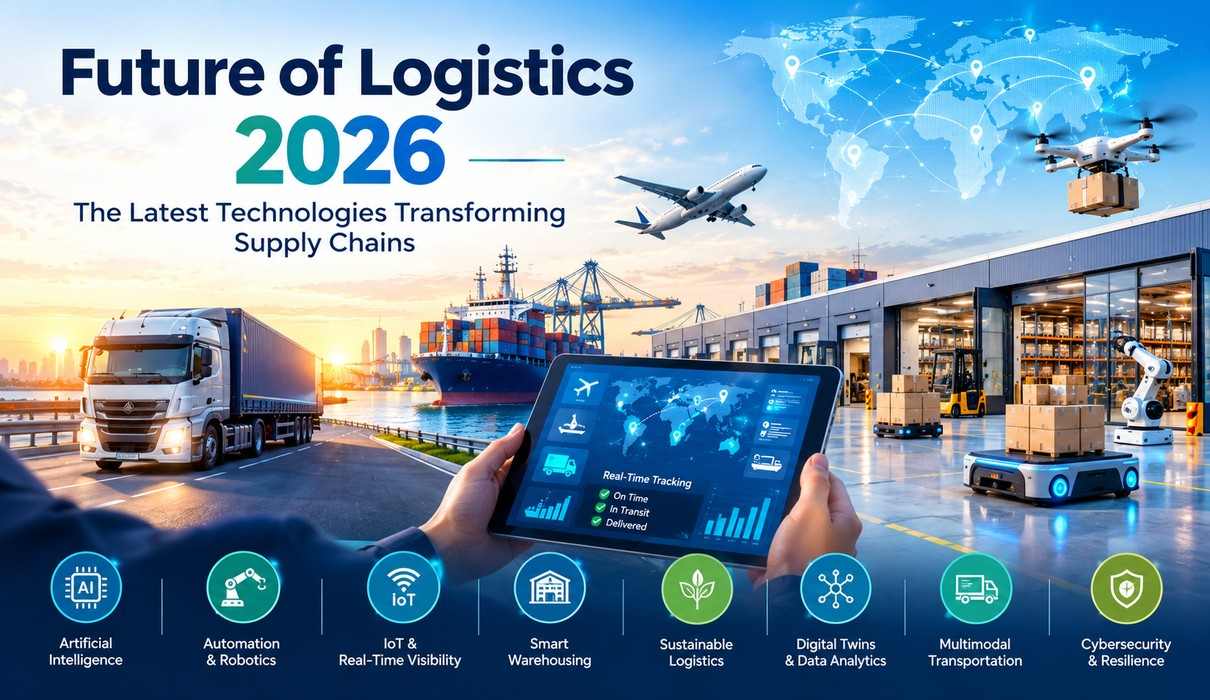
Future of Logistics 2026: The Latest Technologies Transforming Supply Chains
The logistics industry is entering a new era in 2026. Supply chains are no longer focused only on moving products from one location to another. Businesses now need logistics networks that are faster, smarter, more flexible, connected and resilient.
The rapid growth of e-commerce, quick commerce, global trade, manufacturing, direct-to-consumer businesses and on-demand delivery is increasing pressure on logistics companies. At the same time, artificial intelligence (AI), robotics, Internet of Things (IoT), automation, digital twins, real-time tracking and advanced analytics are changing how goods are stored, transported and delivered.
In India, this transformation is particularly important. Growing e-commerce and quick-commerce demand is creating new requirements for warehouses, micro-fulfilment centres and technology-enabled logistics infrastructure. CBRE expects India’s quick-commerce gross order value to reach ₹2 trillion by 2028, while the country’s warehouse automation market is projected to reach $1.42 billion by 2030. (CBRE)
So, what does the future of logistics in 2026 look like? Let’s explore the major technologies and trends transforming modern supply chains.
1. Artificial Intelligence Is Transforming Logistics
Artificial intelligence is becoming one of the most important technologies in logistics. Instead of relying entirely on historical information and manual decision-making, logistics businesses can use AI to analyse large amounts of data and identify patterns.
AI can help companies forecast demand, optimise transportation routes, manage inventory, predict delays and identify potential supply-chain disruptions.
For example, an AI system can analyse previous sales, weather conditions, seasonal demand, traffic, holidays and regional purchasing behaviour to estimate where products will be required. This allows businesses to position inventory closer to customers and reduce unnecessary transportation.
In India, research on AI and logistics has linked AI adoption and multimodal integration with improved logistics performance and cost reduction, reinforcing the importance of technology in the country’s supply-chain development. (ScienceDirect)
2. Agentic AI and Autonomous Decision-Making
The next stage of AI in logistics is moving beyond simple prediction.
Agentic AI can potentially perform multi-step tasks, make recommendations and coordinate activities with limited human intervention. Instead of simply telling a logistics manager that a shipment is delayed, an intelligent system could identify alternative routes, evaluate costs, contact relevant systems and recommend or initiate corrective actions according to predefined rules.
This could make supply chains more responsive.
Imagine a shipment being delayed because of severe weather. An AI agent could detect the disruption, assess alternative transportation options, check inventory levels and recommend a new route before the delay significantly affects customers.
The result could be a logistics network that responds to problems proactively rather than waiting for humans to discover them.
3. Smart Warehouses and Robotics
Warehouses are rapidly becoming technology-driven environments.
Modern warehouses increasingly use:
- Automated Storage and Retrieval Systems (ASRS)
- Autonomous Mobile Robots (AMRs)
- Automated Guided Vehicles (AGVs)
- Robotic picking systems
- Conveyor automation
- RFID technology
- Computer vision
- IoT sensors
- Warehouse Management Systems
- Automated sorting systems
These technologies can reduce repetitive manual work while improving inventory accuracy and order-processing speed.
Industry reporting in 2026 shows continued growth in warehouse robotics, driven by labour challenges and demand for faster fulfilment. (The Wall Street Journal)
For India, smart warehousing is also becoming increasingly important as businesses respond to e-commerce, manufacturing growth and customer expectations for rapid delivery. Modern facilities are combining automation, IoT, AI, analytics, RFID and digital twins to improve visibility and operational efficiency. (India Brand Equity Foundation)
4. Real-Time Supply Chain Visibility
Traditional logistics often depended on periodic updates. In 2026, businesses increasingly expect real-time supply chain visibility.
Tracking technologies can provide information about:
- Shipment location
- Vehicle movement
- Delivery status
- Temperature
- Inventory levels
- Warehouse activity
- Route conditions
- Potential delays
IoT sensors, GPS, connected devices and cloud platforms can bring this information together in a central dashboard.
This enables businesses to identify exceptions quickly. Instead of discovering a delivery problem after a customer complains, logistics teams can receive an alert and take corrective action earlier.
Real-time visibility is therefore becoming more than a tracking feature. It is becoming a strategic tool for managing supply-chain performance.
5. Digital Twins for Logistics Planning
A digital twin is a virtual representation of a physical system.
In logistics, a digital twin can represent a warehouse, transportation network, distribution centre or entire supply chain. Companies can use the digital environment to simulate different scenarios before implementing changes in the real world.
For example, a company could test:
- What happens if warehouse demand increases by 30%?
- Which distribution centre should handle additional orders?
- What happens if a major transportation route is disrupted?
- How many vehicles are required during peak season?
- Where should a new warehouse be located?
This ability to simulate different scenarios can improve decision-making while reducing operational risk.
Digital twins are especially valuable for complex supply chains where a small change in one part of the network can affect many other activities.
6. Quick Commerce Is Reshaping Warehousing
Customer expectations have changed dramatically.
Consumers increasingly expect products to arrive quickly, sometimes within hours rather than days. This has encouraged the growth of quick commerce, particularly in urban markets.
Instead of relying only on large warehouses located far outside cities, businesses are developing smaller fulfilment locations closer to consumers.
These micro-fulfilment centres can hold selected high-demand products and support faster last-mile delivery.
CBRE expects quick commerce to encourage a hub-and-spoke model involving micro-fulfilment centres with approximately 2,000–4,000 SKUs in India. (CBRE)
This trend will influence warehouse location, inventory planning, delivery networks and urban logistics.
7. Smarter Last-Mile Delivery
The last mile remains one of the most challenging and expensive parts of logistics.
Technology is helping businesses improve last-mile delivery through:
- AI route optimisation
- Dynamic delivery scheduling
- Real-time traffic information
- Automated customer notifications
- Delivery-location intelligence
- Electric vehicles
- Smart lockers
- Micro-fulfilment centres
- Predictive delivery estimates
AI can continuously evaluate traffic, delivery density, driver availability and customer preferences to improve route planning.
In India’s growing e-commerce and festive markets, logistics companies are increasingly using AI for demand forecasting, route optimisation and issue resolution while expanding their ability to serve Tier 2 and Tier 3 cities. (The Financial Express)
8. Multimodal Transportation and Connected Infrastructure
The future of logistics is not limited to road transportation.
Businesses are increasingly looking at combinations of road, rail, air, waterways and ports to improve efficiency and resilience.
Multimodal logistics allows companies to select the most appropriate transportation method for different parts of a journey.
India’s logistics infrastructure is also evolving. Dedicated Freight Corridors are increasing rail freight capacity and improving connections between major industrial and commercial regions. Recent data shows freight movement on India’s Eastern and Western Dedicated Freight Corridors has continued to grow strongly. (The Financial Express)
Better integration between transportation modes can help reduce congestion, improve delivery reliability and support more efficient movement of goods.
9. IoT and Connected Logistics
The Internet of Things is another major technology shaping the future of logistics.
Connected sensors can monitor shipments, vehicles, warehouses and products continuously.
For example, temperature-sensitive products such as medicines, vaccines and certain food items require strict environmental conditions. IoT sensors can monitor temperature and humidity and send alerts when conditions move outside acceptable ranges.
Connected vehicles can also provide information about fuel consumption, location, maintenance requirements and driving patterns.
This creates a more transparent logistics environment where businesses can monitor physical assets using digital information.
10. Predictive Maintenance
Unexpected equipment failures can create major logistics disruptions.
Predictive maintenance uses sensors, machine data and AI to identify signs that equipment may require maintenance.
Instead of waiting for a conveyor, vehicle or warehouse machine to fail, businesses can schedule maintenance before the problem becomes serious.
This can help reduce:
- Equipment downtime
- Emergency repair costs
- Delivery delays
- Productivity losses
- Safety risks
Predictive maintenance is especially useful in highly automated warehouses where a single equipment failure can interrupt an entire fulfilment process.
11. Sustainable and Green Logistics
Sustainability is becoming an increasingly important part of logistics strategy.
Companies are looking for ways to reduce fuel consumption, emissions, packaging waste and unnecessary transportation.
Important developments include:
- Electric delivery vehicles
- Alternative fuels
- Route optimisation
- Renewable-energy warehouses
- Energy-efficient equipment
- Sustainable packaging
- Load optimisation
- Rail and waterway transportation
- Reverse logistics
- Circular supply chains
AI can contribute to sustainability by improving delivery routes and reducing empty vehicle kilometres.
Electric vehicles are particularly relevant to urban last-mile delivery, where shorter routes and frequent stops can make electrification more practical.
The future of logistics will therefore increasingly connect operational efficiency with environmental performance.
12. Automation in Transportation
Automation is also moving beyond warehouses.
AI, computer vision, autonomous systems and advanced driver-assistance technologies are changing transportation.
Automated systems can assist with navigation, fleet management, route optimisation and safety.
In some markets, autonomous trucks, automated ports, AI-assisted rail operations and autonomous maritime systems are already being tested or deployed.
The long-term goal is not simply to remove humans from logistics operations. Instead, automation can handle repetitive, predictable or hazardous tasks while people focus on supervision, planning, exception management and strategic decisions.
13. Cloud-Based Logistics Platforms
Modern supply chains involve manufacturers, suppliers, transporters, warehouses, retailers and customers.
Managing all these participants using disconnected systems can create delays and data gaps.
Cloud-based logistics platforms can connect different parts of the supply chain and provide shared access to information.
Businesses can use cloud platforms for:
- Transportation management
- Warehouse management
- Inventory management
- Order management
- Fleet tracking
- Analytics
- Supplier coordination
- Customer communication
This makes logistics more connected and scalable.
14. Cybersecurity Will Become More Important
As logistics becomes more digital, cybersecurity becomes increasingly important.
A modern supply chain may depend on cloud systems, IoT devices, GPS platforms, warehouse automation and digital payment systems. A cyberattack affecting one part of the network could potentially disrupt multiple operations.
Therefore, logistics companies will need stronger:
- Data protection
- Access controls
- Network security
- Device security
- Backup systems
- Employee cybersecurity training
- AI governance
Technology creates efficiency, but it also creates new risks. Building secure digital infrastructure will be essential for the future of logistics.
15. The Rise of Data-Driven Supply Chains
Data is becoming one of the most valuable assets in logistics.
Businesses can collect information from sales systems, warehouses, vehicles, suppliers, customers, sensors and external sources.
The challenge is no longer simply collecting data. The real challenge is turning data into useful decisions.
Advanced analytics can help companies answer questions such as:
- Where will demand increase?
- Which products should be stocked?
- Which routes are inefficient?
- Which suppliers create delays?
- Where is warehouse capacity underused?
- Which customers require faster delivery?
Companies that successfully combine high-quality data with AI and automation can build more responsive supply chains.
16. Logistics in India: A Major Growth Opportunity
India is becoming an important market for logistics technology.
The growth of e-commerce, manufacturing, quick commerce, infrastructure investment and organised warehousing is increasing demand for modern logistics solutions.
CBRE reported healthy industrial and logistics leasing activity during the first half of 2026, with third-party logistics, engineering and manufacturing, and e-commerce among the leading demand drivers. (CBRE)
At the same time, India’s logistics transformation is being supported by multimodal infrastructure, digitalisation and policy initiatives.
The opportunity extends beyond major cities. As online commerce expands into smaller cities and towns, businesses will need technology-enabled distribution networks capable of serving increasingly dispersed demand.
The Future of Logistics: From Automation to Intelligent Supply Chains
The biggest change in logistics in 2026 is not any single technology.
It is the integration of multiple technologies.
AI can analyse data. IoT can collect real-time information. Robotics can perform physical tasks. Digital twins can simulate scenarios. Cloud platforms can connect participants. Automation can execute repetitive processes.
Together, these technologies can create an intelligent supply chain capable of sensing changes, predicting problems and responding faster.
The future logistics company will therefore not simply transport products. It will manage a connected digital ecosystem.
Conclusion
The Future of Logistics 2026 is being shaped by artificial intelligence, robotics, automation, IoT, digital twins, real-time visibility, smart warehouses, multimodal transportation and sustainable technologies.
Businesses that adopt these technologies strategically can improve speed, accuracy, flexibility and customer experience while controlling costs and managing supply-chain risks.
However, technology alone will not guarantee success. Companies also need reliable data, skilled employees, cybersecurity, effective processes and strong technology integration.
As logistics becomes more intelligent and connected, the winners will be businesses that successfully combine human expertise with digital capabilities.
From AI-powered forecasting to robotic warehouses and smarter last-mile delivery, the transformation has already begun. The supply chains of the future will be more predictive, automated, visible, sustainable and responsive—and 2026 is an important step toward that future.