

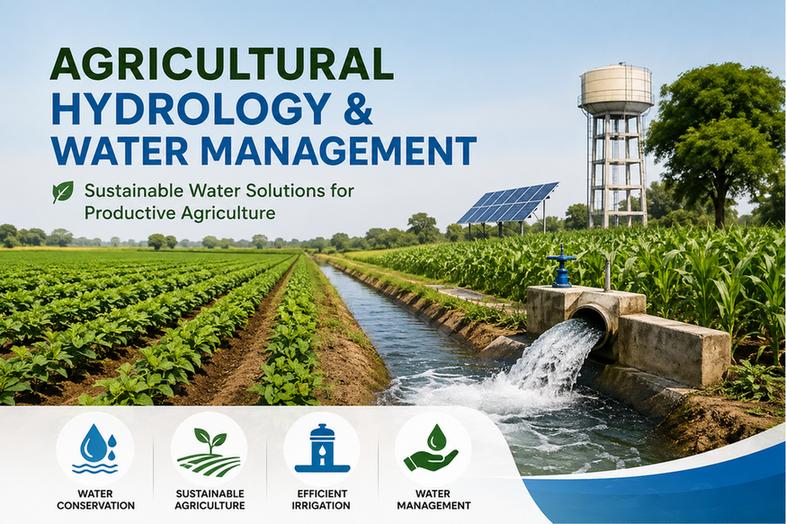
Agricultural Hydrology & Water Management: Building a Sustainable Future for Farming
Agriculture depends on water, but managing that water efficiently has become one of the biggest challenges facing modern farming. Changing rainfall patterns, groundwater depletion, droughts, soil degradation, and increasing competition for freshwater are putting pressure on agricultural communities worldwide. This is where agricultural hydrology and water management play a critical role.
Agricultural hydrology focuses on understanding how water moves through agricultural landscapes, including rainfall, soil moisture, groundwater, surface water, evaporation, and plant water use. Water management applies this knowledge to ensure that crops receive adequate water while reducing waste, protecting natural resources, and maintaining long-term soil and ecosystem health.
With the growing demand for food and increasing climate uncertainty, sustainable agricultural water management is no longer optional. It is an essential part of creating productive, resilient, and environmentally responsible farming systems.
What Is Agricultural Hydrology?
Agricultural hydrology is the study of water movement, distribution, storage, and use within agricultural environments. It connects hydrology with soil science, crop science, irrigation, meteorology, and environmental management.
Water enters agricultural systems primarily through rainfall and irrigation. Some of this water infiltrates the soil, some becomes surface runoff, some is stored as soil moisture, and some returns to the atmosphere through evaporation and plant transpiration.
Understanding these processes helps farmers and agricultural professionals answer important questions:
- How much water is available to crops?
- How much water does a particular crop require?
- How quickly does water infiltrate the soil?
- How much irrigation is necessary?
- Where is water being lost through runoff or evaporation?
- How can groundwater resources be protected?
- How can excessive irrigation affect soil and ecosystems?
By answering these questions, agricultural hydrology provides the scientific foundation for better agricultural water management.
Why Agricultural Water Management Matters
Agriculture is one of the largest users of freshwater globally. Irrigation has helped increase food production in many regions, but inefficient irrigation can lead to significant water losses and environmental problems.
Poor water management may contribute to:
- Groundwater depletion
- Soil salinity
- Waterlogging
- Nutrient leaching
- Soil erosion
- Surface-water pollution
- Reduced river flows
- Higher agricultural production costs
In contrast, effective agricultural water management can improve crop productivity while reducing unnecessary water consumption.
Efficient water management also helps farmers adapt to climate variability. When rainfall becomes less predictable, farms with effective irrigation systems, soil moisture monitoring, rainwater harvesting, and water-conservation practices are generally better prepared for periods of water shortage.
The Role of Soil in Agricultural Hydrology
Soil is one of the most important components of an agricultural hydrological system. Its physical and chemical properties determine how much water can enter, move through, and remain available in the root zone.
Sandy soils generally allow water to infiltrate rapidly but may have limited water-holding capacity. Clay-rich soils can retain more water but may have slower infiltration and drainage. Organic matter can improve soil structure and increase the ability of soil to retain moisture.
Healthy soil therefore plays an important role in water conservation.
Practices such as cover cropping, crop rotation, reduced tillage, compost application, and maintaining organic matter can improve soil structure and water-holding capacity. These practices can help reduce runoff and erosion while making more water available to plants.
For this reason, soil and water management in agriculture should be considered together rather than as separate activities.
Irrigation and Efficient Water Use
Irrigation is essential in many agricultural regions, particularly where rainfall is insufficient or unreliable. However, irrigation efficiency can vary significantly depending on the technology and management practices used.
Traditional flood irrigation can result in considerable water loss through evaporation, runoff, and deep percolation. More efficient systems, such as drip and sprinkler irrigation, can deliver water more precisely to crops.
Drip Irrigation
Drip irrigation supplies water directly or close to the plant root zone. It can reduce evaporation and minimize unnecessary wetting of areas where crops are not growing.
It is particularly useful for:
- Vegetable production
- Orchards
- Vineyards
- High-value crops
- Water-limited agricultural regions
Sprinkler Irrigation
Sprinkler systems distribute water across agricultural fields in a way that can resemble natural rainfall. Modern sprinkler systems can be automated according to crop requirements and weather conditions.
Smart Irrigation
Smart irrigation combines sensors, weather information, automation, and data analysis to determine when and how much water should be applied.
Soil moisture sensors, weather stations, satellite imagery, and agricultural software can help farmers make more accurate irrigation decisions. Instead of irrigating according to a fixed schedule, farmers can respond to actual soil and crop conditions.
Rainwater and Runoff Management
Rainfall is a valuable water resource, but intense rainfall can produce large amounts of runoff. If water moves rapidly across a field, it may carry soil, nutrients, and agricultural chemicals into nearby rivers and lakes.
Effective rainwater management in agriculture aims to capture more rainfall within the farm system while reducing damaging runoff.
Useful approaches include:
- Rainwater harvesting
- Farm ponds
- Contour farming
- Terracing
- Vegetative buffer strips
- Conservation tillage
- Cover crops
- Improved soil organic matter
These techniques can increase infiltration, reduce erosion, and improve the availability of water during dry periods.
Groundwater Management in Agriculture
Groundwater is an important source of irrigation water in many farming regions. However, excessive pumping can cause groundwater levels to decline faster than natural recharge can replace them.
Long-term groundwater depletion can increase pumping costs, reduce well productivity, and create serious environmental challenges.
Sustainable groundwater management requires a balance between water withdrawal and natural or managed recharge. Farmers, water managers, policymakers, and local communities need reliable information about groundwater availability and agricultural demand.
Technologies such as groundwater monitoring systems, remote sensing, smart irrigation, and water-use tracking can support better decision-making.
Agricultural Water Management and Climate Change
Climate change is making water management more complex. Many agricultural regions are experiencing changes in rainfall patterns, temperature, drought frequency, and the timing of water availability.
Higher temperatures can increase crop water demand because evaporation and plant transpiration may rise. At the same time, prolonged droughts can reduce surface-water and groundwater supplies.
Climate-resilient agricultural water management focuses on preparing farms for these changing conditions.
Important strategies include:
- Improving irrigation efficiency
- Selecting drought-tolerant crop varieties
- Increasing soil moisture retention
- Harvesting and storing rainwater
- Diversifying cropping systems
- Monitoring weather and soil conditions
- Protecting groundwater resources
- Using data-driven irrigation scheduling
These strategies can help reduce agricultural vulnerability to water shortages while maintaining productivity.
The Importance of Water Quality
Agricultural water management is not only about the quantity of water available. Water quality is equally important.
Agricultural runoff can carry fertilizers, pesticides, sediments, salts, and other pollutants into surface-water systems. Excess nutrients can contribute to eutrophication and damage aquatic ecosystems.
Good agricultural practices can reduce these risks. Farmers can use fertilizers more efficiently, maintain vegetation near waterways, improve soil health, and carefully manage irrigation to reduce nutrient leaching.
Water-quality monitoring can also help identify pollution sources and evaluate the effectiveness of conservation practices.
Technology in Modern Agricultural Hydrology
Digital technology is transforming the way agricultural water resources are monitored and managed.
Remote sensing can provide information about crop health, soil moisture, vegetation conditions, and field-level water stress. Satellite imagery can help identify areas that require additional irrigation or areas receiving excessive amounts of water.
Artificial intelligence and machine learning can also be used to analyze large volumes of agricultural and environmental data. These technologies can support predictions related to rainfall, irrigation requirements, drought risk, and crop water demand.
Internet-connected sensors provide another valuable tool. Soil moisture sensors can continuously measure conditions in the root zone, while weather stations can provide information about temperature, humidity, rainfall, wind speed, and solar radiation.
When these technologies are integrated into farm management systems, they can support more precise and efficient water use.
Water Management Practices for Sustainable Agriculture
Sustainable agricultural water management requires a combination of technologies, farming practices, and informed decision-making.
Some of the most effective approaches include:
1. Improve Irrigation Scheduling
Irrigation should be based on crop water requirements, soil moisture, weather conditions, and the growth stage of the crop.
2. Maintain Healthy Soil
Increasing organic matter and reducing soil disturbance can improve water infiltration and retention.
3. Reduce Evaporation
Mulching, appropriate irrigation timing, and maintaining ground cover can reduce water losses caused by evaporation.
4. Control Runoff and Erosion
Contour farming, terraces, vegetation, and conservation practices can slow water movement and increase infiltration.
5. Harvest Rainwater
Collecting and storing rainfall can provide an additional source of water during dry periods.
6. Monitor Water Use
Measuring water consumption allows farmers to identify inefficiencies and make informed management decisions.
7. Protect Groundwater
Groundwater pumping should be monitored and managed according to local water availability and recharge conditions.
Benefits of Sustainable Agricultural Water Management
Effective water management can provide environmental, economic, and agricultural benefits.
From a farming perspective, better water management can improve crop performance and reduce irrigation costs. Applying the right amount of water at the right time can prevent both water stress and excessive irrigation.
From an environmental perspective, efficient water use can reduce groundwater depletion, runoff, erosion, and nutrient losses. It can also help protect rivers, wetlands, lakes, and other ecosystems.
At a broader level, sustainable water management contributes to food security. As the global population grows and competition for freshwater increases, agriculture must produce more food without placing unsustainable pressure on water resources.
The Future of Agricultural Hydrology & Water Management
The future of agricultural water management will increasingly depend on integration. Hydrological science, agricultural technology, climate information, soil management, and farmer knowledge must work together.
Precision agriculture will likely play an expanding role. Instead of treating an entire field as a single unit, farmers can use data to understand differences in soil moisture, crop growth, and water requirements across individual areas.
Artificial intelligence, satellite monitoring, automated irrigation, digital weather forecasting, and sensor networks can make water management more responsive and precise.
However, technology alone cannot solve agricultural water challenges. Successful water management also requires appropriate policies, farmer education, investment in infrastructure, local knowledge, and cooperation among communities and water users.
Conclusion
Agricultural hydrology and water management are essential components of sustainable and productive farming. Understanding how water moves through soil, crops, farms, and surrounding ecosystems allows agricultural communities to use limited water resources more efficiently.
From precision irrigation and soil conservation to rainwater harvesting and groundwater protection, a wide range of practices can improve agricultural water efficiency. Modern technologies are making it easier to monitor water conditions and make data-driven decisions, while climate-resilient farming practices can help agriculture adapt to increasing water uncertainty.
The goal is not simply to use less water. It is to use water more intelligently, efficiently, and sustainably while protecting soil, crops, freshwater resources, and ecosystems.
As agriculture faces growing pressure from climate change, population growth, and freshwater scarcity, agricultural hydrology and sustainable water management will become increasingly important. Farms that adopt efficient water-use strategies today can be better positioned to remain productive, profitable, and environmentally responsible in the future.
Frequently Asked Questions
What is agricultural hydrology?
Agricultural hydrology is the study of water movement, storage, distribution, and use within agricultural systems. It examines processes such as rainfall, infiltration, runoff, soil-water storage, evaporation, transpiration, irrigation, and groundwater movement.
Why is agricultural water management important?
Agricultural water management helps farmers use water efficiently, maintain crop productivity, reduce water losses, protect groundwater, prevent soil degradation, and minimize environmental impacts.
How can farmers improve water-use efficiency?
Farmers can improve water-use efficiency through drip irrigation, soil moisture monitoring, efficient irrigation scheduling, rainwater harvesting, mulching, conservation tillage, cover crops, and improved soil management.
How does climate change affect agricultural water management?
Climate change can alter rainfall patterns, increase temperatures, intensify drought conditions, and change crop water requirements. These changes make efficient irrigation, water conservation, and climate-resilient farming increasingly important.
What role does technology play in agricultural water management?
Sensors, satellite imagery, remote sensing, weather stations, automation, artificial intelligence, and data analytics can help farmers monitor soil and crop conditions and apply water more accurately.