

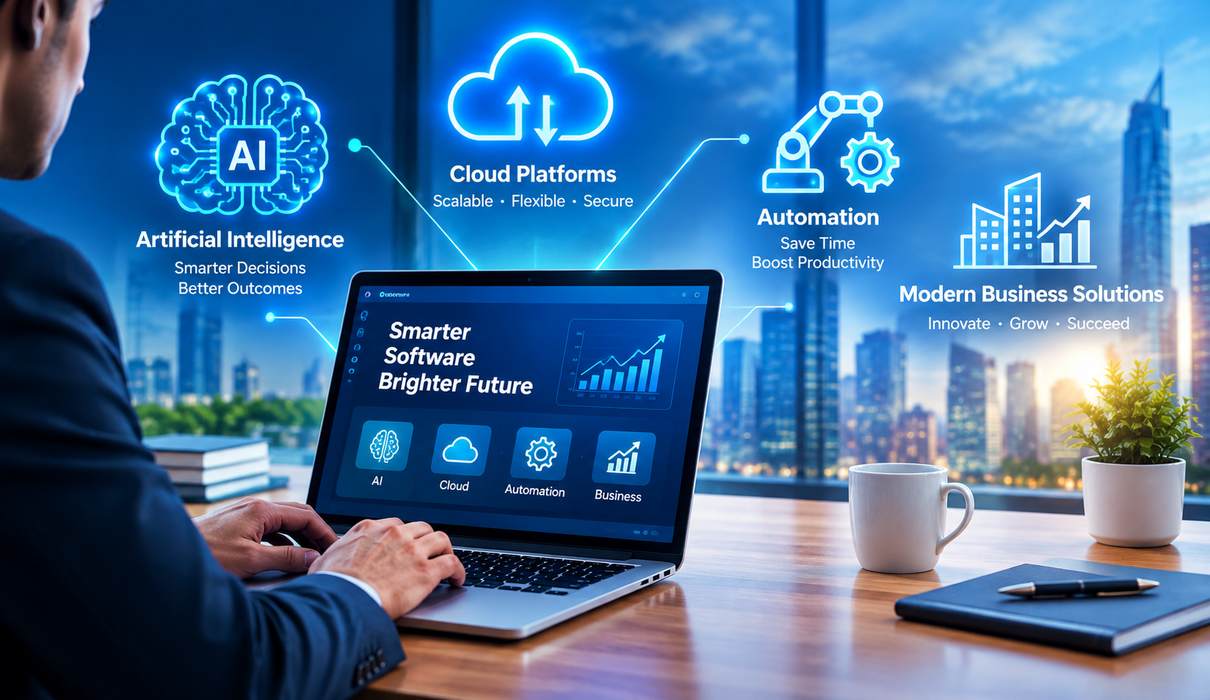
Advanced Software Technology: Artificial Intelligence, Cloud Platforms, Automation and Modern Business Solutions
Software technology is changing the way businesses operate, communicate, serve customers and compete in digital markets. From artificial intelligence and cloud computing to intelligent automation and advanced business applications, modern software has become a central part of everyday business strategy. Organizations of all sizes are adopting new technologies to improve productivity, reduce operational complexity, manage data and create better customer experiences.
The growth of advanced software technology is also changing how companies develop products and deliver services. Traditional software applications are increasingly being enhanced with artificial intelligence, machine learning, cloud infrastructure, automation tools and real-time analytics. These technologies allow businesses to create faster, smarter and more flexible digital environments.
In 2026, businesses are focusing not only on adopting software but also on building connected technology ecosystems. Artificial intelligence, cloud platforms, cybersecurity, automation and software-as-a-service solutions are working together to support modern business operations.
What Is Advanced Software Technology?
Advanced software technology refers to modern software systems that use technologies such as artificial intelligence, machine learning, cloud computing, automation, data analytics, application programming interfaces and intelligent digital platforms.
Unlike traditional software, advanced solutions are designed to be more adaptable, connected and data-driven. They can analyze large volumes of information, automate repetitive activities, support decision-making and provide digital services across different devices and locations.
Businesses can use advanced software for areas such as:
- Customer relationship management
- Financial management
- Human resources
- Marketing and sales
- Supply chain management
- Business analytics
- Cybersecurity
- Communication and collaboration
- Product development
- Customer support
The goal is to create technology environments that improve efficiency while giving organizations greater flexibility and control.
Artificial Intelligence Is Transforming Business Software
Artificial intelligence is one of the most important forces influencing software development. AI-powered applications can process information, recognize patterns, generate content, assist employees and support business decisions.
Modern software increasingly includes AI features rather than treating artificial intelligence as a separate technology. Businesses can use AI-powered software to automate customer service, analyze documents, identify business trends and personalize digital experiences.
AI applications can support organizations in several ways.
AI-Powered Customer Service
Businesses can integrate AI assistants and chatbots into websites, mobile applications and customer service platforms. These systems can answer common questions, guide customers through processes and provide support outside traditional business hours.
AI-powered customer service can also help human support teams by summarizing conversations, identifying customer issues and suggesting responses.
Intelligent Data Analysis
Modern businesses generate huge amounts of information from websites, applications, transactions and customer interactions. AI can help analyze this data and identify patterns that may not be immediately visible through traditional reporting.
For example, an AI-enabled analytics platform can identify changes in customer behavior, sales patterns or operational performance.
Generative AI in Software
Generative AI is becoming increasingly relevant to software development and business productivity. It can help generate text, summarize documents, assist with coding, create reports and support creative workflows.
However, businesses still need appropriate human review, data protection and governance when using generative AI for important processes.
Cloud Platforms Are the Foundation of Modern Software
Cloud computing has become a major component of modern software infrastructure. Instead of depending entirely on local servers and hardware, organizations can access computing resources, applications and data through cloud platforms.
Cloud-based software offers several important benefits.
Scalability
Businesses can increase or decrease computing resources according to demand. This can be particularly useful for organizations experiencing seasonal traffic or rapid growth.
Remote Accessibility
Cloud applications can allow authorized employees to access business systems from different locations and devices. This supports distributed teams and flexible working environments.
Faster Software Deployment
Cloud infrastructure can simplify software deployment and updates. Development teams can build, test and release applications more efficiently using modern cloud environments.
Data and Application Integration
Cloud platforms can connect different applications and services. This makes it easier for businesses to create integrated digital ecosystems instead of operating isolated software systems.
Cloud technology is therefore becoming an important foundation for modern business software.
Automation Improves Business Productivity
Automation is another major trend shaping advanced software technology. Businesses perform many repetitive tasks every day, including data entry, document processing, scheduling, notifications, reporting and transaction management.
Software automation can reduce the amount of manual work required for these processes.
For example, an automated workflow can receive a customer request, record the information in a business system, notify the appropriate employee and send a confirmation message without requiring several manual steps.
Automation can also help improve consistency. When repetitive processes are handled through predefined workflows, businesses can reduce certain types of human error and make operations easier to monitor.
SaaS Is Changing the Way Businesses Use Software
Software-as-a-Service, commonly known as SaaS, has transformed how businesses purchase and use applications.
Instead of installing software on individual computers or maintaining extensive infrastructure, businesses can access many applications through internet-connected platforms, usually through subscription-based models.
SaaS solutions are available for many business functions, including:
- Project management
- Accounting
- Customer relationship management
- Human resources
- Marketing
- Communication
- Collaboration
- Design
- Data analytics
- Cybersecurity
One important advantage of SaaS is accessibility. Organizations can adopt specialized applications without necessarily building the entire technology infrastructure themselves.
SaaS platforms can also receive regular updates, allowing businesses to access new features without traditional software upgrade processes.
Low-Code and No-Code Development
Software development is also becoming more accessible through low-code and no-code platforms.
Traditional software development can require specialized programming knowledge and significant development time. Low-code platforms provide visual development environments that can simplify application creation, while no-code platforms allow users with limited programming experience to build certain types of digital solutions.
These platforms can help businesses create:
- Internal workflow applications
- Data collection tools
- Customer portals
- Business dashboards
- Approval systems
- Automated processes
Professional developers remain important for complex applications, security-sensitive systems and large-scale software architecture. However, low-code and no-code tools can help business teams participate more actively in digital innovation.
Cybersecurity Is Essential for Advanced Software
As businesses become more dependent on software, cybersecurity becomes increasingly important.
Modern applications handle sensitive information such as customer records, financial information, employee data and business documents. Security therefore needs to be considered throughout the software lifecycle.
Businesses are adopting security practices such as:
- Multi-factor authentication
- Encryption
- Identity and access management
- Security monitoring
- Regular software updates
- Backup systems
- Vulnerability testing
- Zero-trust security approaches
AI and automation can also support cybersecurity by identifying unusual activity and helping security teams prioritize potential threats.
However, technology alone cannot eliminate every security risk. Employees, processes and organizational policies remain important parts of an effective cybersecurity strategy.
Intelligent Business Applications
Advanced software is increasingly designed around intelligent business applications. These applications combine traditional business functionality with AI, analytics, automation and cloud services.
For example, a modern customer relationship management platform may not simply store customer information. It may also analyze customer activity, identify potential sales opportunities, automate follow-up tasks and generate summaries for sales teams.
Similarly, modern financial software can combine accounting functionality with automated reporting, data analysis and workflow management.
This shift is moving business software from passive record-keeping systems toward more active decision-support platforms.
The Role of Data in Modern Software
Data has become one of the most valuable resources for digital businesses. Advanced software allows organizations to collect, organize and analyze information from multiple sources.
Business intelligence dashboards can provide real-time or near-real-time information about important performance indicators. Managers can use these insights to monitor sales, customer engagement, operational efficiency and other business metrics.
Data-driven software can also support forecasting and planning. By analyzing historical information and current trends, organizations can develop more informed strategies.
However, businesses must pay attention to data quality. Inaccurate, incomplete or poorly structured data can reduce the value of analytics and AI systems.
Software Integration and APIs
Modern businesses often use dozens of different software applications. Connecting these systems is essential for creating efficient digital workflows.
Application programming interfaces, commonly called APIs, allow different software systems to communicate with each other.
For example, an e-commerce platform may connect with payment systems, inventory software, accounting applications and delivery services through APIs.
Effective software integration can reduce duplicate data entry and help organizations create smoother workflows.
As businesses adopt more cloud services and specialized SaaS platforms, API-based integration will remain an important part of modern software architecture.
Personalization and Better Customer Experiences
Advanced software is also changing how businesses interact with customers.
AI and analytics can help businesses understand customer preferences and behavior. This information can be used to provide more personalized recommendations, communications and services.
E-commerce platforms, streaming services, financial applications and digital marketing systems can use customer data to create individualized experiences.
Personalization must, however, be balanced with transparency and responsible data management. Customers increasingly expect businesses to protect their information and explain how personal data is used.
Software Development Is Becoming More Intelligent
AI is also influencing the process of building software itself.
Developers can use AI-assisted development tools to generate code suggestions, identify potential errors, explain existing code and assist with documentation.
Automated testing can help development teams identify software issues earlier in the development cycle. Cloud-based development environments can also allow teams to collaborate more efficiently.
These technologies do not eliminate the need for software engineers. Instead, they can change how developers spend their time, allowing them to focus more on architecture, problem-solving, security and product design.
Sustainable Software and Efficient Computing
Sustainability is becoming another consideration in software technology.
Efficient software can reduce unnecessary computing resources and improve the performance of digital systems. Cloud providers and businesses are also exploring more efficient infrastructure, resource optimization and energy-conscious computing practices.
Software optimization can benefit both sustainability objectives and business performance. Applications that use computing resources efficiently may also provide faster and more reliable experiences.
Challenges of Advanced Software Technology
Despite its benefits, advanced software technology also creates challenges.
One challenge is implementation cost. Businesses may need to invest in infrastructure, software subscriptions, employee training and cybersecurity.
Another challenge is integration. Connecting new applications with older systems can require technical expertise and careful planning.
Data privacy is also important, particularly when applications use AI or process sensitive information.
Organizations must also consider employee adoption. New software does not automatically improve productivity if employees do not understand how to use it effectively.
A successful technology strategy therefore requires more than purchasing new software. Businesses need clear objectives, appropriate training, strong security practices and continuous evaluation.
Future of Software Technology
The future of software technology is likely to be increasingly intelligent, automated and interconnected.
Artificial intelligence will continue to influence application development and business processes. Cloud platforms will remain important for scalable digital infrastructure, while automation will expand into more operational workflows.
AI agents and intelligent software assistants may also become more common in business environments, helping employees complete multi-step tasks across different applications.
At the same time, cybersecurity, privacy and responsible technology management will become increasingly important.
The future of software is therefore not simply about adding more features. It is about creating digital systems that can adapt to changing business requirements while remaining secure, reliable and useful.
Conclusion
Advanced software technology is transforming modern business through artificial intelligence, cloud platforms, automation, SaaS, data analytics and intelligent applications. These technologies are helping organizations improve productivity, simplify workflows, strengthen customer experiences and make better use of business information.
AI is making applications more intelligent, cloud computing is providing flexible infrastructure, automation is reducing repetitive work and SaaS platforms are making sophisticated software more accessible.
For businesses, the most important step is to adopt technology with a clear purpose. Rather than implementing every new software trend, organizations can focus on solutions that address specific operational challenges and create measurable value.
As digital transformation continues, advanced software technology will remain an important part of modern business strategy. Companies that combine innovation with security, responsible data management, employee training and effective technology planning can build stronger digital foundations for the future.