

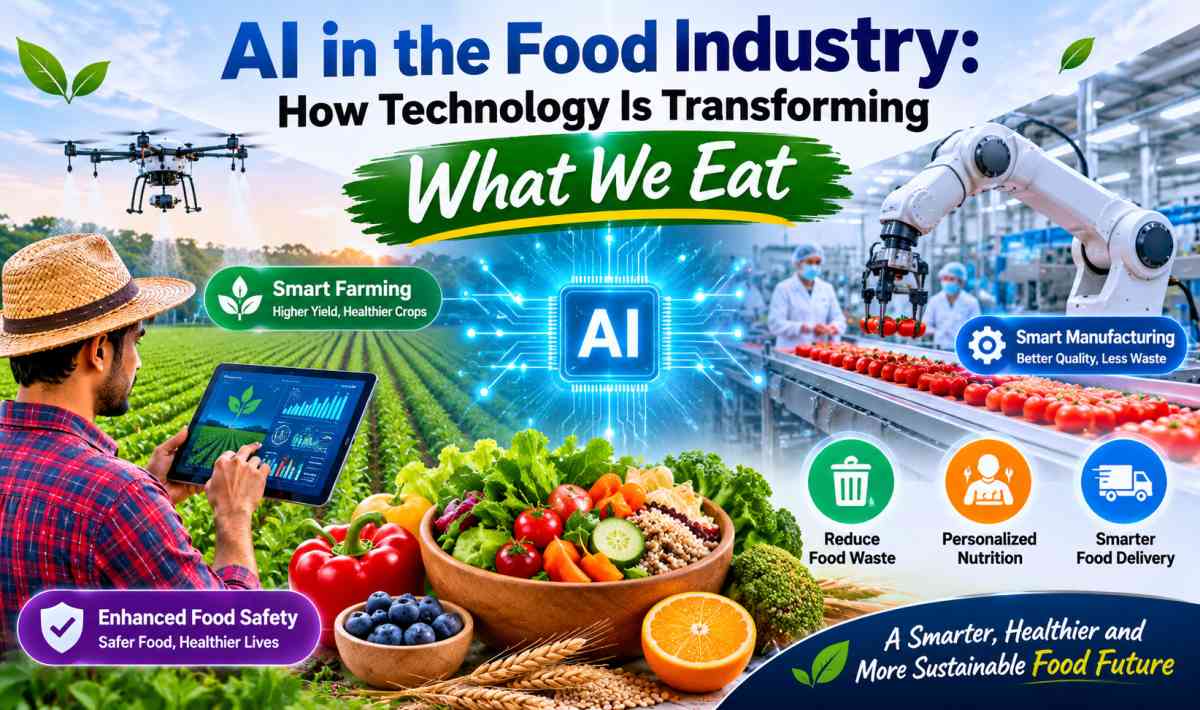
AI in the Food Industry: How Technology Is Transforming What We Eat
Artificial Intelligence (AI) is transforming industries worldwide, and the food industry is no exception. From smart farming and automated food production to personalized nutrition and intelligent food delivery, AI is changing how food is grown, processed, packaged, distributed, and consumed. As technology continues to advance, businesses are discovering new ways to improve food quality, reduce waste, enhance safety, and deliver better experiences to consumers.
The global food industry faces several important challenges, including population growth, climate change, rising production costs, food waste, and increasing demand for healthier and more sustainable products. Traditional methods alone may not be sufficient to address these challenges efficiently. AI-powered technologies offer practical solutions by analyzing large amounts of data, predicting future demand, identifying potential risks, and automating repetitive tasks.
In India, where agriculture, food processing, restaurants, grocery delivery, and packaged food businesses play a significant role in the economy, AI has considerable potential. Farmers can use intelligent systems to monitor crops, manufacturers can improve production efficiency, and restaurants can understand customer preferences more effectively.
This article explores how AI in the food industry is transforming what we eat, its major applications, benefits, challenges, and future trends.
What Is AI in the Food Industry?
AI in the food industry refers to the use of artificial intelligence technologies to improve activities across the food supply chain. These technologies include machine learning, computer vision, predictive analytics, robotics, natural language processing, and intelligent automation.
AI systems process information from cameras, sensors, sales records, weather forecasts, production equipment, and customer feedback. They use this information to identify patterns, make predictions, and support better decisions.
For example, a food manufacturer can use AI to detect defective products on a production line. A farmer can analyze crop images to identify early signs of disease, while a restaurant can predict how much food it needs to prepare for the next day.
Unlike traditional systems that rely heavily on fixed rules, many AI models can learn from new data and improve their predictions over time. However, their effectiveness depends on data quality, suitable implementation, and human oversight.
1. AI Is Transforming Smart Farming
Agriculture is the foundation of the food industry. The quality and availability of food depend heavily on farming practices, environmental conditions, and resource management. AI is helping farmers make informed decisions and use resources more efficiently.
Precision Agriculture
Precision agriculture uses AI, sensors, satellite imagery, drones, and other digital tools to monitor crops and farmland. These technologies help farmers identify differences in soil conditions, crop health, and water requirements across a field.
AI-powered systems can analyze this information and recommend where irrigation, fertilizers, or other treatments may be needed. This can help reduce unnecessary resource use while supporting healthier crop development.
Early Detection of Crop Diseases
Crop diseases and pest infestations can significantly affect agricultural productivity. AI-based image recognition systems can examine photographs of leaves and plants to identify possible signs of disease.
Early warnings allow farmers to investigate problems and take appropriate action before they spread widely. The accuracy of these systems depends on the crop, disease, image quality, and local conditions, so expert confirmation may still be necessary.
Weather and Yield Prediction
Machine learning models can analyze historical weather data, rainfall patterns, soil conditions, and crop information to estimate potential yields. These forecasts help farmers plan planting schedules, harvesting, storage, and transportation.
In India, where farmers often face unpredictable rainfall and changing temperatures, AI-supported agricultural services could help improve planning and reduce avoidable losses.
2. AI Is Improving Food Processing and Manufacturing
Food manufacturing requires consistent quality, efficient production, and strict hygiene standards. AI is helping manufacturers improve these processes by monitoring equipment, identifying defects, and optimizing production schedules.
Automated Quality Inspection
Computer vision systems use cameras and AI models to inspect food products as they move along production lines. They can identify visible defects such as damaged packaging, unusual shapes, discoloration, and incorrect product sizes.
For example, a fruit processing company can use AI to sort apples according to size, color, and visible quality. A bakery can inspect products for consistency, while a packaged food manufacturer can check labels and packaging seals.
Automated inspection can process large quantities of products quickly, although specialized equipment and human quality checks may still be necessary.
Predictive Maintenance
Manufacturing equipment can experience unexpected failures that interrupt production and increase costs. AI-powered predictive maintenance systems analyze information such as vibration, temperature, operating hours, and energy consumption to identify possible equipment problems.
Manufacturers can schedule maintenance before a major breakdown occurs. This helps reduce downtime, improve production planning, and extend equipment life.
Smart Production Planning
AI can analyze production capacity, ingredient availability, order volumes, and processing times to recommend more efficient manufacturing schedules.
This is especially useful for products with short shelf lives, such as dairy products, bakery items, and ready-to-eat meals. Better planning can help manufacturers avoid overproduction and reduce food waste.
3. AI Is Enhancing Food Safety
Food safety is one of the most important responsibilities of food producers, restaurants, retailers, and distributors. Contamination, improper storage, and poor handling can create serious health risks.
AI can support food safety by identifying unusual patterns and monitoring conditions that influence food quality.
Detecting Contamination Risks
AI systems can analyze laboratory results, inspection records, environmental sensor readings, and production data to identify potential contamination risks. They can flag unusual changes that deserve further investigation.
These systems do not replace laboratory testing or established food safety procedures. Instead, they help businesses identify potential problems earlier and focus attention on higher-risk areas.
Monitoring Storage Conditions
Many food products require specific temperature and humidity conditions during storage and transportation. Internet of Things (IoT) sensors can continuously collect this information, while AI models analyze it for unusual changes.
For example, if a refrigerated delivery vehicle experiences an unexpected temperature increase, the system can send an alert to the responsible team.
This approach is valuable for dairy products, seafood, frozen foods, meat, and certain medicines or ingredients that require controlled storage conditions.
Improving Traceability
Food traceability involves tracking products from their origin to the final consumer. AI can analyze supply chain records to help businesses identify where ingredients came from, how products were handled, and where potential quality issues occurred.
When combined with reliable digital records and suitable tracking technologies, these systems can support faster investigations and more targeted product recalls.
4. AI Is Reducing Food Waste
Food waste is a major environmental and economic challenge. Food can be lost during harvesting, storage, processing, transportation, retail sales, and household consumption.
AI offers several ways to reduce waste by improving forecasting, inventory management, and food distribution.
Demand Forecasting
Restaurants, supermarkets, hotels, and food manufacturers need to estimate how much food customers will purchase. Producing too much can result in unsold inventory, while producing too little can lead to shortages.
AI models analyze historical sales, seasonal patterns, promotions, weather conditions, and local events to estimate future demand.
For example, a restaurant may use sales data to predict demand for popular dishes during weekends. A supermarket can adjust its orders based on expected customer traffic.
Accurate forecasts help businesses purchase ingredients more carefully and reduce unnecessary food preparation.
Smarter Inventory Management
AI-powered inventory systems track stock levels, expiration dates, sales rates, and storage conditions. They can alert employees when products are approaching their best-before dates or when inventory needs replenishment.
Retailers can use these insights to plan discounts, adjust orders, and prioritize products that need to be sold sooner.
Connecting Surplus Food With Buyers
Digital platforms can use predictive analytics to identify surplus food and connect businesses with potential buyers or donation partners. For example, a bakery may have unsold products at the end of the day, while a restaurant may have ingredients that need to be used quickly.
Better coordination can help redirect suitable surplus food instead of allowing it to become waste.
5. AI Is Changing Restaurants and Food Delivery
Restaurants are increasingly using digital tools to improve service, control costs, and understand customer preferences. AI can support both front-of-house operations and kitchen management.
AI-Powered Ordering Systems
AI-enabled chatbots and virtual assistants can help customers explore menus, ask questions about ingredients, and place orders through websites or messaging platforms.
These systems can also answer common questions about opening hours, delivery options, and available menu items. Complex requests and allergy-related questions should still receive appropriate human attention.
Kitchen Automation and Robotics
Robots and automated equipment can perform certain repetitive kitchen tasks, such as dispensing ingredients, mixing, frying, or assembling standardized meals.
Automation can help businesses improve consistency and manage repetitive workloads. However, many cooking tasks require flexibility, creativity, and judgment, making human workers essential in numerous restaurant environments.
Personalized Food Recommendations
Food delivery applications can analyze previous orders, cuisine preferences, browsing activity, and customer feedback to recommend relevant dishes.
For example, a customer who frequently orders South Indian breakfast may receive recommendations for similar meals. Restaurants can use aggregated customer insights to develop menus that better match local demand.
Businesses must balance personalization with responsible data collection and respect for customer privacy.
6. AI Is Supporting Personalized Nutrition
Consumers increasingly want food that fits their preferences, dietary requirements, and lifestyle. AI is helping make nutrition information more accessible and personalized.
Personalized Meal Planning
AI-powered nutrition applications can suggest meals based on user-selected preferences, food allergies, cultural traditions, budgets, and dietary goals.
For example, an application could help a vegetarian household plan meals using locally available ingredients. Another tool might suggest balanced meal options that fit a person’s preferred cuisine and schedule.
Such recommendations should rely on reliable nutritional information and should not replace professional medical advice when someone has a medical condition or specialized dietary needs.
Understanding Food Labels
AI-powered applications can help users interpret ingredient lists and nutrition labels. Some tools allow users to scan packaging and receive summaries of calories, protein, carbohydrates, allergens, or other listed information.
These features can make food choices easier, but consumers should verify important details directly on product packaging. AI systems may occasionally misread labels or provide incomplete explanations.
Developing Functional Foods
Food researchers can use AI to investigate ingredient combinations, nutritional characteristics, and possible new formulations. This may support the development of products containing additional fiber, plant-based proteins, or other desired nutritional properties.
Scientific testing remains necessary to establish nutritional value, safety, and any health-related claims.
7. AI Is Accelerating Food Product Innovation
Creating a new food product traditionally requires extensive experimentation, ingredient testing, consumer research, and production trials. AI can help researchers explore potential formulations more efficiently.
Faster Recipe Development
Machine learning systems can analyze ingredient characteristics, flavor profiles, nutritional data, and consumer preferences to suggest new recipes or product combinations.
A food company developing a plant-based snack, for example, can use AI to identify possible ingredient combinations that meet its texture, taste, and cost requirements.
These suggestions still need to be tested through cooking trials, sensory evaluation, and safety assessments.
Plant-Based and Alternative Proteins
AI is also being explored in the development of plant-based meat alternatives, fermentation-derived ingredients, and other alternative protein products.
Researchers can use computational models to investigate protein properties, predict ingredient behavior, and prioritize promising formulations for laboratory testing.
These approaches may help companies create products with improved taste, texture, nutritional composition, and affordability.
Understanding Consumer Preferences
AI can analyze customer reviews, surveys, and market research to identify popular flavors, emerging dietary preferences, and areas where existing products disappoint consumers.
Manufacturers can use these insights to guide product development. However, online feedback may not represent the preferences of every customer group, so businesses should combine AI analysis with real-world testing.
8. AI Is Optimizing Food Supply Chains
Food products often travel through several stages before reaching consumers. Farmers, processors, warehouses, transport companies, wholesalers, and retailers must coordinate their activities to maintain quality and control costs.
AI can improve supply chain visibility by analyzing transportation schedules, inventory records, weather forecasts, and delivery information.
Route Optimization
AI-powered logistics systems can recommend delivery routes based on distance, traffic, delivery windows, vehicle capacity, and product requirements.
More efficient routes can reduce fuel consumption, delivery delays, and transportation costs.
For perishable foods, route planning can be especially important because delays may affect product quality and remaining shelf life.
Predicting Supply Disruptions
AI models can help identify possible supply chain disruptions by analyzing weather events, transport conditions, supplier performance, and changes in demand.
For example, a food distributor may use forecasts to anticipate a delay in ingredient deliveries and identify alternative suppliers or inventory sources.
These predictions are not always accurate, but they can give businesses more time to prepare.
Improving Cold Chain Management
Cold chain logistics involves maintaining appropriate temperatures throughout the storage and transportation of temperature-sensitive foods.
AI systems can combine sensor data with transport schedules and historical performance to detect risks and recommend corrective action. This supports product quality and can help prevent avoidable spoilage.
9. AI Is Transforming Food Retail and Supermarkets
Supermarkets and grocery retailers manage thousands of products with different prices, expiration dates, storage needs, and customer demand patterns. AI can help simplify these operations.
Smart Shelves and Computer Vision
AI-enabled cameras and smart shelf systems can identify empty shelf spaces, monitor product placement, and help employees detect inventory discrepancies.
This information allows retailers to restock products more efficiently and improve product availability.
Dynamic Pricing and Promotions
Retailers can use AI to analyze demand, stock levels, competitor information, and product expiration dates when planning promotions.
For example, a store might offer a discount on suitable products approaching their best-before date to encourage sales and reduce waste.
Pricing decisions must remain transparent and comply with applicable laws and consumer protection requirements.
Better Customer Experiences
AI-powered search, product recommendations, and virtual shopping assistants can help customers discover suitable products more quickly.
Retailers can also use aggregated purchasing patterns to understand local preferences and improve product selection.
10. Benefits of AI in the Food Industry
The adoption of AI offers several important benefits across the food value chain.
Greater efficiency: Automation and intelligent planning can reduce repetitive work, improve scheduling, and help businesses use their resources more effectively.
Improved food quality: Computer vision and predictive monitoring can help identify defects, maintain consistent production standards, and detect potential problems earlier.
Reduced food waste: Better demand forecasting and inventory management can help businesses avoid overproduction and manage perishable products more effectively.
Enhanced food safety: Data analysis can support risk detection, storage monitoring, and faster investigations into quality issues.
Lower operating costs: More efficient use of ingredients, energy, labor, storage, and transportation may reduce avoidable expenses.
Personalized consumer experiences: AI can help people discover products, understand food information, and find meals that match their preferences.
More informed decisions: Farmers, manufacturers, retailers, and restaurant owners can use data-driven insights to make better operational decisions.
The benefits vary by business size, application, and implementation quality. AI adoption should be evaluated using measurable outcomes rather than assumptions about what the technology can achieve.
11. Challenges of Using AI in the Food Industry
Despite its potential, AI adoption presents challenges that businesses must address.
High Initial Investment
AI software, sensors, cameras, robotics, and supporting infrastructure can be expensive. Small farms, independent restaurants, and local food manufacturers may struggle to afford advanced systems.
Affordable subscription-based tools and shared technology services could help smaller businesses participate in digital transformation.
Data Quality and Availability
AI models depend on useful, accurate, and relevant data. Incomplete farming records, inconsistent product information, or poor-quality sensor readings can reduce the reliability of predictions.
Businesses need suitable data collection practices, regular monitoring, and ongoing system evaluation.
Skills and Training
Employees may require training to operate AI tools, interpret recommendations, and respond to system alerts. Organizations should invest in digital skills while ensuring that automation supports workers rather than treating technology as a complete replacement for human expertise.
Privacy and Cybersecurity
Food businesses may collect customer information, supplier records, and commercially sensitive operational data. Weak security practices can expose this information to unauthorized access.
Appropriate access controls, secure systems, responsible data use, and compliance with applicable privacy laws are essential.
Reliability and Accountability
AI can make incorrect predictions or overlook unusual situations. Food safety and quality decisions therefore require clear procedures, human oversight, and appropriate testing.
Businesses must also determine who is responsible when automated recommendations contribute to a problem.
Unequal Access to Technology
Large companies may have more resources to adopt advanced AI than small producers. Supporting smaller businesses through training, infrastructure, and accessible digital services will be important for more inclusive growth.
12. The Future of AI in the Food Industry
The future of AI in the food industry will likely involve deeper integration between artificial intelligence, robotics, IoT sensors, cloud computing, and data analytics.
Smart farms may increasingly combine satellite information, local sensors, and predictive models to improve agricultural decisions. Food manufacturers may adopt more automated inspection systems, while supermarkets could use real-time inventory intelligence to manage products more efficiently.
Generative AI may also help food companies summarize research, develop product concepts, create customer support content, and analyze consumer feedback. Its outputs will still need verification, especially when food safety, nutritional claims, or regulatory requirements are involved.
Another important development is the integration of AI with sustainability initiatives. Businesses may use data-driven systems to monitor energy consumption, reduce packaging waste, optimize transportation, and improve the use of agricultural resources.
In India, opportunities exist across agricultural technology, dairy processing, packaged foods, restaurant operations, and grocery delivery. Regional-language interfaces and affordable mobile services could make digital tools more accessible to farmers and small businesses.
However, the future will not depend on technology alone. Responsible implementation, reliable data, worker training, scientific validation, and fair access will determine how successfully AI contributes to a better food system.
Conclusion
AI in the food industry is transforming how food is produced, processed, inspected, transported, sold, and consumed. From precision agriculture and automated quality control to personalized nutrition and intelligent food delivery, artificial intelligence is creating opportunities to improve efficiency, food safety, and consumer experiences.
Its ability to analyze large amounts of information helps businesses make better predictions, identify operational problems, and reduce avoidable waste. At the same time, challenges such as implementation costs, data quality, cybersecurity, and reliability must be addressed carefully.
For India and the wider global food market, AI can become an important tool for building a more efficient, innovative, and sustainable food ecosystem. The most successful approach will combine intelligent technology with human expertise, responsible practices, and a strong commitment to food quality.
As AI continues to evolve, it will not simply change how the food industry operates. It will also influence how businesses respond to consumer expectations and how food systems prepare for future challenges.
Frequently Asked Questions (FAQs)
1. How is AI used in the food industry?
AI is used in smart farming, food quality inspection, food safety monitoring, demand forecasting, inventory management, restaurant automation, personalized nutrition, and supply chain optimization.
2. How does AI help reduce food waste?
AI predicts customer demand, monitors inventory, identifies products approaching their expiration dates, and improves production and delivery planning. These capabilities can help businesses reduce overproduction and spoilage.
3. Can AI improve food safety?
Yes. AI can analyze sensor readings, inspection records, and production data to identify potential risks. It can also monitor storage temperatures and support traceability, but it does not replace laboratory testing or established safety procedures.
4. How is AI changing restaurants?
Restaurants use AI for online ordering, customer support, menu recommendations, demand forecasting, inventory management, and selected automated kitchen tasks.
5. What are the disadvantages of AI in the food industry?
Major challenges include high initial costs, limited data quality, cybersecurity risks, a shortage of trained workers, unreliable predictions, and unequal access to technology.
6. What is the future of AI in the food industry?
Future applications may include more intelligent farms, automated food inspection, predictive supply chains, improved alternative proteins, personalized food recommendations, and technology-driven waste reduction.
7. Is AI beneficial for small food businesses?
Yes. Small farms, restaurants, bakeries, and grocery shops can benefit from affordable AI tools for demand forecasting, inventory management, customer communication, and production planning. The value depends on the cost, business needs, and quality of implementation.