

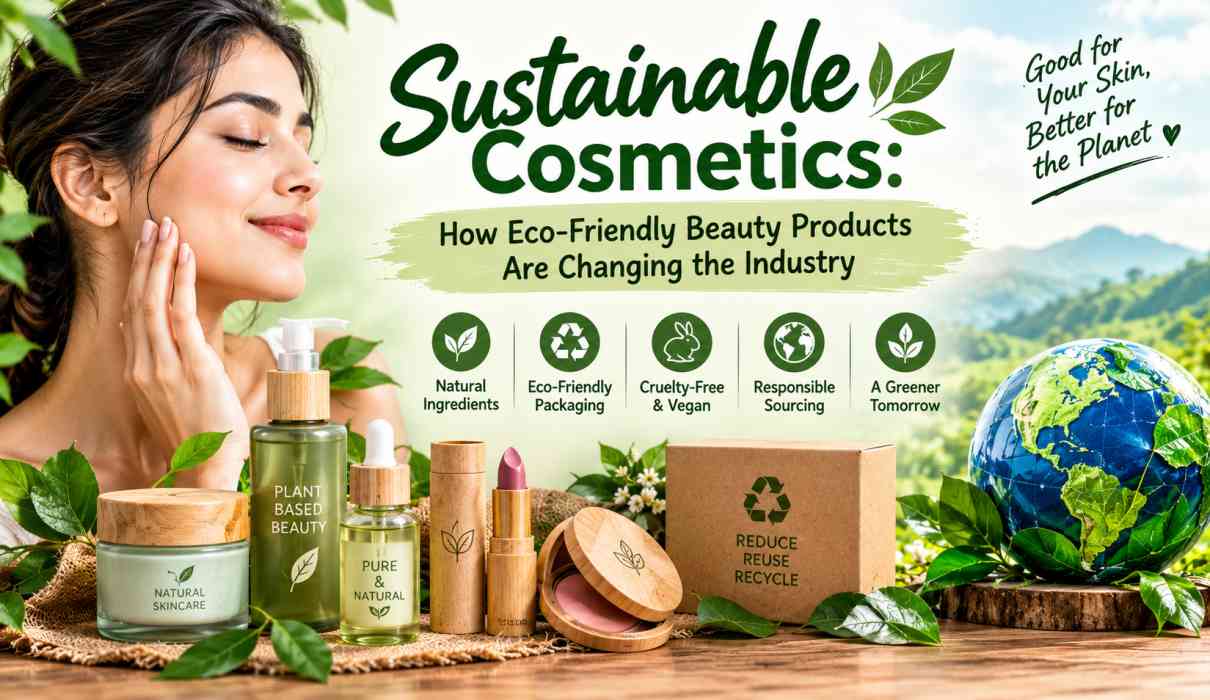
Sustainable Cosmetics: How Eco-Friendly Beauty Products Are Changing the Industry
The cosmetics industry is undergoing an important transformation as sustainability becomes a bigger part of how beauty products are designed, manufactured, packaged, and marketed. From recyclable packaging and refill systems to responsibly sourced ingredients and more transparent supply chains, sustainable cosmetics are changing the way brands approach beauty and personal care.
Sustainability in cosmetics is no longer limited to using natural-looking packaging or adding a “green” label to a product. It can involve the entire product lifecycle—from sourcing raw materials and manufacturing to packaging, transportation, use, and disposal.
In India, interest in eco-friendly beauty is also developing alongside greater consumer interest in ingredient information, transparency, and science-backed claims. Mintel’s India beauty research has identified growing interest in eco-friendly packaging and ingredients, while also noting that product effectiveness remains an important consideration for consumers.
This shift is creating opportunities for both established cosmetics companies and newer beauty brands to rethink how products are created.
What Are Sustainable Cosmetics?
Sustainable cosmetics are beauty and personal care products designed with environmental and social considerations throughout their lifecycle.
There is no single feature that automatically makes a cosmetic product sustainable. Instead, sustainability can involve several factors, including:
- Responsible ingredient sourcing
- Recyclable or recycled packaging
- Refillable containers
- Reduced packaging materials
- Efficient manufacturing
- Responsible water and energy use
- Ethical supply chains
- Reduced waste
- Cruelty-free practices where applicable
- Transparent environmental claims
A sustainable product therefore needs to be evaluated as a whole rather than based on one marketing claim.
For example, replacing a plastic container with another material does not automatically make a product environmentally better. The complete lifecycle of the material, including manufacturing, transportation, durability, recycling, and disposal, matters.
Why Is Sustainable Beauty Becoming More Important?
The beauty industry uses a wide variety of materials, including plastics, glass, metals, paper, botanical ingredients, synthetic ingredients, and complex packaging components.
As beauty consumption grows, companies are looking for ways to reduce environmental impact without sacrificing product performance or convenience.
Recent industry research shows that sustainability is increasingly connected with packaging innovation, refill formats, recycled materials, and ingredient transparency. In India, Euromonitor reports that eco-conscious packaging and recycled plastics are influencing beauty and personal-care packaging development.
At the same time, sustainability is not the only factor influencing consumers. Research from McKinsey suggests that refillable packaging has faced challenges in achieving widespread consumer acceptance, demonstrating that sustainable products also need to offer convenience and value.
This means the future of sustainable cosmetics is likely to depend on finding a balance between environmental responsibility, product performance, affordability, and convenience.
1. Eco-Friendly Cosmetic Packaging
Packaging is one of the most visible areas of sustainability in the beauty industry.
Traditional cosmetics packaging can contain multiple components, such as bottles, caps, pumps, boxes, labels, protective films, and inserts. Some combinations are difficult to separate and recycle.
Brands are therefore experimenting with:
- Recycled plastic
- Recyclable glass
- Aluminum
- Paper-based packaging
- Reduced packaging
- Refillable containers
- Concentrated formulas
- Reusable components
Recycled plastic is particularly interesting because it can allow brands to reduce their dependence on virgin plastic while maintaining familiar packaging formats.
Euromonitor identifies recycled plastics, cartons, refill solutions, and other packaging innovations as important developments in India’s beauty and personal-care packaging market.
2. Refillable Beauty Products
Refillable cosmetics are designed so that customers can keep a durable outer container and replace only the product inside.
Potential benefits include reducing the amount of packaging required for repeated purchases and encouraging a more circular consumption model.
Examples can include:
- Refillable makeup containers
- Refillable fragrance bottles
- Refill pouches
- Replaceable cosmetic cartridges
- Reusable skincare containers
However, refill systems need to be convenient to succeed. Consumers may avoid them if refilling is complicated, expensive, messy, or difficult to find.
This is one reason sustainable cosmetics companies are increasingly focusing on making eco-friendly systems as convenient as conventional purchasing.
3. Sustainable Ingredients
Packaging is only one part of sustainable beauty.
The ingredients used in cosmetics also have environmental implications. Companies are increasingly examining where ingredients come from, how they are produced, and how much water, land, or energy may be involved in their production.
Responsible ingredient sourcing can include:
- Traceable agricultural ingredients
- Responsibly sourced plant materials
- Efficient biotechnology
- Recycled or upcycled ingredients
- Responsibly produced synthetic ingredients
- Locally sourced materials where appropriate
Importantly, “natural” does not automatically mean “sustainable.”
An ingredient can be natural but require significant land, water, energy, or transportation. Similarly, a laboratory-produced ingredient may sometimes have advantages in terms of consistency or resource efficiency.
The sustainability question therefore needs to consider the complete production system rather than simply whether an ingredient comes from nature.
4. Waterless and Concentrated Cosmetics
Water is a major component of many personal-care products.
This has encouraged companies to explore concentrated formulas and waterless formats such as powders, bars, solid products, and concentrates.
The potential advantages include:
- Less water transported in finished products
- Smaller packaging
- Reduced shipping weight
- Longer shelf stability in some formats
- Different opportunities for refill systems
Waterless products can therefore connect formulation innovation with packaging and transportation efficiency.
However, their overall environmental impact still depends on ingredients, manufacturing, packaging, consumer use, and disposal.
5. Sustainable Manufacturing
Sustainable cosmetics also require changes inside manufacturing facilities.
Beauty companies can examine:
- Energy consumption
- Water consumption
- Manufacturing waste
- Chemical processing
- Equipment efficiency
- Renewable energy
- Wastewater treatment
- Production efficiency
Using less energy or water during manufacturing can potentially reduce the environmental footprint of a product.
Some companies are also exploring renewable energy and more efficient production systems as part of broader sustainability strategies.
The important point is that sustainability cannot stop at the retail shelf. It needs to extend into the factory.
6. Ethical and Responsible Sourcing
Many cosmetic ingredients originate from agricultural or natural-resource supply chains.
Responsible sourcing can involve ensuring that raw materials are obtained through systems that consider workers, communities, ecosystems, and long-term resource availability.
Companies may increasingly need to understand:
Where did this ingredient come from?
Who produced it?
How was it processed?
Can its origin be traced?
Better traceability can help brands identify supply-chain risks and communicate more clearly with consumers.
7. Transparency Is Becoming More Important
Consumers are exposed to thousands of beauty claims online and on product packaging.
Words such as “natural,” “clean,” “green,” “eco-friendly,” and “sustainable” can mean different things depending on the company and market.
Mintel’s 2025 India research highlights a growing consumer desire for ingredient information and evidence, while also pointing to increasing interest in science-backed beauty claims.
This creates an important opportunity for brands to make sustainability communication more specific.
Instead of simply saying:
“Our packaging is sustainable.”
A company can explain what material it uses, whether it contains recycled content, how consumers can dispose of it, and what portion of the package can be recycled under relevant local systems.
Specific information is generally more useful than vague environmental language.
8. The Problem of Greenwashing
As sustainable beauty becomes more popular, greenwashing is an important concern.
Greenwashing happens when environmental claims create a stronger impression of sustainability than the available evidence supports.
Examples can include vague statements such as:
- “Eco-friendly”
- “Planet safe”
- “Green beauty”
- “100% sustainable”
without sufficient explanation of what those statements actually mean.
This is why transparency and evidence are becoming increasingly important in the cosmetics industry.
Mintel notes that beauty brands face increasing pressure to substantiate environmental and ethical claims, while regulation and consumer expectations are pushing the industry toward greater accountability.
9. Sustainable Cosmetics in India
India’s beauty and personal-care market is evolving rapidly, with online shopping, social media, new beauty brands, and changing consumer expectations influencing product development.
Research from Mintel indicates that Indian consumers are paying increasing attention to ingredient information, safety, and transparency, while eco-friendly packaging remains an important area of interest.
India’s packaging sector is also experiencing changes driven by sustainability requirements, consumer expectations, and regulatory developments. Euromonitor reports increasing attention to recycled materials, refill formats, and other packaging innovations.
This creates opportunities for Indian cosmetics companies to develop products that combine local ingredients, modern formulation science, responsible packaging, and transparent communication.
10. The Role of Technology in Sustainable Beauty
Technology is helping cosmetics companies investigate new approaches to sustainability.
Artificial intelligence, data analytics, biotechnology, and digital supply-chain systems can support areas such as:
- Ingredient discovery
- Demand forecasting
- Inventory management
- Product development
- Supply-chain traceability
- Packaging optimization
- Consumer education
For example, better demand forecasting can potentially reduce overproduction and unnecessary inventory.
Biotechnology may also allow companies to develop certain ingredients through controlled processes rather than relying entirely on traditional agricultural or extraction methods.
The combination of technology and sustainability could become one of the most important areas of innovation in the cosmetics industry.
11. Sustainable Cosmetics and E-Commerce
Online beauty shopping has grown rapidly, but e-commerce also creates packaging and delivery challenges.
A cosmetic product ordered online may require additional shipping materials, protective packaging, and transportation.
Brands are therefore exploring ways to make e-commerce packaging more efficient.
Possible approaches include:
- Smaller shipping boxes
- Minimal protective materials
- Recyclable shipping packaging
- Consolidated deliveries
- Lightweight product packaging
- Reusable shipping systems
As beauty sales increasingly move through digital marketplaces and direct-to-consumer channels, packaging efficiency may become an increasingly important part of sustainable product design.
12. Sustainability vs. Product Performance
One of the biggest challenges for sustainable cosmetics is balancing environmental goals with product performance.
Consumers still expect products to work effectively, look attractive, feel comfortable, remain stable, and provide value.
Mintel’s research on sustainable beauty emphasizes that efficacy remains an important factor in purchasing decisions.
This means sustainable cosmetics cannot depend only on environmental messaging.
The strongest products will need to combine:
Performance + Safety + Transparency + Sustainability + Convenience
When these factors work together, sustainability becomes part of a better product experience rather than a separate feature.
13. What Is the Future of Sustainable Cosmetics?
The future of sustainable cosmetics is likely to involve more innovation across the complete product lifecycle.
We may see wider experimentation with:
- Refillable packaging
- Recycled materials
- Low-waste formats
- Concentrated formulas
- Biotechnology-based ingredients
- Digital product traceability
- Smarter packaging
- More transparent environmental claims
- More efficient manufacturing
- Circular beauty systems
However, not every sustainability solution will work equally well for every product.
A refill system may work for one type of cosmetic but not another. Glass may be reusable but heavier to transport. Paper may reduce plastic but require coatings or additional components.
Future sustainability strategies will therefore need to consider the entire lifecycle of a product.
How Consumers Can Make More Sustainable Choices
Consumers do not need to completely change their routines to participate in sustainable beauty.
A few practical steps can help:
Check the Packaging
Look at what the container is made from and whether disposal information is provided.
Avoid Buying More Than You Need
Using products fully before purchasing replacements can reduce unnecessary consumption and waste.
Look for Specific Claims
Prefer clear information over vague environmental marketing.
Consider Refills When Convenient
If a refill system is practical and genuinely reduces packaging, it can be an option worth considering.
Read Ingredient Information
Transparent ingredient information can help consumers make informed choices based on their own needs and preferences.
Recycle Correctly
Follow local recycling instructions because accepted materials vary by location.
Frequently Asked Questions
What are sustainable cosmetics?
Sustainable cosmetics are beauty and personal-care products developed with environmental and social considerations across areas such as ingredients, packaging, manufacturing, transportation, use, and disposal.
Are natural cosmetics always sustainable?
No. Natural ingredients are not automatically sustainable. Their environmental impact depends on how they are grown, harvested, processed, transported, and used.
What is sustainable cosmetic packaging?
Sustainable cosmetic packaging can include recyclable, recycled, reusable, refillable, or reduced-material packaging, depending on the product and local waste-management system.
Why are refillable cosmetics becoming popular?
Refillable products can reduce the need for new outer packaging when the refill system is properly designed and used. However, convenience, cost, availability, and consumer habits influence whether refill systems succeed.
What is greenwashing in cosmetics?
Greenwashing refers to environmental marketing that may give consumers an exaggerated or unclear impression about a product’s environmental benefits. Specific evidence and transparent claims can help address this problem.
Is sustainable beauty becoming important in India?
Yes. Research on India’s beauty and personal-care market shows growing interest in eco-friendly packaging, ingredients, ingredient transparency, and conscious beauty, although product performance and value remain important purchasing factors.
Conclusion
Sustainable cosmetics are changing the beauty industry by encouraging brands to think beyond the product itself. Packaging, ingredients, manufacturing, sourcing, transportation, consumer use, and disposal are increasingly becoming part of the sustainability conversation.
The industry is experimenting with recycled materials, refillable packaging, concentrated products, responsible sourcing, biotechnology, and more transparent environmental communication.
At the same time, sustainability cannot succeed through marketing claims alone. Products still need to deliver reliable performance, safety, convenience, and value.
The next generation of cosmetics is likely to be shaped by a combination of science, technology, responsible sourcing, smarter packaging, and informed consumer choices.
As brands continue to innovate, sustainable beauty has the potential to move from a niche concept into a broader approach to product development—helping create a cosmetics industry that considers both consumer needs and environmental responsibility.