

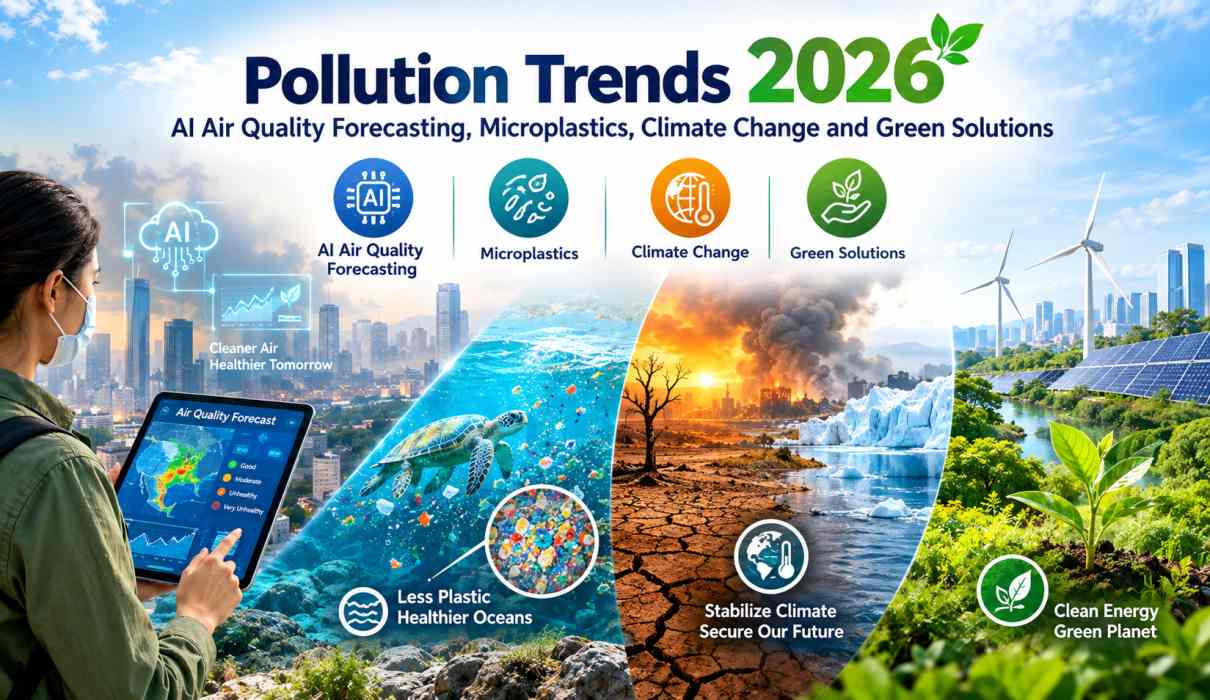
Below is a SEO-friendly article of approximately 1,900 words, incorporating current 2026 developments in AI air-quality forecasting, microplastic pollution, climate interactions, monitoring technology and green solutions.
Pollution Trends 2026: AI Air Quality Forecasting, Microplastics, Climate Change and Green Solutions
Pollution remains one of the world’s most important environmental challenges in 2026. Air pollution, plastic waste, water contamination, industrial emissions and climate-related pollution continue to affect ecosystems, cities and communities around the globe. At the same time, rapid developments in artificial intelligence, environmental monitoring, renewable energy and clean technologies are creating new opportunities to understand and reduce pollution.
One of the most significant trends this year is the growing use of artificial intelligence for air quality forecasting. Machine learning and deep-learning systems can analyze large amounts of environmental, weather and emissions data to identify pollution patterns and improve forecasts. Research published in 2026 indicates that deep-learning approaches can outperform traditional forecasting methods in many situations, particularly when they incorporate multiple sources of spatial and temporal data.
Another emerging concern is microplastic pollution in the atmosphere. Microplastics are increasingly being studied not only as ocean and land pollutants but also as airborne particles that can travel through the atmosphere. The World Meteorological Organization’s 2026 Air Quality and Climate Bulletin highlighted the need for improved monitoring of atmospheric pollutants including fine particulate matter, ozone, black carbon and microplastics.
Meanwhile, climate change and pollution are becoming increasingly interconnected. Heatwaves can contribute to ground-level ozone formation, while wildfires can release large quantities of particulate matter and other pollutants. These developments are encouraging governments, researchers and businesses to pursue integrated environmental solutions.
1. AI Is Transforming Air Quality Forecasting
Artificial intelligence is becoming an increasingly important tool for understanding and predicting air pollution.
Traditional air-quality forecasting often relies on statistical models, physical atmospheric models and historical observations. These approaches remain valuable, but pollution is influenced by numerous interacting factors, including weather, traffic, industrial activity, agriculture, wildfires and atmospheric chemistry.
AI and deep learning can process these complex relationships using large datasets. Models can analyze information from air-quality sensors, satellites, meteorological systems, traffic networks and historical pollution records.
A 2026 systematic review of more than 150 peer-reviewed studies found that deep-learning models generally performed better than traditional statistical and deterministic approaches, particularly when they captured complex spatial and temporal relationships. The researchers also highlighted challenges including inconsistent datasets, limited transparency and the concentration of research in data-rich urban regions.
In practical applications, improved forecasting could help cities issue pollution alerts earlier, support public-health planning and assist authorities in managing emission sources.
2. Real-Time Air Quality Monitoring Is Expanding
Air pollution monitoring is also becoming more connected.
Modern monitoring systems can combine information from government monitoring stations with smaller sensors, satellite observations, weather data and other digital sources. This creates opportunities for more detailed understanding of pollution at neighborhood and regional levels.
Real-time monitoring can be particularly useful during pollution events caused by wildfires, dust storms, industrial incidents or stagnant atmospheric conditions.
However, expanding monitoring networks also requires careful attention to data quality. Low-cost sensors can provide valuable supplementary information but may require calibration and validation. Standardized methods are important when data are used for scientific research, regulation or public-health decisions.
The 2026 WMO assessment emphasizes the need for better atmospheric observations of pollutants such as PM2.5, ground-level ozone, black carbon and microplastics.
3. Microplastics Are Emerging as an Atmospheric Pollution Concern
Microplastics have traditionally been associated with oceans, rivers, soil and food chains. Increasing research is now examining their presence in the atmosphere.
Plastic materials can gradually break down through sunlight, mechanical abrasion and weathering. Fibers from textiles, particles associated with road traffic, industrial activities, waste and urban dust can potentially enter the atmosphere.
The issue is particularly important because airborne particles can be transported over considerable distances before being deposited on land or water.
A 2026 review of airborne microplastics in India identified textile-derived fibers, traffic-related emissions, road-dust resuspension, industrial activities and indoor dust among important potential sources. It also emphasized that atmospheric transport is influenced by meteorological conditions and that standardized monitoring remains limited.
This makes atmospheric microplastic pollution an important area for future environmental research.
4. AI Could Improve Microplastic Detection
Artificial intelligence is not limited to conventional air pollution.
Researchers are increasingly exploring AI and machine learning for detecting, classifying and tracking microplastics. Identifying microplastics can be difficult because particles vary considerably in size, shape, color, polymer type and degree of weathering.
A review published in August 2026 examined how AI could contribute to microplastic monitoring, predictive modeling and risk assessment. It identified AI as a potentially useful tool for addressing some of the analytical challenges associated with the diversity and complexity of microplastic particles.
Future systems could combine advanced imaging, spectroscopy, machine learning and environmental databases to make microplastic identification faster and more consistent.
However, AI should complement laboratory testing and scientific validation rather than replace them. Reliable datasets and standardized measurement techniques remain essential.
5. Climate Change and Air Pollution Are Closely Connected
One of the defining pollution trends of 2026 is the growing recognition that climate change and air quality cannot be treated as completely separate issues.
The WMO’s September 2026 Air Quality and Climate Bulletin describes strong links between air quality and climate change. Atmospheric aerosols can influence radiation, clouds and climate, while climate-related changes can affect pollution patterns.
Heatwaves provide an important example. High temperatures, intense sunlight and stagnant atmospheric conditions can promote the formation of ground-level ozone.
Wildfires provide another connection. Hotter and drier conditions in some regions can contribute to wildfire risks, while wildfire smoke releases particulate matter and other pollutants into the atmosphere.
The WMO reported that increased pollution from wildfires and heatwaves poses challenges for efforts to improve air quality and protect human and ecosystem health.
6. Wildfire Smoke Is Becoming an Important Pollution Issue
Wildfire pollution has become a major area of environmental monitoring.
Smoke can contain fine particulate matter and other substances that affect air quality far from the original fire location. Atmospheric transport can carry smoke across cities, regions and national borders.
This creates a need for better forecasting systems capable of combining fire activity, weather conditions, atmospheric chemistry and population exposure.
AI-assisted forecasting could potentially help authorities identify areas likely to experience poor air quality and communicate risks to residents.
Satellite observations are also important because they can provide information about large-scale smoke movement and fire activity.
7. Green Energy Is a Key Pollution-Reduction Strategy
The transition toward cleaner energy is another major component of pollution reduction.
Renewable energy sources such as solar and wind can reduce reliance on fossil-fuel combustion for electricity generation. Electrification of transport and improved energy efficiency can also reduce emissions from some sectors.
The relationship between clean energy and air quality is especially important in urban areas, where transport, industry and energy consumption can contribute significantly to pollution.
A major advantage of integrated climate and clean-air policies is that they can address multiple environmental objectives simultaneously.
A September 2026 UN-backed assessment by UNEP and the Climate and Clean Air Coalition reported that coordinated action on air pollution and climate change could generate substantial health and economic benefits. The measures highlighted include renewable energy, electric vehicles and cleaner cooking fuels.
8. Electric Mobility and Cleaner Transportation
Transportation remains an important area for pollution reduction.
Electric vehicles can eliminate tailpipe emissions from conventional combustion engines, although their overall environmental impact also depends on electricity generation, battery production, vehicle manufacturing and other factors.
Public transportation, walking, cycling and efficient urban planning can also reduce dependence on private vehicles.
Future smart-city systems may combine traffic management, electric mobility, air-quality sensors and AI forecasting to understand how transportation patterns influence local air pollution.
Cleaner transportation therefore involves more than simply replacing one type of vehicle. It requires broader changes in how people and goods move through cities.
9. Cleaner Industrial Technologies Are Expanding
Industrial facilities are another important focus of pollution-control efforts.
Modern pollution-control systems can capture or reduce particulate matter, nitrogen oxides, sulfur compounds and other emissions. Industries are also exploring cleaner production processes, electrification, renewable energy and improved resource efficiency.
Digital technologies can make industrial pollution management more precise. Sensors and automated systems can continuously monitor emissions and identify unusual patterns.
AI may eventually help industries predict equipment problems, optimize energy consumption and identify processes that contribute to unnecessary emissions.
Combining environmental monitoring with industrial automation can therefore support both operational efficiency and pollution reduction.
10. Plastic Pollution Requires a Circular-Economy Approach
Microplastics are only one part of the larger plastic-pollution challenge.
Plastic waste can enter rivers, oceans, soil and eventually the atmosphere through fragmentation and environmental transport. Reducing this problem requires action throughout the life cycle of plastic products.
A circular-economy approach focuses on reducing unnecessary plastic use, designing products for longer life, improving collection and recycling systems and finding suitable alternatives where appropriate.
Better waste management can also reduce the amount of plastic that escapes into the environment.
The increasing attention to atmospheric microplastics reinforces the importance of addressing plastic pollution at its sources rather than focusing only on cleanup after environmental contamination occurs.
11. Smart Cities Are Becoming Pollution-Management Hubs
The smart city concept is increasingly connected with environmental management.
Future urban systems can combine air-quality sensors, traffic data, weather information, energy systems and AI analytics.
Such systems could help cities identify pollution hotspots, understand traffic-related emissions and optimize public transportation.
Digital dashboards can also provide residents with information about air quality and environmental conditions.
However, smart-city technologies should be implemented with attention to data quality, privacy, cybersecurity, accessibility and affordability. Technology is most useful when it supports transparent decision-making and practical environmental improvements.
12. Green Buildings Can Help Reduce Environmental Impact
Buildings are another important part of the pollution and climate conversation.
Energy-efficient buildings can reduce energy consumption through improved insulation, efficient cooling and heating systems, smart controls, renewable energy and better building design.
Indoor air quality is also receiving increasing attention. Ventilation, filtration, building materials and maintenance can influence indoor environmental conditions.
Green buildings therefore address both energy consumption and the quality of the environments in which people live and work.
Future buildings may use connected sensors to automatically monitor temperature, humidity, energy use and indoor air conditions.
13. Nature-Based Solutions Are Gaining Importance
Technology is not the only solution to pollution.
Nature-based approaches such as urban forests, wetlands, green corridors and restored ecosystems can provide environmental benefits when appropriately designed and maintained.
Vegetation can contribute to urban cooling and ecosystem services, while wetlands can help filter water and support biodiversity.
Nature-based solutions should not be considered a replacement for reducing pollution at its source. Instead, they can complement emission reductions, clean technologies and effective environmental management.
14. Better Environmental Data Will Shape Pollution Policies
One of the most important pollution trends in 2026 is the growing importance of high-quality environmental data.
Researchers need reliable information about where pollutants originate, how they move, how long they remain in the environment and how exposure changes over time.
AI can only be as reliable as the data used to train and evaluate it. The 2026 review of AI-based air-quality forecasting specifically identified data fragmentation, inconsistent evaluation methods, limited transparency and weak representation of some regions as continuing challenges.
Expanding monitoring networks and creating standardized datasets will therefore be essential for the next generation of environmental technologies.
15. The Future of Pollution Control Will Be Integrated
The future of pollution management is likely to involve multiple technologies and strategies working together.
AI can forecast pollution. Sensors can measure it. Satellites can observe large-scale environmental changes. Renewable energy can reduce some emissions. Electric transportation can transform urban mobility. Circular-economy systems can reduce plastic waste. Nature-based solutions can support ecosystem resilience.
The most effective strategies will connect these approaches rather than treating each pollution problem separately.
The growing scientific focus on the relationship between air pollution and climate change reinforces this integrated approach. The WMO has emphasized that air quality and climate policies need coordinated action because the two issues are strongly interconnected.
Conclusion
Pollution Trends 2026 reveal a significant transformation in how environmental problems are monitored, understood and addressed. Artificial intelligence is improving air-quality forecasting and creating new possibilities for pollution prediction. At the same time, atmospheric microplastics are emerging as an important research area, demonstrating that plastic pollution extends beyond oceans and land.
Climate change is adding further complexity. Heatwaves, wildfires and changing atmospheric conditions can influence air pollution, while some pollutants also affect climate processes. This connection makes coordinated climate and clean-air strategies increasingly important.
Green solutions such as renewable energy, electric mobility, cleaner industrial processes, improved waste management, circular-economy practices and energy-efficient buildings can contribute to pollution reduction.
The future of environmental protection will depend not on one technology or one policy but on the combination of AI, scientific monitoring, clean energy, responsible production, effective regulation and sustainable environmental practices.
As 2026 progresses, pollution management is becoming smarter and more data-driven. The challenge now is to ensure that these innovations are scientifically reliable, widely accessible and translated into practical action. A cleaner future will require both technological progress and long-term commitment to protecting air, water, land and ecosystems.