

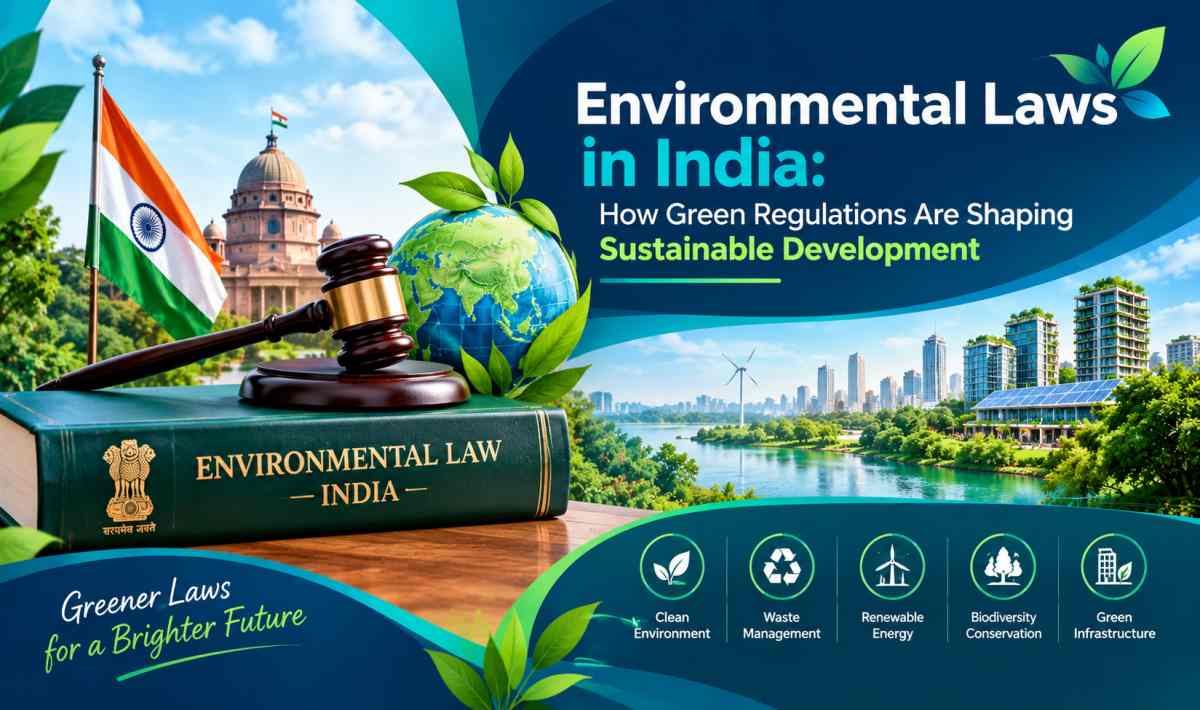
Environmental Laws in India: How Green Regulations Are Shaping Sustainable Development
Introduction
Environmental protection has become one of India’s most important priorities as the country balances rapid economic growth with the need to conserve natural resources. Increasing urbanisation, industrial expansion, air pollution, climate change, and waste generation have created significant environmental challenges. To address these concerns, environmental laws in India establish legal frameworks that encourage sustainable development and responsible resource management.
Over the years, the Indian government has introduced legislation, regulations, and policies designed to protect ecosystems, reduce pollution, conserve biodiversity, and improve environmental accountability. These green regulations influence industries, construction companies, real estate developers, businesses, and individuals.
Sustainable development focuses on meeting present needs without compromising the ability of future generations to meet their own needs. Environmental legislation supports this principle by encouraging economic progress while protecting natural ecosystems.
Understanding environmental laws in India is essential for businesses, property developers, investors, and citizens who want to contribute to a cleaner and more sustainable future.
1. Understanding Environmental Laws in India
Environmental laws are legal rules and regulations designed to protect the environment from harmful human activities. They establish standards for pollution control, waste management, natural resource conservation, and environmental protection.
In India, environmental governance involves the central government, state governments, pollution control boards, environmental authorities, and judicial institutions.
The Ministry of Environment, Forest and Climate Change (MoEFCC) plays a central role in developing environmental policies and administering major environmental legislation.
The Central Pollution Control Board (CPCB) and State Pollution Control Boards (SPCBs) monitor pollution and perform regulatory functions under applicable laws.
Major Objectives of Environmental Laws
The primary objectives include:
- Preventing air, water, and soil pollution.
- Protecting forests, wildlife, and biodiversity.
- Encouraging sustainable industrial development.
- Promoting responsible waste management.
- Conserving natural resources.
- Improving environmental accountability.
- Supporting public health and ecological balance.
These objectives demonstrate how environmental regulations help create a balance between economic development and environmental sustainability.
2. Major Environmental Protection Laws in India
India has developed several important environmental laws that form the foundation of its environmental protection framework.
Environment (Protection) Act, 1986
The Environment (Protection) Act, 1986, is one of India’s most significant environmental laws.
It provides the central government with broad powers to establish environmental standards, regulate potentially harmful activities, and take measures to protect and improve environmental quality.
The Act also provides the legal foundation for numerous environmental rules and notifications.
Its importance lies in creating an overarching framework for environmental regulation across different sectors.
Air (Prevention and Control of Pollution) Act, 1981
The Air Act focuses on preventing, controlling, and reducing air pollution.
It establishes regulatory responsibilities for pollution control boards and provides mechanisms for controlling emissions from industrial activities.
Industries covered by applicable requirements may need consent from the relevant State Pollution Control Board before establishing or operating facilities.
The law supports cleaner industrial operations and improved air quality.
Water (Prevention and Control of Pollution) Act, 1974
The Water Act aims to prevent and control water pollution while maintaining or restoring the wholesomeness of water.
It regulates activities that may discharge sewage or industrial effluents into water bodies.
Pollution control boards administer relevant consent requirements and monitor compliance with applicable standards.
The legislation plays an important role in protecting rivers, lakes, groundwater resources, and aquatic ecosystems.
Wildlife (Protection) Act, 1972
The Wildlife (Protection) Act provides legal protection for wildlife and supports the conservation of habitats and biodiversity.
It establishes mechanisms for protected areas and regulates activities involving protected species.
Wildlife conservation is essential for maintaining ecological balance and preserving India’s natural heritage.
Forest (Conservation) Act, 1980
The forest conservation framework regulates the diversion of forest land for non-forest purposes.
The legislation, renamed the Van (Sanrakshan Evam Samvardhan) Adhiniyam, 1980, was amended in 2023.
Its application depends on the statutory provisions, relevant rules, and the classification of land involved.
Forest conservation regulations are particularly important for infrastructure, mining, and large development projects.
3. The Role of Environmental Laws in Sustainable Development
Sustainable development involves balancing economic growth, environmental protection, and social well-being.
Environmental laws in India help achieve this balance by establishing standards that development activities must follow.
Encouraging Responsible Industrial Growth
Industries contribute significantly to employment and economic development. However, industrial operations can also generate pollution and consume natural resources.
Environmental regulations encourage businesses to adopt cleaner production methods, improve waste treatment, and reduce harmful emissions.
Protecting Natural Resources
Water, forests, land, and biodiversity are essential for economic and social development.
Environmental laws establish safeguards that help prevent excessive resource exploitation and environmental degradation.
Supporting Long-Term Economic Stability
Environmental damage can increase healthcare costs, reduce agricultural productivity, and create infrastructure risks.
By preventing pollution and protecting ecosystems, effective environmental governance can support long-term economic stability.
Promoting Social Responsibility
Environmental protection is increasingly recognised as a shared responsibility involving governments, businesses, communities, and individuals.
Legal frameworks encourage organisations to consider environmental impacts when planning and implementing development projects.
4. Environmental Impact Assessment and Green Development
Environmental Impact Assessment (EIA) is an important regulatory mechanism for evaluating the potential environmental consequences of certain proposed projects.
In India, the EIA Notification, 2006, issued under the Environment (Protection) Act, provides the framework for environmental clearance of specified projects and activities, subject to applicable amendments.
Projects covered by the notification may require prior environmental clearance.
Importance of Environmental Impact Assessment
EIA helps identify potential environmental risks before project implementation.
Its objectives include:
- Evaluating possible environmental impacts.
- Identifying pollution prevention measures.
- Assessing potential effects on surrounding ecosystems.
- Supporting informed regulatory decisions.
- Encouraging environmentally responsible project planning.
Depending on the project category and applicable requirements, the clearance process may involve environmental studies, public consultation, appraisal, and regulatory approval.
Environmental clearance does not automatically replace other statutory approvals or permissions.
5. Green Building Regulations and Sustainable Real Estate
India’s construction and real estate sectors have an important role in promoting sustainable development.
Buildings consume energy, water, and construction materials throughout their lifecycle. Sustainable building practices can reduce environmental impacts while improving operational efficiency.
Energy-Efficient Building Design
Energy efficiency is a major component of sustainable architecture.
Relevant building energy frameworks include the Energy Conservation Act, 2001, as amended, and building energy codes adopted through applicable regulatory mechanisms.
Energy-efficient buildings may incorporate:
- Natural lighting and ventilation.
- Efficient heating and cooling systems.
- Improved insulation.
- Energy-efficient lighting.
- Smart building management systems.
Water Conservation in Buildings
Water-efficient construction practices can reduce pressure on local water resources.
Rainwater harvesting, wastewater treatment, and water-efficient fixtures may be required under applicable local building rules or project approval conditions.
Green Building Certification
Voluntary certification systems such as the Indian Green Building Council’s rating programmes and GRIHA encourage environmentally responsible building design.
These certifications assess sustainability-related building features, although certification requirements differ from mandatory legal compliance.
Green building practices can help developers improve resource efficiency and attract environmentally conscious occupants.
6. Waste Management Laws and Circular Economy Development
Waste management is a major environmental challenge in India, particularly in rapidly growing cities.
Indian environmental regulations address different waste streams, including municipal solid waste, plastic waste, electronic waste, batteries, and hazardous waste.
Solid Waste Management
Solid waste regulations establish responsibilities relating to waste segregation, collection, processing, and disposal.
Effective implementation can reduce landfill dependence and improve urban sanitation.
Plastic Waste Management
Plastic waste regulations address plastic waste handling and impose responsibilities on relevant producers, importers, and brand owners.
Extended Producer Responsibility (EPR) mechanisms encourage covered businesses to support the environmentally sound management of plastic packaging waste.
E-Waste Management
The E-Waste (Management) Rules, 2022, introduced a regulatory framework for covered electronic waste, including EPR obligations.
These requirements support formal recycling and environmentally responsible handling of electronic products.
Circular Economy Benefits
A circular economy focuses on reducing waste, extending product lifecycles, and recovering valuable materials.
Environmental regulations can support this approach by encouraging recycling, reuse, and resource efficiency.
Businesses adopting circular economy principles may also identify opportunities to reduce material costs and improve operational sustainability.
7. Latest Environmental Regulations in India in 2026
Environmental regulations continue to evolve as India responds to pollution, resource management, and sustainability challenges.
One significant development is the Solid Waste Management Rules, 2026, notified on January 27, 2026, and effective from April 1, 2026.
These rules replaced the Solid Waste Management Rules, 2016, and introduced stronger requirements for waste segregation, monitoring, and accountability.
Important Features of the 2026 Rules
The updated framework includes:
- Mandatory segregation of solid waste into four streams.
- Defined responsibilities for bulk waste generators.
- Digital monitoring and reporting mechanisms.
- Environmental compensation for specified violations.
- Greater emphasis on recycling and resource recovery.
The four waste categories are wet waste, dry waste, sanitary waste, and special care waste.
These developments highlight India’s growing emphasis on circular economy principles and environmentally responsible waste management.
8. Environmental Compliance for Indian Businesses
Environmental compliance is increasingly important for businesses operating in manufacturing, construction, infrastructure, and other regulated sectors.
Companies must identify the environmental permissions, standards, and reporting obligations applicable to their activities.
Pollution Control Permissions
Depending on the industry and applicable legal requirements, businesses may need Consent to Establish and Consent to Operate from the relevant pollution control authority.
Waste Management Responsibilities
Businesses handling regulated waste streams must follow applicable collection, storage, transportation, recycling, and disposal requirements.
Environmental Monitoring
Certain facilities must monitor emissions, effluents, and other environmental parameters.
Maintaining accurate records can help organisations demonstrate compliance and identify operational improvements.
Consequences of Non-Compliance
Environmental violations may result in regulatory directions, environmental compensation, penalties, or other legal consequences, depending on the applicable legislation.
Businesses can reduce compliance risks by conducting regular environmental assessments and reviewing regulatory changes.
9. Role of the National Green Tribunal
The National Green Tribunal (NGT) is an important institution in India’s environmental justice system.
Established under the National Green Tribunal Act, 2010, it provides a specialised forum for specified environmental disputes.
The tribunal considers cases involving substantial environmental questions arising under legislation listed in its governing statute.
Importance of the NGT
The NGT contributes to environmental governance by:
- Addressing eligible environmental disputes.
- Examining environmental damage and regulatory failures.
- Applying relevant environmental law principles.
- Considering compensation and environmental restoration.
- Supporting accountability through legally enforceable orders.
Its jurisdiction and available remedies are determined by the National Green Tribunal Act and applicable judicial decisions.
10. Challenges in Implementing Environmental Laws
Despite India’s extensive environmental legal framework, effective implementation remains challenging.
Rapid Urbanisation
Growing cities require additional housing, transport networks, industries, and public infrastructure.
Managing development while protecting ecosystems requires careful planning and effective regulation.
Limited Monitoring Resources
Environmental authorities may face staffing, technical, and financial constraints.
These challenges can affect inspections, monitoring, and enforcement.
Public Awareness
Some individuals and businesses remain unfamiliar with their environmental responsibilities.
Awareness programmes and accessible regulatory information can help improve compliance.
Coordination Between Authorities
Environmental governance involves multiple government departments and regulatory institutions.
Effective coordination is necessary to prevent administrative delays and improve enforcement outcomes.
11. Future of Environmental Laws in India
The future of environmental regulation in India is likely to involve greater integration of technology, resource efficiency, and sustainability considerations.
Digital Environmental Monitoring
Digital reporting platforms, remote sensing, and automated monitoring systems can improve environmental oversight.
Stronger Waste Management Systems
Greater attention to waste segregation, recycling, and resource recovery may encourage investments in sustainable infrastructure.
Climate-Resilient Infrastructure
Flood-resistant construction, efficient water management, and climate-responsive urban planning are becoming increasingly important.
Sustainable Business Practices
Businesses may increasingly incorporate environmental risk management into investment decisions and long-term planning.
However, future regulatory changes will depend on government decisions, legislative developments, and judicial interpretation.
12. How Individuals Can Support Environmental Protection
Environmental protection is not solely the responsibility of governments and businesses.
Individuals can contribute through responsible daily practices and community participation.
Practical measures include:
- Segregating household waste according to applicable local requirements.
- Conserving electricity and water.
- Reducing unnecessary plastic consumption.
- Supporting recycling and responsible disposal.
- Choosing resource-efficient products.
- Participating in environmental awareness initiatives.
- Reporting suspected environmental violations through appropriate official channels.
Collective participation can strengthen the effectiveness of environmental regulations and support sustainable communities.
Frequently Asked Questions
1. What are the major environmental laws in India?
Major laws include the Environment (Protection) Act, 1986; Water Act, 1974; Air Act, 1981; Wildlife (Protection) Act, 1972; and India’s forest conservation legislation.
2. How do environmental laws promote sustainable development?
Environmental laws establish standards for pollution prevention, resource conservation, waste management, and environmentally responsible development.
3. What is the Environment (Protection) Act, 1986?
It is a central environmental law that empowers the government to take measures for protecting and improving environmental quality.
4. What are the Solid Waste Management Rules, 2026?
They are regulations effective from April 1, 2026, that establish updated requirements for solid waste segregation, management, monitoring, and stakeholder responsibilities.
5. Why are environmental laws important for real estate?
Environmental laws influence construction approvals, pollution management, resource conservation, and sustainable building practices. Requirements vary by project type, size, and location.
6. What is the role of the National Green Tribunal?
The NGT handles specified environmental disputes and provides remedies within its statutory jurisdiction.
Conclusion
Environmental laws in India are essential for promoting sustainable development while protecting the country’s natural resources and ecosystems.
From pollution control and wildlife conservation to green buildings and waste management, environmental legislation influences how businesses, governments, and communities approach development.
Recent developments, including the Solid Waste Management Rules, 2026, demonstrate an increasing focus on accountability, resource recovery, and environmentally responsible practices.
However, the success of environmental regulations depends on effective implementation, public awareness, institutional coordination, and consistent compliance.
As India continues to develop its infrastructure, industries, and urban centres, integrating environmental protection into economic planning will remain essential.
A sustainable future requires more than strong environmental laws. It requires responsible implementation, innovation, and active participation from every section of society.