

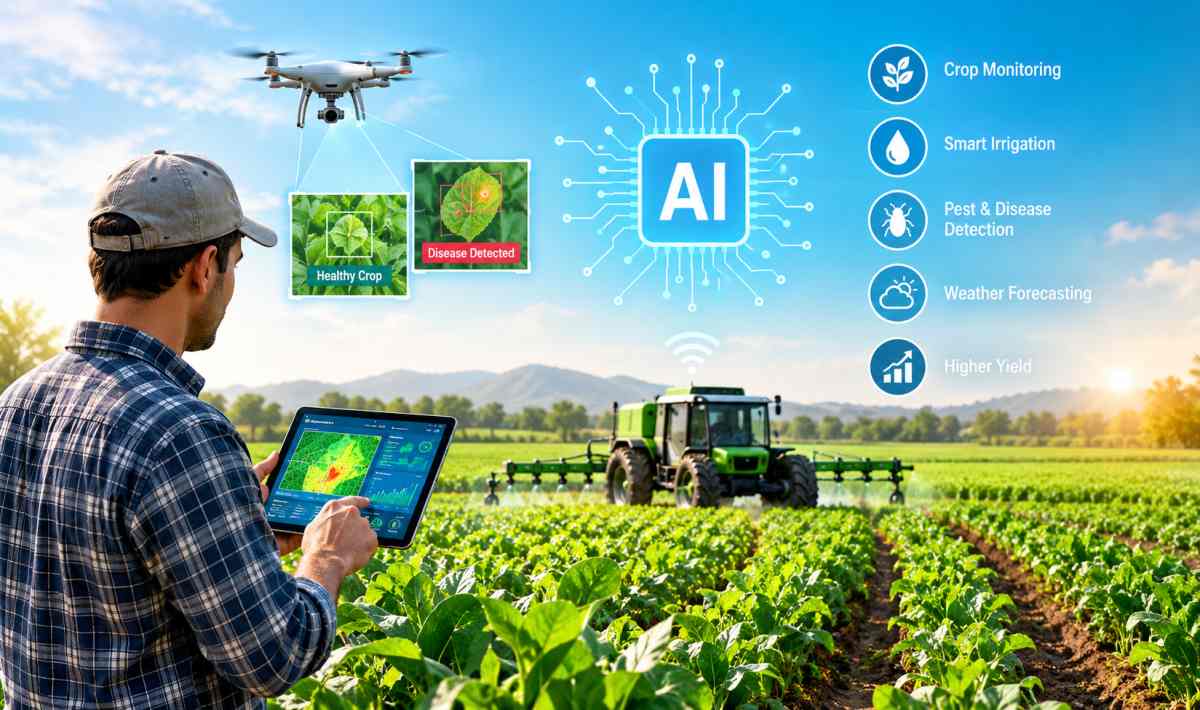
How Artificial Intelligence Works in Modern Farming
Agriculture has always played an essential role in human life by providing food, employment, and raw materials for industries. However, modern farmers face several challenges, including climate change, unpredictable rainfall, rising production costs, water shortages, soil degradation, and increasing demand for food. Traditional farming methods remain valuable, but they may not always provide the speed, accuracy, and efficiency required to address these challenges.
Artificial intelligence (AI) is emerging as an important technology that can help farmers make better decisions, manage resources efficiently, and improve agricultural productivity. By combining machine learning, satellite imagery, drones, sensors, robotics, and data analytics, AI-powered farming systems can analyze agricultural conditions and provide useful recommendations.
From identifying plant diseases to predicting weather patterns and automating irrigation, artificial intelligence is changing how modern farms operate. These technologies help farmers understand what is happening in their fields and determine which actions may be necessary to protect crops and improve yields.
In this article, we explore how artificial intelligence works in modern farming, its major applications, its benefits and challenges, and how AI technology could shape the future of agriculture.
What Is Artificial Intelligence in Agriculture?
Artificial intelligence in agriculture refers to the use of computer systems that analyze data, recognize patterns, make predictions, and support decisions related to farming activities.
Unlike conventional farming practices that often depend heavily on manual observation and experience, AI-powered systems can process large amounts of information from multiple sources. These sources may include soil sensors, weather stations, satellite images, drones, farm machinery, and historical crop records.
For example, an AI system can analyze soil moisture levels, temperature, humidity, and weather forecasts to estimate when a field may require irrigation. Similarly, an image recognition system can examine photographs of plant leaves to identify possible signs of disease.
AI does not replace the knowledge and experience of farmers. Instead, it provides additional information that can help them make informed decisions.
The main technologies used in AI agriculture include machine learning, computer vision, predictive analytics, natural language processing, and intelligent automation. When combined with agricultural expertise, these technologies can make farming more precise, efficient, and sustainable.
How Artificial Intelligence Works in Modern Farming
Artificial intelligence works by collecting agricultural data, analyzing it using specialized algorithms, and converting the results into useful information for farmers.
Although individual systems differ, most AI-powered farming solutions follow several basic steps.
1. Collecting Agricultural Data
The first step involves gathering information about crops, soil, weather, and farming activities. Modern farms can use different devices and technologies to collect this data.
Soil sensors measure moisture, temperature, and other soil characteristics. Weather stations record rainfall, humidity, wind speed, and temperature. Drones and satellites capture images that reveal crop growth patterns and changes in field conditions.
Farmers may also use information from previous harvests, fertilizer applications, irrigation schedules, and pest management records.
The quality of this information matters. Accurate and relevant data helps AI systems generate more useful predictions and recommendations.
2. Processing and Analyzing Information
After collecting data, AI software processes it to identify patterns and relationships. Machine learning models can be trained using historical agricultural information to recognize conditions associated with healthy crops, pest outbreaks, or changing soil moisture.
For example, a system may compare current crop images with thousands of previously labeled images to identify visual patterns associated with particular plant diseases.
Similarly, predictive models can analyze historical weather conditions and crop performance to estimate potential production outcomes.
AI predictions are not always correct. Their accuracy depends on data quality, the suitability of the model, and whether current conditions resemble the situations used during training.
3. Generating Recommendations
Once the data has been analyzed, the AI system provides information that farmers can use to plan their activities.
Recommendations might include checking a particular field for disease, adjusting irrigation schedules, inspecting areas with poor crop growth, or reviewing the timing of fertilizer applications.
For instance, if sensors indicate that a section of farmland has sufficient moisture while another section is becoming dry, an AI-assisted irrigation system may recommend watering only the areas that need it.
Farmers can evaluate these recommendations alongside their practical knowledge, financial considerations, and local agricultural guidance.
4. Automating Farming Activities
Some AI systems can connect directly to agricultural equipment. Depending on the technology and its configuration, they may help control irrigation valves, guide autonomous machinery, or support precision spraying.
Automation can reduce repetitive manual work and improve consistency. However, automated systems still require appropriate supervision, maintenance, safety measures, and human oversight.
By connecting data collection, analysis, recommendations, and equipment, AI creates a more informed approach to farm management.
Major Applications of Artificial Intelligence in Agriculture
Artificial intelligence can support many farming activities, from preparing fields to managing harvested produce. The following applications demonstrate how the technology is being used in modern agriculture.
1. Precision Farming and Crop Management
Precision farming involves managing agricultural land according to the specific needs of different areas within a field.
Not every section of a farm has identical soil conditions, moisture levels, nutrient availability, or crop growth. Applying the same amount of water and fertilizer everywhere may therefore be inefficient.
AI-powered precision agriculture systems combine sensor readings, satellite imagery, GPS information, and crop records to identify variations across farmland.
For example, an AI system may detect that one section of a field has weaker vegetation than neighboring areas. Farmers can investigate whether the problem is caused by insufficient nutrients, poor drainage, pests, or another factor.
Based on the findings, they can adjust their management practices rather than treating the entire field identically.
This targeted approach can help farmers use inputs more efficiently, reduce unnecessary applications, and make better use of available resources.
2. AI-Powered Crop Disease Detection
Crop diseases can spread quickly and cause significant agricultural losses when they are not identified early.
Traditional disease detection often relies on farmers noticing symptoms such as yellowing leaves, unusual spots, discoloration, or stunted growth. AI-powered image recognition can help identify suspicious patterns earlier or more consistently.
Farmers can capture images using smartphones, drones, or specialized cameras. Computer vision models analyze the images and compare visible characteristics with patterns learned from labeled training data.
The system may then identify a possible disease or recommend further inspection.
For example, an image analysis application could flag leaves showing symptoms associated with a fungal infection. The farmer can use that information to seek confirmation from an agricultural expert and determine an appropriate treatment.
However, an image alone may not provide a definitive diagnosis. Similar symptoms can result from nutrient deficiencies, water stress, pests, or multiple diseases.
AI-based disease detection is therefore most useful as an early-warning and decision-support tool rather than a complete replacement for expert diagnosis.
3. Smart Irrigation and Water Management
Water management is one of the most important applications of artificial intelligence in farming, particularly in regions where rainfall is unpredictable or irrigation resources are limited.
Traditional irrigation schedules may rely on fixed intervals or general observations. However, the actual water requirements of crops change according to soil moisture, temperature, plant growth stage, rainfall, and local weather conditions.
AI-powered irrigation systems can combine these variables to estimate when and where water is needed.
For example, sensors may detect declining soil moisture while a weather forecast indicates a high probability of rainfall. The system can use this information to recommend delaying irrigation, subject to crop requirements and local conditions.
More advanced systems can connect to automated pumps and irrigation valves to control water delivery.
Smart irrigation can help reduce unnecessary watering, improve water-use efficiency, and support healthier crop growth. Its effectiveness depends on reliable sensors, appropriate irrigation equipment, and accurate information about the crops being grown.
4. Weather Forecasting and Crop Yield Prediction
Weather conditions strongly influence planting schedules, crop development, pest activity, irrigation requirements, and harvesting decisions.
AI-based forecasting tools analyze historical weather records, current meteorological observations, and other relevant information to identify patterns and estimate future conditions.
These systems can support decisions such as when to sow seeds, whether to prepare for heavy rainfall, or when to inspect crops for heat-related stress.
AI can also assist with crop yield prediction. By analyzing past harvests, crop varieties, soil conditions, rainfall, temperature, and vegetation data, predictive models estimate potential agricultural output.
Such estimates help farmers plan storage, transportation, labor requirements, and sales.
Nevertheless, yield predictions are estimates rather than guarantees. Unexpected storms, droughts, disease outbreaks, and other events can significantly affect actual production.
5. Agricultural Drones and Satellite Monitoring
Drones and satellites provide valuable information about large agricultural areas that may be difficult to inspect manually.
Drones can capture high-resolution images of fields, while satellites provide repeated observations over wider areas. AI software analyzes these images to identify changes in vegetation, crop growth, and field conditions.
For example, unusual patterns in vegetation imagery may indicate water stress, nutrient problems, pest damage, or uneven crop development.
Farmers can use these findings to identify areas that need closer inspection.
Some agricultural drones also support targeted spraying or the distribution of certain agricultural materials where permitted and appropriately equipped.
When combined with AI, aerial monitoring can help farmers prioritize field inspections and make decisions based on more detailed information.
However, image interpretation is not always straightforward. Cloud cover, lighting, plant growth stages, and soil conditions can influence results. Farmers should verify important findings before making costly treatment decisions.
6. AI-Powered Pest and Weed Control
Pests and weeds can reduce crop yields and increase production costs. Controlling them efficiently is important for both profitability and environmental management.
AI-powered computer vision systems can analyze field images to distinguish crops from weeds or identify visual signs of pest activity.
Some precision spraying systems use cameras and AI models to locate weeds and apply herbicides only where necessary. Other systems help farmers identify areas where pest inspections may be particularly important.
Targeted treatment can reduce unnecessary chemical applications when the technology is properly designed and used.
AI can also support integrated pest management by combining weather conditions, crop growth stages, historical pest activity, and field observations to estimate potential risks.
Farmers should still follow approved pesticide labels, local regulations, and expert recommendations. AI predictions alone should not determine whether a chemical treatment is necessary.
7. Agricultural Robots and Automation
Agricultural robotics is another area where AI can improve operational efficiency.
Modern agricultural robots can support activities such as planting, harvesting, fruit picking, weed removal, and crop monitoring. Their capabilities vary considerably depending on the crop, machine design, and operating environment.
AI enables these machines to interpret sensor information, recognize objects, navigate designated areas, and respond to certain changes in their surroundings.
For example, a robotic harvesting system may use cameras to identify fruit and estimate whether it is ready to be picked.
Autonomous or semi-autonomous equipment can also help reduce the amount of repetitive manual work required for certain operations.
Despite these advantages, agricultural robots can be expensive and may struggle with uneven terrain, changing weather, dense vegetation, or delicate crops. Human supervision and maintenance remain important.
Benefits of Artificial Intelligence in Modern Farming
AI can offer several advantages when it is implemented appropriately and combined with sound agricultural practices.
Improved Agricultural Productivity
AI-assisted monitoring and decision-making can help farmers identify crop problems earlier, optimize field management, and reduce preventable losses.
These improvements may contribute to higher yields, although results depend on crop type, local conditions, and the effectiveness of the technology.
Reduced Farming Costs
Precision irrigation, targeted fertilizer applications, and more efficient pest management can reduce unnecessary resource use.
Automation may also reduce certain labor requirements and improve operational consistency. However, equipment purchases, software subscriptions, repairs, and training must be included when evaluating total costs.
Better Resource Management
AI can help farmers make more informed decisions about water, fertilizers, pesticides, fuel, and machinery.
Using resources more carefully can improve farm efficiency and support environmental sustainability.
Faster Decision-Making
Agricultural conditions can change quickly. AI systems can process large quantities of data faster than manual analysis alone, helping farmers identify issues that deserve immediate attention.
This can be especially useful when managing large farms or monitoring multiple fields.
More Informed Risk Management
Predictive analytics can help farmers evaluate potential risks associated with weather, crop disease, irrigation shortages, and changing production conditions.
Although AI cannot eliminate agricultural uncertainty, it can provide additional information for planning and preparation.
Challenges of Using AI in Agriculture
Despite its potential, artificial intelligence is not a perfect solution for every farm.
High Initial Investment
Sensors, drones, smart machinery, connectivity equipment, and AI software can require substantial investment.
Small-scale farmers may find it difficult to purchase and maintain these technologies without financial assistance, cooperative arrangements, or affordable service providers.
Limited Internet Connectivity
Some AI applications require reliable internet access to transfer data or use cloud-based processing.
Rural areas with limited connectivity may face difficulties adopting these systems. Offline tools and locally processed data can help address some of these challenges.
Data Quality and Accuracy
AI systems depend on reliable data. Incorrect sensor readings, incomplete records, poor-quality images, and unsuitable training datasets can produce misleading results.
Agricultural recommendations must also account for differences in climate, soil, crop varieties, and farming practices.
Technical Knowledge and Training
Farmers need appropriate training to understand how AI tools work, interpret their recommendations, and recognize their limitations.
Accessible interfaces, regional-language support, agricultural extension services, and practical demonstrations can improve adoption.
Data Privacy and Ownership
Digital farming platforms may collect information about land, crop performance, production costs, and farm operations.
Farmers should understand how their data is stored, who can access it, and whether it may be shared with third parties.
Clear data policies and appropriate security protections are important for building trust.
The Future of AI in Indian Agriculture
India’s agricultural sector includes smallholder farms, large commercial operations, diverse climatic regions, and many different crop varieties. AI could support this diversity by making agricultural information more accessible and improving decision-making.
In the coming years, AI applications may become increasingly integrated with digital agricultural advisory services, local weather information, satellite monitoring, and mobile-based farm management tools.
For example, a farmer could use a smartphone application to receive information about possible crop disease symptoms, local weather risks, irrigation needs, or suitable times for field operations.
AI-powered agricultural advisory services may also provide information in regional languages, helping farmers access guidance more easily.
Other opportunities include precision fertilizer management, crop insurance assessments, supply-chain forecasting, post-harvest storage management, and improved connections between farmers and markets.
However, successful adoption will require affordable technology, reliable local data, farmer training, responsible data governance, and support from agricultural institutions.
AI should complement established agricultural knowledge, scientific research, and local expertise rather than replace them.
How Farmers Can Start Using AI Technology
Farmers do not necessarily need expensive machinery to begin exploring AI-powered agriculture. A gradual approach can help them evaluate the technology before making major investments.
Start with a specific problem: Identify an issue such as water wastage, crop disease monitoring, or unpredictable planting schedules.
Explore affordable digital tools: Smartphone applications, digital weather services, and basic farm management platforms may provide a practical starting point.
Use reliable agricultural information: Compare AI recommendations with local weather data, crop requirements, and advice from qualified agricultural professionals.
Test before expanding: Trial a technology on a small portion of the farm and compare its results with existing practices.
Calculate the financial benefits: Consider equipment costs, subscriptions, labor savings, resource use, and changes in crop performance.
Seek training and support: Agricultural universities, extension services, farmer organizations, and technology providers may offer useful guidance.
This step-by-step approach can help farmers determine whether a particular AI solution provides meaningful benefits under their specific farming conditions.
Conclusion
Artificial intelligence is becoming an important part of modern agriculture by helping farmers analyze data, monitor crops, manage water, predict risks, and automate selected farming activities.
From precision farming and disease detection to smart irrigation and agricultural robotics, AI technologies offer practical ways to improve decision-making and use resources more efficiently.
However, successful implementation requires reliable data, suitable equipment, technical training, and careful evaluation of costs and benefits. AI cannot eliminate every agricultural challenge, and its recommendations should always be considered alongside local knowledge and professional agricultural guidance.
As technology continues to develop, AI-powered farming could contribute to more productive, resource-efficient, and resilient agricultural systems.
For farmers, agricultural businesses, and technology providers, the opportunity lies in using artificial intelligence responsibly to solve real farming problems. By combining human experience with data-driven insights, modern agriculture can become better prepared to meet the growing demand for food while protecting valuable natural resources.