

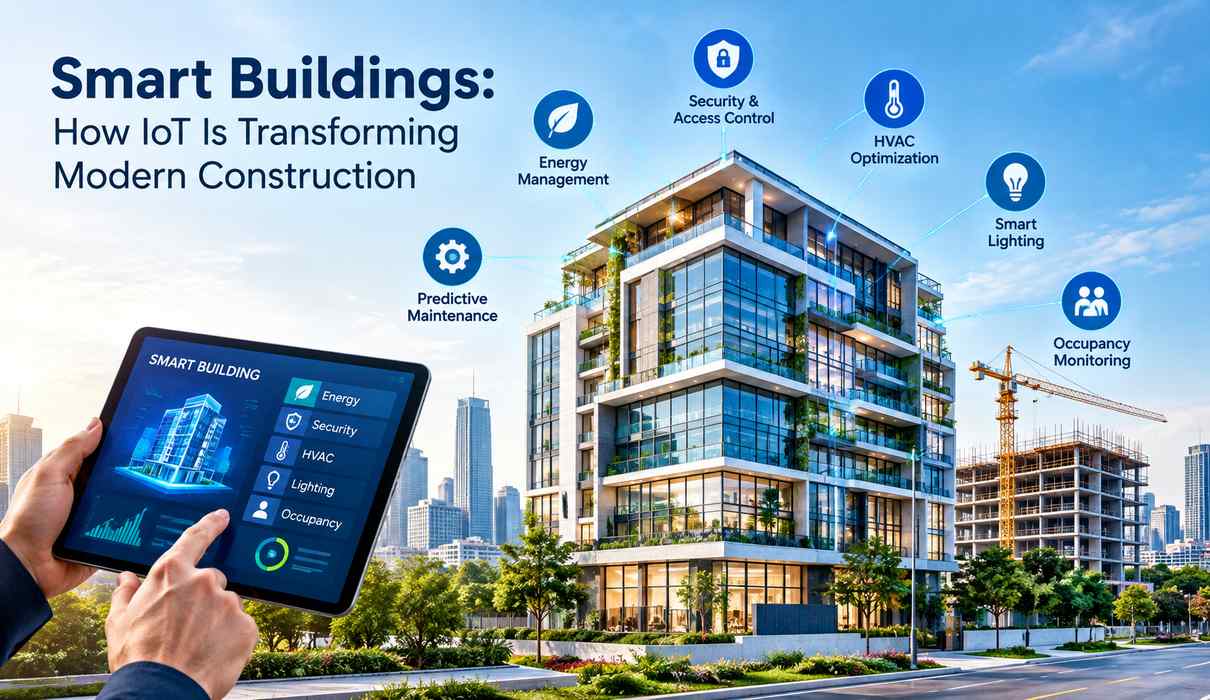
Smart Buildings: How IoT Is Transforming Modern Construction
The construction industry is undergoing a major technological transformation, and smart buildings powered by the Internet of Things (IoT) are becoming an important part of modern development. From intelligent lighting and automated HVAC systems to connected security devices and real-time energy monitoring, IoT is changing how buildings are designed, constructed, operated, and maintained.
A smart building uses connected sensors, devices, software, and communication networks to collect and exchange information. This data helps building owners, facility managers, construction companies, and occupants make better decisions, improve efficiency, reduce operational costs, and create more comfortable environments.
As businesses and property developers look for more sustainable and technology-driven solutions, IoT-enabled construction is expected to play an increasingly important role. This article explores how IoT is transforming modern construction, its key applications, benefits, challenges, and future potential.
What Are Smart Buildings?
A smart building is a structure equipped with connected technologies that can monitor and control different building systems. These systems may include lighting, heating and cooling, ventilation, security, access control, elevators, water management, fire safety, and energy consumption.
The Internet of Things connects physical devices through networks so they can collect and exchange data. For example, temperature sensors can detect changes in indoor conditions and communicate with a building management system. The system can then automatically adjust air conditioning or ventilation according to the requirements of the space.
Unlike traditional buildings, which often depend on manual monitoring and fixed schedules, smart buildings can respond dynamically to changing conditions.
The combination of IoT, cloud computing, artificial intelligence, automation, and data analytics makes it possible to create buildings that are more responsive, efficient, and easier to manage.
How IoT Works in Modern Construction
IoT-based smart buildings generally rely on several interconnected components.
1. Sensors
Sensors collect information from the building and its surroundings. Common examples include temperature, humidity, motion, occupancy, air-quality, light, water-flow, and energy sensors.
These devices continuously generate data that can help building systems respond to real-world conditions.
2. Connected Devices
IoT devices communicate with one another through wired or wireless networks. Smart thermostats, lighting controls, security cameras, access systems, meters, and other connected equipment can exchange information.
3. Data Platforms
Collected information can be sent to cloud-based or local platforms where it is stored and analyzed. Building managers can use dashboards to monitor different systems from a centralized location.
4. Automation
Automation allows a building to respond to information without requiring constant human intervention. For example, lights can automatically switch off when a room is unoccupied, while ventilation systems can adjust based on occupancy or air-quality measurements.
5. Analytics and Artificial Intelligence
Data collected through IoT devices can be analyzed to identify patterns and potential problems. When combined with artificial intelligence, building systems can potentially predict maintenance requirements and optimize energy consumption.
IoT Applications in Smart Buildings
IoT technology has applications across almost every stage of building operation.
Smart Lighting Systems
Traditional lighting systems often operate according to fixed schedules or manual switches. Smart lighting can use occupancy and daylight sensors to control lights automatically.
When a room is empty, lighting can be reduced or switched off. When natural daylight is available, artificial lighting can be adjusted accordingly.
This approach can help reduce unnecessary electricity consumption while maintaining suitable lighting conditions.
Intelligent HVAC Systems
Heating, ventilation, and air-conditioning systems are major energy consumers in many buildings. IoT sensors can monitor temperature, humidity, occupancy, and indoor air quality.
Connected HVAC systems can use this information to adjust heating and cooling according to actual conditions rather than relying entirely on predetermined schedules.
For large commercial buildings, this type of monitoring can provide facility managers with detailed information about system performance and energy usage.
Smart Security and Access Control
IoT is also transforming building security. Connected cameras, smart locks, access-control systems, motion sensors, and alarms can work together as part of an integrated security network.
For example, access systems can record authorized entry and exit activity, while connected security devices can send alerts when unusual activity is detected.
These systems can give property managers centralized visibility into building security.
Energy Management
Energy management is one of the most important applications of IoT in construction and building operations.
Smart meters and sensors can monitor electricity consumption across different areas of a property. Building managers can analyze this information to identify inefficient equipment, unusual consumption patterns, or areas where energy can potentially be saved.
When integrated with renewable energy systems such as solar panels and battery storage, smart building platforms can also provide better visibility into energy generation and consumption.
Predictive Maintenance
Maintenance is traditionally performed according to fixed schedules or after equipment fails. IoT creates another approach known as predictive maintenance.
Sensors can monitor equipment conditions such as vibration, temperature, pressure, or operating performance. Changes in these measurements may indicate that equipment requires inspection.
Instead of waiting for a major failure, maintenance teams can use available data to identify potential issues earlier.
This can help reduce unexpected downtime and improve the management of building equipment.
IoT During the Construction Phase
IoT is not limited to completed buildings. Connected technology can also support construction projects.
Equipment Tracking
Construction companies can use connected sensors and tracking technologies to monitor equipment and machinery. This can help teams understand where equipment is located and how it is being used.
Better tracking can support equipment management and reduce unnecessary idle time.
Worker Safety
Wearable devices and connected safety systems can provide information about working conditions. Depending on the technology used, sensors may monitor environmental conditions or identify situations that require attention.
IoT can therefore become part of a broader construction safety strategy alongside established workplace safety procedures.
Material Monitoring
Connected sensors can help monitor certain construction materials and environmental conditions. For example, sensors may be used to measure temperature or humidity where those conditions are important to construction processes.
This type of data can provide project teams with additional information for quality-control decisions.
Project Monitoring
IoT devices, drones, cameras, and other digital technologies can help construction managers monitor project progress.
When combined with Building Information Modeling (BIM) and project-management platforms, connected data can provide a more detailed view of construction activities.
Benefits of IoT in Smart Buildings
The growing adoption of IoT in construction is driven by several potential benefits.
Improved Energy Efficiency
Connected systems can monitor energy use and adjust building operations according to actual requirements. This can help reduce unnecessary consumption and support energy-efficiency goals.
Lower Operating Costs
Better monitoring and automation can help identify inefficient equipment and reduce unnecessary resource usage. Predictive maintenance may also help prevent costly equipment failures.
Better Occupant Comfort
Smart buildings can automatically adjust temperature, lighting, ventilation, and other environmental conditions based on occupancy and sensor information.
This can create more responsive indoor environments for occupants.
Improved Building Management
Instead of monitoring multiple systems separately, facility managers can use centralized platforms to view information from different building systems.
This can make it easier to identify problems and make operational decisions.
Enhanced Safety and Security
Connected security devices can provide real-time information and alerts. Integrated systems can help property teams monitor access, environmental conditions, and potential security events.
Support for Sustainability
IoT can contribute to sustainability by helping buildings monitor and manage energy, water, and other resources more efficiently.
This is particularly important as developers and organizations increasingly focus on reducing the environmental impact of buildings.
IoT and Sustainable Construction
Sustainability is becoming a major consideration in modern construction. Smart technologies can support sustainability by providing accurate information about how buildings use resources.
For example, water sensors can monitor consumption and potentially identify unusual usage. Energy sensors can provide detailed information about electricity demand. Indoor environmental sensors can monitor air quality and other conditions.
The collected data can help property owners understand building performance and identify opportunities for improvement.
IoT can therefore complement other sustainable construction strategies such as energy-efficient materials, renewable energy, green building design, and efficient water management.
Challenges of Implementing IoT in Construction
Despite its advantages, IoT adoption also presents several challenges.
Initial Investment
Installing sensors, networks, controllers, software, and connected equipment can require significant upfront investment. Developers must evaluate the long-term value of smart technology against initial costs.
Cybersecurity Risks
Connected buildings create more digital access points. Poorly secured devices and networks can potentially expose building systems to cyber threats.
Strong authentication, network security, software updates, access controls, and regular security assessments are important parts of responsible IoT deployment.
Data Privacy
Smart buildings can collect large amounts of information. Occupancy systems, access controls, and other technologies may generate data that needs to be handled responsibly.
Organizations should establish appropriate data-management policies and comply with applicable privacy requirements.
Integration Problems
Buildings may contain equipment from different manufacturers and generations. Connecting these systems can sometimes be difficult if they use different communication standards or platforms.
Interoperability should therefore be considered during the planning and design stage.
Technical Skills
Smart building systems require professionals who understand construction, electrical systems, networking, software, automation, and cybersecurity.
As IoT adoption grows, demand for professionals with multidisciplinary technical skills is also likely to increase.
The Role of AI in IoT-Powered Buildings
The combination of IoT and artificial intelligence could make smart buildings even more capable.
IoT devices generate large volumes of data, while AI can analyze that information to identify patterns and support automated decision-making.
For example, AI-powered building systems could analyze historical energy usage, occupancy patterns, weather information, and equipment performance to optimize building operations.
AI may also help identify unusual equipment behavior and support predictive maintenance.
The key advantage is that IoT provides the data while AI can help interpret that data and turn it into useful operational insights.
Future Trends in Smart Building Construction
The future of smart buildings is likely to involve deeper integration between construction technologies and building-management systems.
Digital Twins
A digital twin is a digital representation of a physical building or system. When connected to real-time IoT data, a digital twin can provide a continuously updated view of building conditions and performance.
This technology can support facility management, maintenance, design analysis, and operational planning.
Edge Computing
Instead of sending all IoT data to distant cloud servers, some processing can take place closer to the devices. This is known as edge computing.
For smart buildings, edge computing can potentially reduce response times and support applications that require faster processing.
5G and Advanced Connectivity
Faster and more reliable connectivity can support large numbers of connected devices. As advanced wireless networks become more widely available, they may contribute to the development of more connected construction sites and buildings.
Smart Water Management
Future buildings are also expected to use more connected systems for water monitoring. Sensors can track water consumption, detect unusual flow patterns, and support more efficient resource management.
Autonomous Building Operations
As automation, AI, and IoT continue to develop, buildings may increasingly be able to manage routine operations with limited manual intervention.
However, human oversight will remain important for safety, maintenance, cybersecurity, and critical decisions.
Conclusion
IoT is transforming modern construction by turning traditional buildings into connected, data-driven environments. From smart lighting and intelligent HVAC systems to predictive maintenance, security, energy management, and construction-site monitoring, IoT offers new ways to improve building performance.
The technology can help construction companies and property owners understand how buildings operate and identify opportunities for greater efficiency, comfort, safety, and sustainability.
At the same time, successful smart building projects require careful planning. Initial investment, cybersecurity, privacy, interoperability, and technical expertise must all be considered before connected systems are implemented.
As IoT continues to develop alongside artificial intelligence, BIM, digital twins, advanced connectivity, and automation, smart buildings are likely to become an increasingly important part of the construction industry.
For developers, architects, contractors, and facility managers, understanding IoT today can help prepare for a construction industry where buildings are not simply structures—but connected systems capable of continuously responding to the people and environments around them.
Primary SEO Keyword: Smart Buildings
Secondary Keywords: IoT in construction, smart building technology, IoT smart buildings, modern construction technology, intelligent buildings, smart construction, building automation, IoT applications in construction, sustainable construction technology, smart building systems