

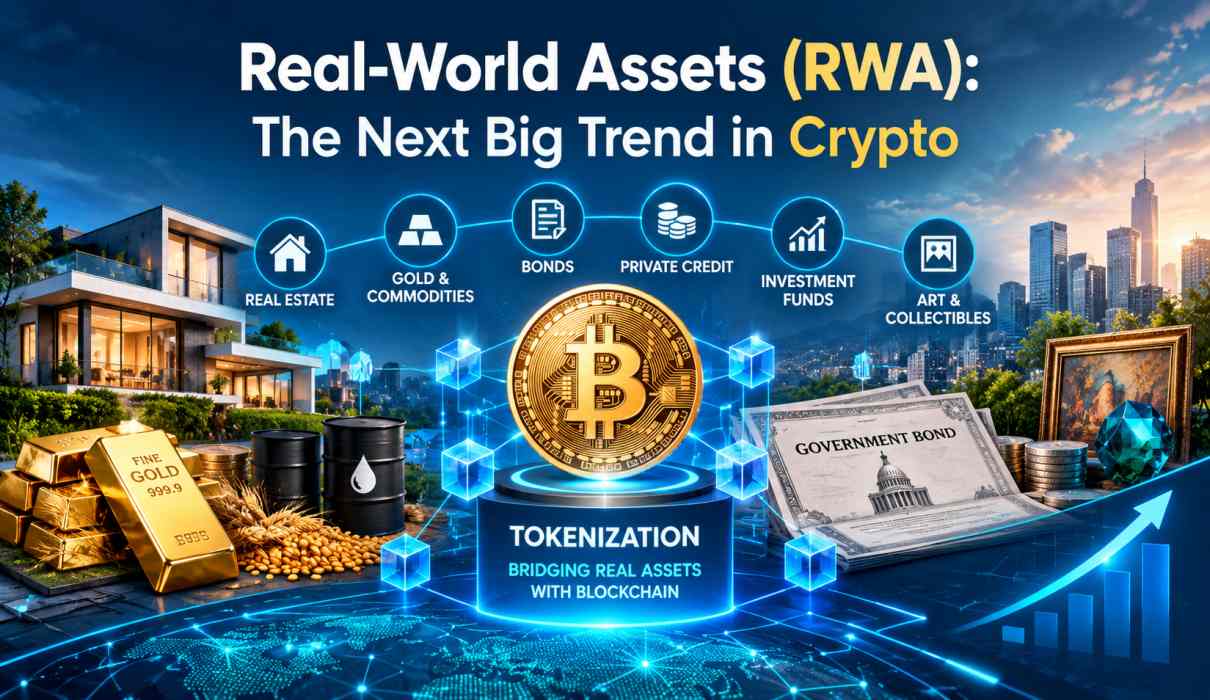
Real-World Assets (RWA): The Next Big Trend in Crypto
The crypto industry is entering a new phase where blockchain technology is moving beyond cryptocurrencies and decentralized finance. One of the most closely watched developments is Real-World Assets (RWA) tokenization, a process that brings traditional assets such as real estate, government bonds, commodities, private credit, and other financial instruments onto blockchain networks.
The Real-World Assets (RWA) market has attracted attention from crypto companies, financial institutions, investors, and blockchain developers because it connects traditional finance with decentralized technology. Instead of representing value only through digital-native assets, blockchain can be used to create digital representations of assets that already exist in the physical or traditional financial world.
As blockchain infrastructure develops and financial institutions explore tokenization, RWA could become an important part of the broader digital-asset ecosystem.
But what exactly are Real-World Assets, how does RWA tokenization work, and why is this trend becoming increasingly important in crypto?
What Are Real-World Assets (RWA)?
Real-World Assets (RWA) are physical or traditional financial assets that can be represented digitally on a blockchain.
Examples include:
- Real estate
- Government bonds
- Corporate bonds
- Commodities
- Gold
- Private credit
- Investment funds
- Art and collectibles
- Invoices and receivables
- Other financial instruments
In traditional markets, ownership and transactions are usually managed through banks, brokers, custodians, registries, and other intermediaries. RWA tokenization aims to represent ownership or economic rights associated with these assets through blockchain-based tokens.
For example, instead of maintaining records of a particular financial asset only through conventional databases, a token could represent a defined claim or interest in that asset. The exact legal rights depend on how the token and underlying asset are structured.
This does not mean that every physical asset automatically becomes a cryptocurrency. Rather, tokenization creates a digital representation of an underlying asset or financial interest.
How Does RWA Tokenization Work?
RWA tokenization generally involves several steps.
1. Identifying the Underlying Asset
The process starts with an asset that has economic value. This could be a property, government security, commodity, loan, or another financial instrument.
2. Establishing Legal Ownership
The asset must be connected to a legal structure that defines who owns it and what rights token holders have. This is an important part of RWA projects because blockchain records alone do not automatically establish ownership under every jurisdiction’s laws.
3. Creating the Digital Token
A blockchain-based token is then created to represent ownership, a claim, or another economic interest connected to the underlying asset.
4. Recording Transactions on Blockchain
Once issued, tokens can potentially be transferred between eligible participants according to the rules of the platform and applicable regulations.
5. Managing the Underlying Asset
A custodian, issuer, trustee, fund manager, or another responsible entity may continue to manage the real-world asset. Depending on the structure, investors may receive income, interest, or other benefits associated with the underlying asset.
This combination of traditional asset ownership structures and blockchain technology is what makes RWA tokenization different from purely digital cryptocurrencies.
Why Are RWAs Becoming a Major Crypto Trend?
One major reason for the growing interest in RWAs is that blockchain technology can potentially be used for assets with much larger and more established markets than cryptocurrencies alone.
The traditional financial system already contains enormous amounts of value in bonds, property, loans, commodities, funds, and other assets. Tokenization could provide new ways to issue, transfer, track, and manage some of these assets.
Several potential advantages are driving interest.
Greater Accessibility
Tokenization may allow certain investment opportunities to be divided into smaller digital units, depending on the legal and financial structure.
For example, an asset that traditionally requires significant capital could potentially be represented through smaller interests. However, fractionalization does not automatically make every investment available to everyone; eligibility and securities regulations can still apply.
Faster Settlement
Blockchain networks can potentially allow transactions to settle more quickly than some traditional systems.
Traditional financial transactions may involve multiple institutions and reconciliation processes. Blockchain-based settlement can reduce some of these steps when the relevant infrastructure is designed for it.
Transparency
Public blockchains can provide transaction records that are visible and verifiable. This can make certain aspects of asset movement easier to audit.
However, transparency depends on what information is actually recorded on-chain. Blockchain does not automatically guarantee transparency about the underlying physical asset.
Programmability
Tokenized assets can potentially interact with smart contracts.
For example, a smart contract could be designed to automate certain processes such as distributions, compliance checks, or transfers under predefined conditions.
Global Infrastructure
Blockchain networks operate across borders, which creates the possibility of building financial infrastructure that can connect participants from different markets.
At the same time, cross-border transactions remain subject to local laws, tax rules, sanctions requirements, and financial regulations.
Which Assets Can Be Tokenized?
Almost any asset with clearly defined ownership or economic rights could potentially be considered for tokenization, although technical feasibility and legal treatment vary significantly.
Real Estate
Real estate is one of the most frequently discussed RWA categories.
A property could potentially be represented through tokens connected to an ownership structure or economic interest. This could make certain aspects of property investment more divisible and digitally transferable.
However, real estate tokenization must deal with property laws, registration systems, taxes, title ownership, and local regulations.
Government Bonds
Government securities are another important category.
Blockchain-based representations of government bonds or similar instruments can potentially combine traditional fixed-income assets with digital settlement infrastructure.
This area has attracted considerable interest because government securities already have established legal and financial frameworks.
Private Credit
Private credit involves lending to businesses or other borrowers outside traditional public bond markets.
Tokenization could potentially make the management and distribution of private-credit interests more efficient, although credit risk remains a fundamental consideration.
Commodities
Gold and other commodities can also be connected to digital tokens.
In such systems, the important question is how the token is legally linked to the underlying commodity and whether the underlying asset is properly held, audited, and redeemable.
Funds and Other Financial Assets
Investment funds, money-market products, invoices, receivables, and other financial claims are also being explored for tokenization.
The broader trend suggests that RWA is not limited to physical assets. It can also involve traditional financial assets represented through blockchain infrastructure.
RWA vs Traditional Crypto
RWA tokens and traditional cryptocurrencies serve different purposes.
Bitcoin, for example, is a digital-native asset that does not represent ownership of a physical property or traditional financial instrument.
An RWA token, by contrast, is generally designed to represent a connection to an underlying real-world asset or financial claim.
This distinction is important.
Traditional crypto: Value primarily exists within a digital blockchain ecosystem.
RWA token: Blockchain technology is used to represent an asset, ownership interest, claim, or financial instrument connected to the real world.
Some RWA projects may also use stablecoins or other crypto infrastructure for payments and settlement.
Benefits of Real-World Asset Tokenization
The potential benefits of RWA tokenization extend beyond individual investors.
For Financial Institutions
Banks and asset managers could potentially use blockchain technology to improve settlement, recordkeeping, distribution, and asset servicing.
For Investors
Tokenization may provide new ways to access certain financial products, subject to eligibility and regulatory requirements.
For Businesses
Companies could potentially use tokenized assets or financial claims to create new financing structures.
For Blockchain Networks
RWA applications can introduce blockchain technology to users and institutions that may not be interested in speculative cryptocurrency markets.
This could broaden the practical use cases of blockchain.
Challenges and Risks of RWA
Despite its potential, RWA tokenization faces several important challenges.
Regulatory Uncertainty
Financial regulations vary significantly between countries and asset classes.
A token representing an investment interest may be treated differently from a token representing a utility or another type of digital asset. Regulatory classification can affect issuance, trading, investor eligibility, reporting, and compliance.
Legal Ownership
A blockchain token does not automatically prove legal ownership of a physical asset.
The legal connection between the token and the underlying asset must be clearly established.
Custody Risk
Many RWA systems depend on custodians or other organizations to hold the underlying assets.
If the custodian fails to properly manage the asset, token holders may face additional risks.
Valuation Risk
Some assets, particularly private companies, property, collectibles, and private credit, can be difficult to value accurately.
A token’s price may not always perfectly reflect the value of the underlying asset.
Liquidity Risk
Tokenization does not automatically create a liquid market.
An asset can be represented on a blockchain and still have limited buyers and sellers.
Smart Contract Risk
If blockchain-based systems rely on smart contracts, software vulnerabilities can create financial risks.
Security audits and robust development practices are therefore important.
Oracle and Data Risk
Blockchain applications may require external information such as asset prices, interest rates, or ownership data.
This information is often supplied through data providers or oracle systems. Incorrect or manipulated data can affect the operation of an RWA platform.
The Role of Stablecoins in the RWA Ecosystem
Stablecoins may become an important part of RWA infrastructure because they are designed to maintain a relatively stable value relative to a reference asset, often a fiat currency.
If tokenized bonds, funds, or other assets are issued on blockchain networks, stablecoins could potentially be used for payments and settlement.
This creates an ecosystem where:
Traditional asset → Tokenization → Blockchain → Stablecoin settlement → Digital financial infrastructure
The combination could help connect traditional finance with decentralized and blockchain-based systems.
RWA and the Future of Finance
The most significant aspect of RWA may be its ability to connect two previously separate worlds.
Traditional finance has decades of experience managing assets, regulations, credit systems, and financial markets.
Blockchain technology offers programmable transactions, digital ownership structures, shared ledgers, and potentially faster settlement.
RWA sits between these systems.
Instead of replacing traditional finance entirely, tokenization may lead to a hybrid model in which traditional financial institutions continue to manage assets while blockchain networks provide new infrastructure for issuance, settlement, and transfer.
This is particularly relevant as financial institutions increasingly experiment with blockchain-based products and infrastructure.
Is RWA the Next Big Trend in Crypto?
RWA is attracting significant attention because it addresses a practical question: How can blockchain technology be connected to the enormous value already existing in traditional financial markets?
Unlike trends based primarily on speculation, RWA focuses on applying blockchain technology to assets with established economic value.
However, it is important to avoid assuming that tokenization automatically makes an asset safer, more profitable, or more liquid.
The success of RWA will depend on several factors, including regulation, legal enforceability, custody, technology, investor protection, liquidity, and institutional adoption.
If these challenges are addressed effectively, RWA could become one of the important infrastructure layers connecting traditional finance and blockchain technology.
What Does the Future Hold for RWA?
The future of Real-World Assets will likely depend on how quickly technology, regulation, and financial institutions develop together.
More financial products could eventually be issued or represented on blockchain networks. Institutions may explore tokenized funds, bonds, credit products, commodities, and other assets.
At the same time, regulators are likely to focus on investor protection, transparency, custody, anti-money-laundering requirements, and legal ownership.
For the crypto industry, this could represent a shift from focusing primarily on digital-native assets toward building broader financial infrastructure.
Frequently Asked Questions About RWA
What does RWA mean in crypto?
RWA stands for Real-World Assets. In crypto, the term generally refers to physical or traditional financial assets that are represented digitally using blockchain-based tokens.
What are examples of real-world assets?
Examples include real estate, government bonds, commodities, gold, private credit, investment funds, invoices, and other traditional financial assets.
Is RWA the same as cryptocurrency?
No. Cryptocurrency is generally a digital-native asset, while an RWA token is designed to represent an underlying real-world asset, ownership interest, or financial claim.
What are the benefits of RWA tokenization?
Potential benefits include improved settlement, greater divisibility, programmable transactions, transparent blockchain records, and new ways of accessing certain financial assets.
Are RWA investments risk-free?
No. RWA projects can involve regulatory, legal, custody, liquidity, valuation, smart-contract, and underlying-asset risks.
Will RWA replace traditional finance?
There is no certainty that it will. A more likely area of development is the integration of blockchain infrastructure with existing financial systems.
Conclusion
Real-World Assets (RWA) are becoming an important trend in the crypto and blockchain industry because they connect digital technology with traditional assets and financial markets.
From real estate and government bonds to private credit and commodities, tokenization could create new ways to issue, manage, transfer, and settle financial assets.
However, the growth of RWA will depend on more than blockchain technology. Clear regulations, legally enforceable ownership structures, reliable custodians, secure smart contracts, accurate data, and sufficient liquidity will all play important roles.
For the crypto industry, RWA represents a broader vision of blockchain: not simply as a technology for digital currencies, but as infrastructure that can support parts of the wider financial system.
As financial institutions, blockchain companies, regulators, and investors continue exploring tokenization, Real-World Assets could become one of the key developments shaping the next stage of blockchain adoption.