
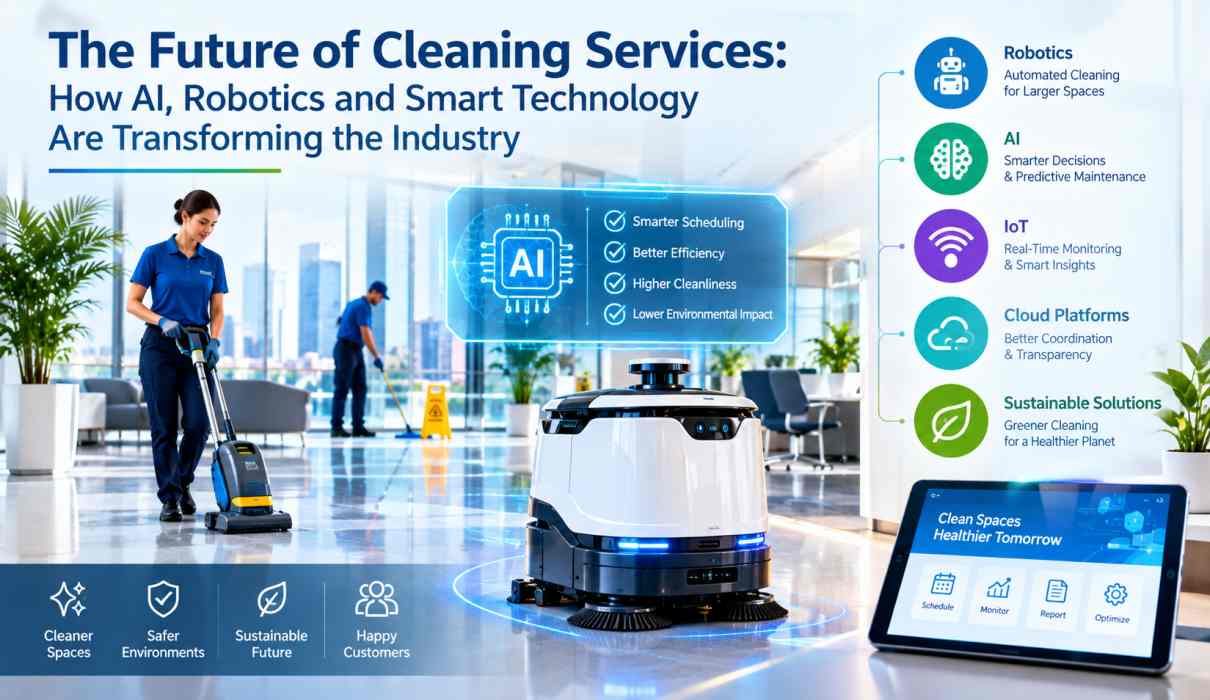
The Future of Cleaning Services: How AI, Robotics and Smart Technology Are Transforming the Industry
The cleaning industry is entering a new era. For decades, professional cleaning services have relied primarily on trained workers, traditional equipment, established cleaning schedules, and manual inspections. While these methods remain important, advances in artificial intelligence (AI), robotics, Internet of Things (IoT) devices, automation, and smart technology are changing how cleaning companies operate.
Today, businesses and property owners increasingly expect cleaning services to deliver more than basic cleaning. They want consistent quality, faster service, better hygiene, greater transparency, sustainable practices, and efficient use of resources. Technology is helping cleaning companies respond to these expectations.
From robotic floor cleaners and AI-powered scheduling to smart sensors and data-driven quality control, the future of cleaning services will be increasingly connected and intelligent.
However, technology is not expected to replace professional cleaners entirely. Instead, the industry is moving toward a model where technology handles repetitive and data-intensive tasks while skilled cleaning professionals focus on detailed work, problem-solving, customer service, and areas that require human judgment.
What Is Smart Cleaning?
Smart cleaning refers to the use of connected technologies, automation, AI, robotics, sensors, and digital platforms to improve cleaning processes.
Traditional cleaning services may rely on fixed schedules. A particular office might be cleaned every evening regardless of how heavily different areas were used during the day.
A smart cleaning system can take a more responsive approach. Sensors can monitor occupancy or usage, digital systems can track cleaning activities, and software can help managers determine where cleaning resources are needed most.
This creates a shift from schedule-based cleaning to data-informed cleaning.
For cleaning companies, this can mean better resource allocation, improved productivity, and more consistent service. For customers, it can provide greater visibility into what has been cleaned, when it was cleaned, and which areas may require additional attention.
How AI Is Transforming Cleaning Services
Artificial intelligence is becoming an important tool for service businesses, including professional cleaning companies.
One of the most useful applications of AI is scheduling and workforce management. Cleaning companies often manage multiple employees, locations, service requests, deadlines, and changing customer requirements. AI-powered software can analyze this information and help create efficient schedules.
For example, a system can consider location, employee availability, workload, cleaning requirements, and appointment times when organizing service assignments.
AI can also support predictive maintenance. If cleaning equipment generates information about usage or performance, software may help identify potential maintenance needs before equipment fails unexpectedly.
Another application is customer communication. AI-powered systems can assist with answering routine questions, processing service requests, sending reminders, and organizing information.
The goal is not to remove the human element from cleaning services. Instead, AI can reduce repetitive administrative work and allow cleaning managers and employees to spend more time on tasks that require human expertise.
The Rise of Robotic Cleaning
Robotic cleaning is one of the most visible examples of technology changing the industry.
Modern cleaning robots can perform repetitive tasks such as vacuuming, floor scrubbing, and certain forms of surface cleaning. Some commercial robots use sensors, cameras, mapping systems, and navigation technology to move around large spaces.
This can be particularly useful in environments such as shopping centers, airports, warehouses, hotels, hospitals, and large office buildings where extensive floor areas require frequent cleaning.
A robotic floor cleaner can operate according to a programmed schedule or work alongside cleaning staff during specific periods.
However, robots are not a complete replacement for professional cleaners. They are generally most effective at repetitive tasks in predictable environments. Human cleaners are still needed for stairs, bathrooms, corners, furniture, high-touch surfaces, unusual spaces, detailed cleaning, and situations requiring judgment.
The future is therefore likely to involve human-robot collaboration rather than complete automation.
Smart Sensors and IoT in Cleaning
The Internet of Things is another technology that can have a significant impact on cleaning operations.
IoT devices are connected sensors and equipment that can collect and transmit information. In a smart building, these devices can help cleaning companies understand how spaces are being used.
For example, occupancy sensors can provide information about how frequently particular areas are used. A restroom with consistently high traffic may require more frequent attention than a rarely used facility.
Smart dispensers can also monitor supplies such as soap, paper towels, or sanitizer. This can help cleaning teams identify when supplies need to be replenished.
Instead of relying entirely on routine inspection, cleaning teams can use real-time or regularly updated information to prioritize their work.
This approach can improve efficiency while helping prevent situations where essential supplies run out or frequently used areas are overlooked.
Data-Driven Cleaning and Quality Control
One of the biggest advantages of smart technology is the ability to collect and analyze operational data.
Cleaning companies can use digital platforms to record completed tasks, employee assignments, customer requests, inspection results, and service times.
This information can help managers identify patterns.
For example, if quality inspections repeatedly identify an issue in a particular area, management can investigate whether additional training, equipment, staffing, or cleaning frequency is needed.
Digital quality-control systems can also provide customers with greater transparency. Depending on the service, customers may be able to view cleaning schedules, completed tasks, inspection records, or service updates through an online platform.
This creates a more measurable approach to professional cleaning.
Smart Cleaning in Commercial Buildings
Commercial cleaning is particularly suited to technology-driven solutions because large facilities often contain multiple rooms, floors, departments, and high-traffic areas.
Office buildings, retail stores, hotels, educational facilities, industrial properties, and other commercial environments may require different cleaning strategies throughout the day.
Smart technology can help cleaning companies divide facilities into zones and assign tasks according to usage.
For example, a high-traffic entrance may need frequent attention during business hours, while conference rooms may require cleaning after meetings. A warehouse may have different requirements from an office area within the same property.
Digital systems can help coordinate these requirements and provide managers with a clearer picture of cleaning operations.
AI-Powered Cleaning Scheduling
Scheduling is one of the areas where automation can make a significant difference.
Traditional scheduling often requires managers to manually coordinate employee availability, customer appointments, travel times, cleaning requirements, and unexpected changes.
Digital scheduling systems can simplify this process.
AI-powered platforms can analyze multiple factors and suggest efficient assignments. If a customer requests an additional cleaning session or an employee becomes unavailable, the system can help managers adjust schedules.
For cleaning businesses with many employees and locations, this can reduce administrative workload and improve coordination.
Better scheduling can also help reduce unnecessary travel between locations, which may contribute to improved productivity and more efficient use of company resources.
Eco-Friendly and Sustainable Cleaning
Technology is also supporting the growing focus on sustainable cleaning practices.
Modern cleaning equipment can be designed to use less water, energy, or cleaning solution while maintaining effective performance.
Smart dispensing systems can help control the amount of cleaning product used. Instead of manually estimating quantities, automated systems can provide measured doses.
Robotic floor-cleaning equipment may also incorporate technologies designed to improve water and energy efficiency.
Digital systems can help companies monitor resource consumption and identify opportunities for improvement.
Sustainability is increasingly important to businesses and property managers, particularly as organizations seek to reduce operational waste and meet environmental goals.
Technology and Workplace Hygiene
Cleaning services have an important role in maintaining hygienic environments, particularly in workplaces and other frequently occupied buildings.
Smart technology can help organizations identify high-traffic areas and prioritize cleaning activities.
Digital checklists can remind employees about important tasks, while inspection systems can help supervisors verify that required work has been completed.
Technology can also support more consistent processes. Instead of relying entirely on memory or paper-based instructions, employees can access standardized digital procedures and task lists.
This can be useful for cleaning companies that manage multiple teams and locations.
The Changing Role of Professional Cleaners
As technology becomes more common, the role of professional cleaners will evolve.
Routine repetitive tasks may increasingly be supported by robotic equipment and automated systems. At the same time, human workers will remain essential for detailed cleaning, specialized services, customer interaction, problem-solving, and quality assurance.
This means cleaning professionals may increasingly need technical skills in addition to traditional cleaning expertise.
Workers may be required to operate robotic equipment, use digital task-management platforms, interpret equipment alerts, perform basic troubleshooting, and follow technology-assisted workflows.
Training will therefore become an important part of the future cleaning industry.
Companies that invest in employee development can help their teams adapt to new technologies while maintaining high standards of service.
Benefits of Smart Cleaning Technology
The adoption of AI, robotics, and smart technology can provide several potential benefits.
1. Improved Efficiency
Automation can handle repetitive tasks and reduce time spent on administrative activities.
2. Better Resource Management
Data can help cleaning companies allocate workers, equipment, supplies, and time more effectively.
3. More Consistent Service
Digital checklists, automated schedules, and quality-control systems can help standardize cleaning processes.
4. Greater Transparency
Digital records can provide customers and managers with clearer information about completed services.
5. Predictive Maintenance
Connected equipment can help identify potential maintenance requirements before major failures occur.
6. Reduced Waste
Smart dispensing and resource-monitoring technologies can help reduce unnecessary consumption.
7. Better Customer Experience
Online booking, automated updates, digital communication, and responsive scheduling can make professional cleaning services easier to manage.
Challenges of Technology in the Cleaning Industry
Despite its benefits, technology also creates challenges.
The initial cost of purchasing robotic equipment, sensors, software, and connected devices can be significant. Smaller cleaning companies may need to adopt technology gradually.
Employee training is another consideration. New systems must be easy to understand and supported by appropriate training.
Cybersecurity and data privacy are also important when companies collect information about employees, customers, buildings, and operations.
There is also a risk of relying too heavily on automation. Cleaning is not always predictable. A spill, unexpected event, unusual surface, or customer request may require immediate human judgment.
For this reason, technology should support professional cleaning teams rather than eliminate human oversight.
What Customers Can Expect From Future Cleaning Companies
As technology becomes more common, customers may expect cleaning companies to provide a more connected service experience.
Online booking and digital service management may become standard. Customers may receive automated appointment reminders, service notifications, and updates.
Businesses may also expect measurable service performance. Instead of simply hiring a company and waiting for periodic inspections, customers may have access to digital records showing when tasks were completed and whether quality checks were performed.
Customized cleaning plans are also likely to become more common.
Rather than using the same schedule for every property, cleaning companies can combine customer requirements with building usage data to develop more responsive cleaning programs.
The Future: Humans and Technology Working Together
The future of the cleaning industry is unlikely to be defined by robots alone. The strongest model will combine technology with human expertise.
Robots can handle repetitive floor-cleaning tasks. AI can help with scheduling and data analysis. IoT sensors can provide information about building usage. Digital platforms can improve communication and recordkeeping.
Professional cleaners can then focus on detailed work, specialized cleaning, quality control, customer needs, and situations where technology cannot provide an adequate solution.
This combination can create a more efficient and flexible cleaning service model.
Technology will also continue to evolve. Improvements in computer vision, navigation, AI, robotics, sensors, and cloud-based software could expand the range of tasks that can be automated or digitally monitored.
Conclusion
The future of cleaning services is becoming smarter, more connected, and increasingly data-driven. AI, robotics, IoT, automation, and digital platforms are transforming how cleaning companies schedule work, manage resources, monitor quality, maintain equipment, and communicate with customers.
Robotic cleaning equipment can handle repetitive tasks, while AI can support scheduling and operational decisions. Smart sensors can provide valuable information about building usage, and digital platforms can improve transparency and customer service.
At the same time, professional cleaners will remain essential. Human judgment, attention to detail, adaptability, communication, and specialized expertise cannot simply be replaced by machines.
The cleaning companies that embrace technology while continuing to invest in people can build a more efficient and responsive service model.
Ultimately, the future of cleaning is not about technology versus people. It is about bringing the two together. By combining smart technology with skilled professionals, the cleaning industry can deliver cleaner spaces, more efficient operations, better customer experiences, and more sustainable services for the years ahead.