

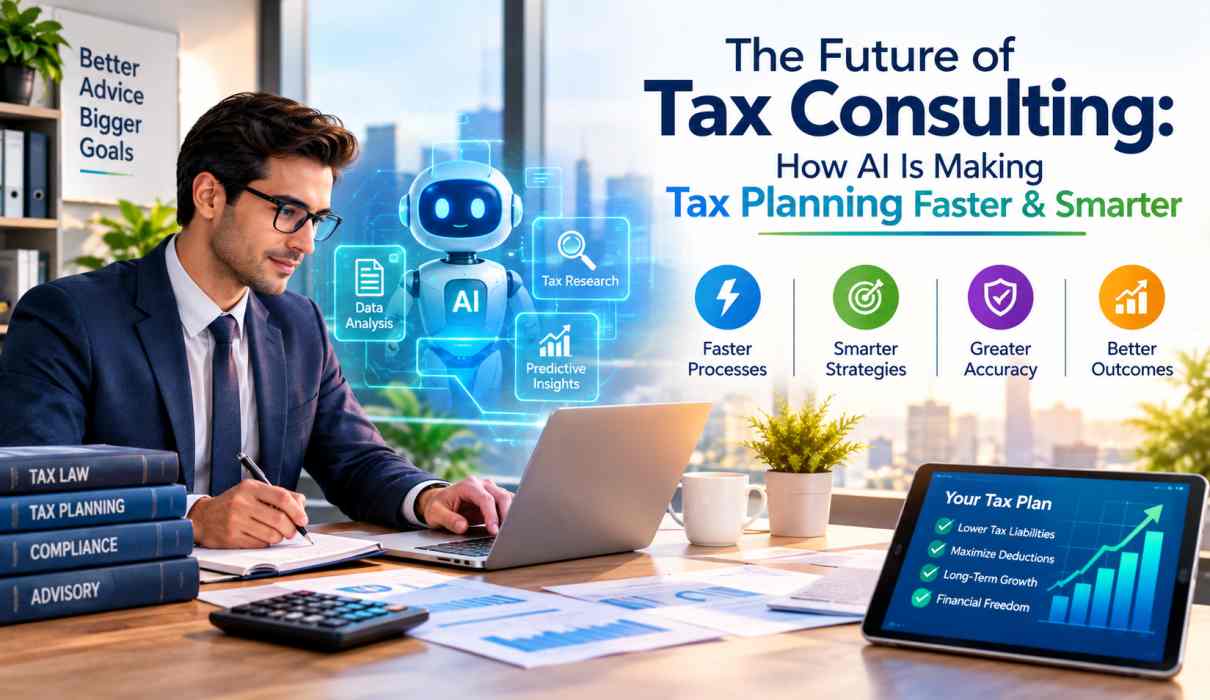
The Future of Tax Consulting: How AI Is Making Tax Planning Faster & Smarter
Tax consulting has traditionally involved detailed financial analysis, extensive documentation, regulatory research, calculations, and careful communication with clients. While these fundamentals remain important, technology is changing how tax professionals perform them. Artificial intelligence (AI), automation, data analytics, cloud platforms, and digital tax systems are making many tax processes faster, more connected, and increasingly data-driven.
For businesses and individuals, this transformation can make tax planning more efficient. For tax consultants, it creates opportunities to spend less time on repetitive administrative work and more time on strategic advice, risk management, and complex tax decisions.
The shift is already happening. According to the OECD’s Tax Administration 2025, 69% of surveyed tax administrations reported using AI in 2023, while another 24% were implementing AI for future use. The OECD also reports that AI is being applied to areas including taxpayer services, risk assessment, fraud detection, and high-volume repetitive tasks.
So, what does this mean for the future of tax consulting? From automated document processing to predictive analytics and AI-assisted tax research, technology is changing almost every stage of the tax planning process.
What Is AI-Powered Tax Consulting?
AI-powered tax consulting refers to the use of artificial intelligence and related technologies to support tax research, data analysis, compliance, planning, reporting, and client services.
AI does not necessarily replace a tax consultant. Instead, it can act as a powerful assistant that processes large volumes of information, identifies patterns, organizes documents, and helps professionals investigate relevant issues more efficiently.
Traditional tax consulting often requires professionals to manually review invoices, financial statements, transactions, correspondence, regulations, and previous tax records. AI-powered tools can assist with extracting information from these documents and identifying items that require human attention.
The result can be a more efficient workflow in which technology handles suitable repetitive tasks while qualified professionals focus on interpretation, judgment, and client-specific advice.
How AI Is Transforming Tax Planning
Tax planning involves understanding a taxpayer’s financial position, identifying applicable rules, evaluating different scenarios, and considering the potential tax consequences of financial decisions.
AI can support this process by processing more information in less time.
1. Faster Financial Data Analysis
Tax consultants often work with large amounts of financial data. AI-powered analytics can help categorize transactions, identify unusual entries, compare historical information, and organize data for further review.
Instead of manually searching through thousands of transactions, a consultant can use automated systems to identify transactions that meet specific criteria.
This does not eliminate professional review. Rather, it allows the consultant to start with a more organized picture of the financial information.
2. Automated Document Processing
Invoices, receipts, bank statements, payroll records, contracts, and financial reports can contain information relevant to tax planning.
Modern document-processing systems can use optical character recognition and AI to extract information from digital and scanned documents.
For example, software may identify dates, amounts, vendor names, tax categories, and transaction descriptions. The extracted information can then be transferred into accounting or tax workflows.
This can reduce manual data entry and potentially lower the risk of simple transcription errors.
3. AI-Assisted Tax Research
Tax regulations can be complex and frequently updated. Tax professionals may need to research legislation, administrative guidance, court decisions, official publications, and other authoritative sources.
AI-powered research systems can help consultants search large collections of information more efficiently and identify potentially relevant provisions.
However, AI-generated answers should not automatically be treated as authoritative tax conclusions. Tax professionals still need to verify important conclusions against current primary sources and applicable rules.
This is especially important because tax laws vary between jurisdictions and can change over time.
Predictive Analytics and Smarter Tax Planning
One of the most valuable applications of AI is predictive analytics.
Traditional tax analysis often focuses on historical financial information. Predictive analytics can help professionals examine patterns and model possible future scenarios.
For example, a business might want to understand how a planned investment, change in business structure, expansion into another jurisdiction, or change in compensation could affect its future tax position.
AI-supported systems can process different assumptions and present potential scenarios for professional evaluation.
The technology does not determine the correct strategy automatically. Instead, it can help consultants compare possibilities more efficiently.
This makes tax planning more dynamic and forward-looking.
AI and Tax Compliance
Tax compliance is another area where automation can have a major impact.
Businesses may have recurring responsibilities involving income taxes, indirect taxes, payroll taxes, information reporting, invoices, documentation, and filing deadlines.
Automated tax platforms can monitor data and workflows, helping businesses identify missing information or upcoming obligations.
The OECD reports that tax administrations are increasingly using digital systems, data analytics, and AI to improve compliance and identify potential risks. Its 2025 research found that AI was being used by many administrations for risk assessment and tax evasion or fraud detection.
This means businesses should increasingly view tax compliance as an ongoing process rather than something that only happens when a filing deadline approaches.
Real-Time Tax Data Is Changing the Industry
Another major development is the movement toward more real-time financial and tax information.
Traditional accounting workflows may involve collecting information periodically and preparing reports at the end of a month, quarter, or year. Modern cloud accounting systems can update financial information continuously.
When tax systems are connected to accounting platforms, businesses can potentially monitor tax-related information throughout the year.
The OECD has highlighted the broader shift toward digital tax administration, including greater use of electronic filing, data analytics, pre-filled returns, and technology-enabled taxpayer services.
For tax consultants, this creates an opportunity to provide more proactive advice rather than focusing primarily on historical reporting.
AI-Powered Tax Risk Detection
Tax consultants can also use AI to identify potential compliance risks.
An AI system may analyze transactions and compare them against historical patterns or predefined rules. It could flag unusual expenses, duplicate transactions, missing documentation, inconsistent classifications, or other items that deserve review.
For larger businesses, this type of analysis can be particularly useful because financial data may come from multiple departments, subsidiaries, bank accounts, accounting systems, and jurisdictions.
The consultant can then investigate flagged items and determine whether they represent legitimate transactions, errors, or issues requiring corrective action.
Personalized Tax Consulting
AI can also help make tax consulting more personalized.
Every client has a different financial situation, business structure, income profile, investment strategy, and risk tolerance. Instead of applying exactly the same workflow to every client, technology can help consultants organize client information and identify relevant issues.
For example, a tax consultant working with a growing business may need to consider business expansion, employee compensation, investments, financing, international transactions, and changes in organizational structure.
AI can help organize relevant information and highlight areas for further analysis.
The consultant remains responsible for applying professional judgment and explaining the implications to the client.
Automation Gives Tax Consultants More Time for Strategy
One of the biggest benefits of AI may not be automation itself but the time it creates.
Tax professionals often spend considerable time on repetitive activities such as:
- Entering financial information
- Sorting documents
- Searching databases
- Checking calculations
- Preparing routine reports
- Categorizing transactions
- Monitoring deadlines
- Responding to common questions
Automating suitable tasks can allow consultants to dedicate more time to higher-value activities such as strategic planning, business advisory, risk management, and client communication.
This could gradually change the role of the tax consultant from primarily compliance-focused work toward a broader financial advisory role.
The Human Role Remains Essential
Despite the rapid development of AI, professional tax expertise remains essential.
Tax decisions can involve complicated facts, legal interpretation, business objectives, ethical considerations, and jurisdiction-specific rules. AI can process information quickly, but it does not automatically understand every real-world circumstance surrounding a taxpayer.
Tax professionals also need to evaluate whether the information being analyzed is accurate and complete.
For this reason, the future is more likely to involve AI-assisted tax consulting rather than completely automated tax consulting.
The consultant provides judgment, context, verification, communication, and accountability, while technology provides speed and analytical support.
AI Risks Tax Consultants Need to Consider
AI brings opportunities, but it also introduces risks.
Data Privacy
Tax records can contain highly sensitive financial and personal information. Consultants need to understand where client data is stored, how it is processed, who can access it, and what security controls are in place.
Incorrect AI Outputs
Generative AI systems can produce incorrect or incomplete information. A confident-looking answer is not necessarily a correct tax conclusion.
Important tax positions should therefore be checked against reliable and current sources.
Outdated Information
Tax rules can change. A system trained on older information may not reflect the latest legislation, regulations, administrative guidance, or case law.
Lack of Transparency
Some AI systems can make recommendations without providing an explanation that is sufficiently clear for professional review.
The OECD has specifically highlighted concerns around transparency, fairness, bias, accountability, and the “black-box” nature of some AI systems used in tax administration.
These issues make human oversight particularly important.
Responsible AI Use in Tax Practice
Professional tax organizations are increasingly paying attention to responsible AI use.
In June 2026, the U.S. Internal Revenue Service’s Office of Professional Responsibility issued introductory guidelines for responsible AI use in federal tax practice. The guidance notes that AI is already widely used in professional tax environments, including document review and research technologies, and emphasizes the need for responsible use as these systems continue to evolve.
This reflects a broader industry trend: adopting AI is not simply a technology decision. Tax firms also need policies covering confidentiality, verification, professional responsibility, data security, and human oversight.
How Small Businesses Can Benefit From AI Tax Tools
AI-powered tax technology is not limited to large corporations.
Small businesses can also benefit from automated bookkeeping, expense categorization, digital receipt management, cash-flow analysis, tax reminders, and reporting tools.
For a small business owner, these systems can reduce the amount of time spent organizing financial information before meeting with a tax consultant.
The consultant can then spend more time discussing the business’s financial position and future plans.
However, small businesses should avoid assuming that software alone can replace professional advice. Automated tools can assist with routine processes, but complex tax situations still require appropriate professional review.
How Tax Consultants Can Prepare for the AI Era
Tax professionals who want to remain competitive should focus on combining tax expertise with technology skills.
Important areas include:
- AI-assisted tax research
- Data analytics
- Cloud accounting systems
- Automated compliance workflows
- Cybersecurity awareness
- Digital document management
- Financial forecasting
- Client data management
- AI verification and quality control
Tax consultants also need strong communication skills. As technology handles more routine processing, explaining complex financial and tax issues clearly may become an even more valuable part of the profession.
What Clients Should Look for in a Modern Tax Consultant
Businesses and individuals choosing a tax consultant can consider several factors.
Look for professionals who understand both traditional tax principles and modern technology. Ask how client information is protected, what software is used, and how AI-generated information is reviewed.
It can also be useful to ask whether the consultant provides year-round tax planning or focuses mainly on annual compliance.
A modern tax consultant should be able to explain technology in simple terms while maintaining professional oversight of important tax decisions.
The Future of Tax Consulting
The future of tax consulting will likely be more connected, automated, predictive, and data-driven.
AI can help tax professionals process information faster, identify potential risks, research relevant information, monitor transactions, and model financial scenarios. Cloud technology can provide access to updated financial data, while automation can reduce repetitive administrative work.
Tax administrations are moving in a similar direction. The OECD reported in 2026 that more than 90% of its Forum on Tax Administration member countries surveyed had either implemented AI solutions or were in the process of doing so as of 2023. The OECD also describes a shift toward more predictive and proactive approaches to compliance.
This creates a tax environment in which businesses may increasingly need to maintain accurate digital records and respond to tax obligations throughout the year.
Conclusion
AI is changing tax consulting by making tax planning faster, more data-driven, and increasingly proactive. From automated document processing and AI-assisted research to predictive analytics and compliance monitoring, technology is helping tax professionals handle large amounts of information more efficiently.
However, smarter tax technology does not mean that professional expertise is becoming unnecessary. Quite the opposite: as automated systems become more capable, human judgment, verification, regulatory knowledge, confidentiality, and strategic advice become increasingly important.
The most effective future model is likely to combine the strengths of both. AI handles suitable repetitive and analytical tasks, while tax consultants provide the professional judgment and strategic guidance that technology cannot reliably replace.
For businesses, preparing for this future means maintaining accurate digital financial records, adopting appropriate technology, protecting sensitive information, and working with tax professionals who understand both taxation and modern digital tools.
Tax consulting is evolving from a primarily retrospective service into a more continuous and technology-supported advisory function. Businesses that understand this shift can use AI and automation not simply to prepare taxes, but to make more informed financial decisions throughout the year.