

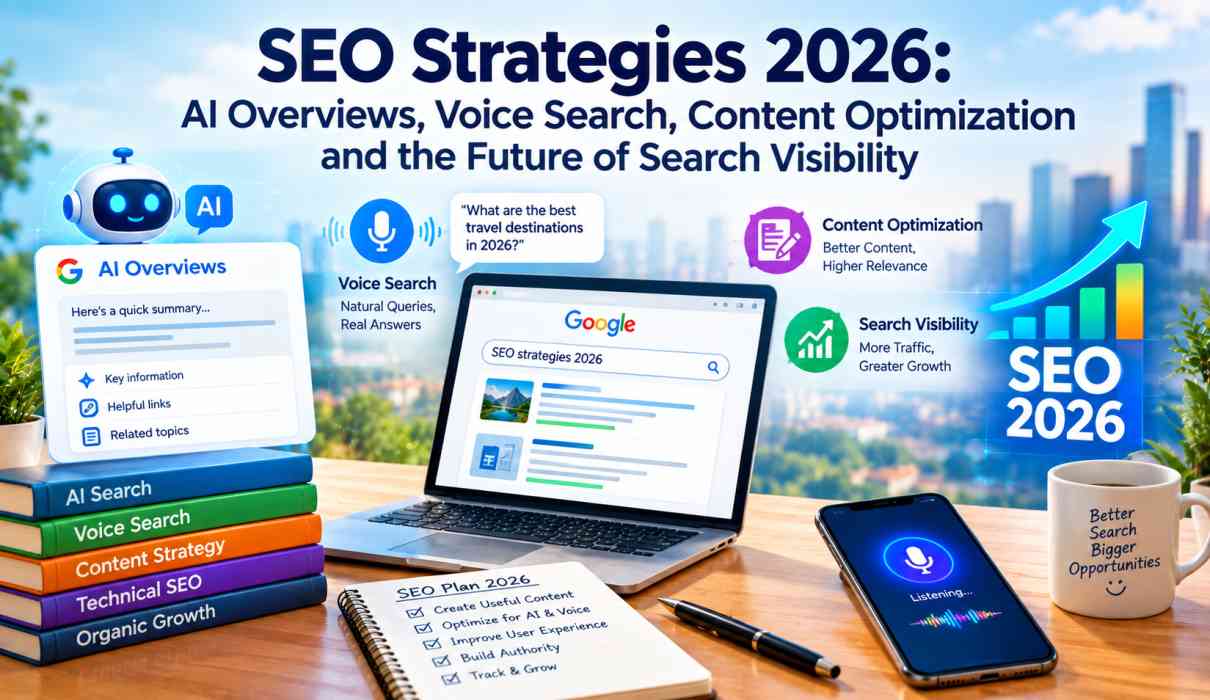
SEO Strategies 2026: AI Overviews, Voice Search, Content Optimization and the Future of Search Visibility
Search engine optimization is changing rapidly in 2026. Search is no longer limited to a traditional list of blue links. Artificial intelligence, conversational queries, AI Overviews, AI Mode, voice interactions, visual search, personalized results and changing user behavior are transforming how people discover information online.
For businesses, bloggers, publishers and marketers, this means that SEO strategies in 2026 need to focus on more than keywords and rankings. Websites must provide useful information, demonstrate expertise, offer a strong user experience and make their content easy for both people and search systems to understand.
Google’s current guidance makes an important point: traditional SEO fundamentals remain relevant for AI-powered search experiences. Websites do not need a special “AI SEO” markup or a separate technical system to appear in AI Overviews or AI Mode. Instead, strong technical SEO, crawlable content, useful information and people-first content remain the foundation.
This article explores the most important SEO trends and strategies for 2026, including AI search, voice search, content optimization, technical SEO, structured data, user experience and the future of organic visibility.
1. AI Overviews Are Changing Search Visibility
One of the biggest developments in SEO is the growth of AI-generated search experiences.
Google’s AI Overviews can provide a summarized response to certain searches while also displaying links to supporting websites. AI Mode is designed for more complex searches and can help users explore questions involving multiple topics, comparisons and follow-up research.
This changes the way businesses think about search visibility.
Previously, SEO often focused heavily on ranking a page for a specific keyword. In an AI-powered search environment, a page may also become a source that supports an AI-generated response.
Google explains that AI search features use information from its Search index and can use techniques such as retrieval-augmented generation and query fan-out to find relevant supporting information.
For website owners, the practical lesson is simple: create content that genuinely answers questions and provides information worth referencing.
2. Traditional SEO Still Matters in AI Search
There is a common misconception that AI search has completely replaced traditional SEO.
It has not.
Google’s 2026 guidance states that the foundational SEO practices used for traditional Search remain relevant for generative AI features. Pages need to be crawlable, indexable and eligible to appear in normal Google Search before they can be considered as supporting links in AI features.
This means businesses should continue focusing on:
- Crawlability
- Indexing
- Internal linking
- Page experience
- Mobile usability
- Relevant content
- Clear page structure
- Descriptive titles
- Useful headings
- Quality external references
- Structured data where appropriate
AI search adds another layer of discovery, but it does not remove the technical foundation of SEO.
3. Content Quality Is More Important Than Keyword Quantity
Keyword stuffing is increasingly outdated.
In 2026, successful SEO content should focus on satisfying the user’s search intent rather than repeating the same phrase multiple times.
For example, an article targeting the keyword “SEO strategies 2026” should not simply repeat that phrase in every paragraph. Instead, it should answer related questions about AI search, content optimization, technical SEO, voice search, user experience and search visibility.
Google’s latest AI optimization guidance emphasizes valuable, unique and non-commodity content. It also warns against producing large amounts of content primarily to manipulate rankings or AI search visibility.
A stronger content strategy is therefore:
Search intent → useful information → original value → clear structure → trustworthy experience.
4. AI-Assisted Content Needs Human Value
Artificial intelligence is becoming a common tool for content creation, research, editing and brainstorming.
However, simply generating large quantities of AI-written articles is not a sustainable SEO strategy.
AI can help with:
- Topic research
- Content outlines
- Brainstorming
- Editing
- Summarizing research
- Identifying questions
- Improving readability
- Creating content variations
But human input can add original experience, examples, opinions, analysis and expertise.
Google’s guidance specifically encourages content that provides unique value rather than simply recycling information already available online.
A useful approach is to treat AI as a productivity tool, while keeping human judgment responsible for accuracy, originality and usefulness.
5. Voice Search Continues to Influence Content Strategy
Voice search remains an important consideration in modern SEO because people often phrase spoken searches differently from typed queries.
Instead of typing:
“best restaurants Kolkata”
a user might ask:
“What are some good restaurants near me?”
Conversational searches tend to use natural language and complete questions.
Businesses can prepare for these patterns by creating content that answers common questions clearly.
Useful formats include:
- Frequently asked questions
- Step-by-step guides
- Local information
- Definition-based content
- Comparison articles
- Short direct answers
- Conversational headings
However, voice search should not be treated as a completely separate SEO system. The broader strategy is to make content easy for users and search systems to understand.
6. Search Intent Should Guide Every Article
Understanding search intent is one of the most important SEO strategies for 2026.
Search intent describes what a person actually wants when they enter a query.
Common categories include:
Informational intent
The user wants to learn something.
Examples:
- What is technical SEO?
- How does AI search work?
- What are SEO trends in 2026?
Commercial investigation
The user is researching before making a decision.
Examples:
- Best SEO tools
- SEO agency comparison
- WordPress SEO services
Transactional intent
The user is ready to take an action.
Examples:
- Buy SEO software
- Hire an SEO consultant
- Subscribe to an SEO platform
Navigational intent
The user wants to reach a specific website or page.
Understanding intent helps marketers create the right type of content instead of producing generic articles around keywords.
7. Topical Authority Is Becoming More Valuable
Rather than publishing hundreds of unrelated articles, websites can benefit from developing strong coverage around relevant topics.
For example, a website focused on digital marketing could build a content cluster covering:
- SEO basics
- Technical SEO
- Keyword research
- AI search
- Content marketing
- Local SEO
- Link building
- Search Console
- SEO analytics
- Ecommerce SEO
These articles can be connected through internal links.
This approach helps users navigate related information while giving search engines clearer context about the site’s subject areas.
The goal should not be publishing as many pages as possible. The goal should be creating a useful library of related content.
8. Internal Linking Remains a Powerful SEO Strategy
Internal links connect pages within the same website.
A good internal linking structure can help users discover related information and help search engines understand relationships between pages.
For example, an article about AI SEO could link naturally to pages about:
- Keyword research
- Content optimization
- Technical SEO
- Search Console
- Local SEO
- SEO analytics
Google’s SEO documentation continues to emphasize links as an important way for pages to be discovered and for users and search engines to understand relationships between resources.
Internal links should be natural and useful rather than inserted simply to increase the number of links on a page.
9. Structured Data Helps Search Engines Understand Content
Structured data provides explicit information about the content of a webpage.
It can help search engines understand entities and page types and, where supported, make pages eligible for certain enhanced search features.
Depending on the website, structured data may be relevant for content such as:
- Products
- Articles
- Events
- Organizations
- Local businesses
- Recipes
- Breadcrumbs
- Videos
Structured data should accurately represent visible page content.
It should not be treated as a shortcut to rankings. Google’s current AI search documentation also makes clear that there is no special schema markup required specifically for AI Overviews or AI Mode.
10. User Experience Is an SEO Priority
A website can have excellent content and still provide a poor experience if pages are slow, difficult to navigate or overloaded with intrusive elements.
SEO strategies in 2026 should therefore consider:
- Mobile usability
- Page loading performance
- Readable typography
- Clear navigation
- Logical page structure
- Accessible content
- Easy-to-use menus
- Limited intrusive elements
The objective is simple: visitors should be able to find and understand the information they need without unnecessary friction.
Google’s AI search guidance specifically recommends providing a good page experience for visitors arriving from Search.
11. Visual and Multimedia SEO Are Growing
Modern search is increasingly multimodal.
People can discover information through text, images, video and other formats. Google has also highlighted the importance of supporting textual information with high-quality images and videos where appropriate.
For content creators, this means an article does not have to be text-only.
Useful additions can include:
- Original photographs
- Infographics
- Charts
- Short videos
- Demonstration images
- Diagrams
- Screenshots
- Downloadable resources
Visual content should support the main topic rather than simply decorate the page.
12. Local SEO Remains Important
For businesses serving specific geographic areas, local SEO continues to be an important source of visibility.
Local SEO strategies include maintaining accurate business information, creating useful location-specific content and keeping business profiles updated.
For example, a local service company can create useful content around:
- Services offered
- Areas served
- Local customer questions
- Pricing factors
- Service guides
- Local regulations
- Frequently requested services
Google’s AI search guidance also recommends keeping Business Profile information up to date where relevant.
13. Search Console Is Becoming More Important
SEO decisions should increasingly be based on actual performance data rather than assumptions.
In 2026, Google introduced dedicated Search Console reporting for visibility in generative AI features. The reports provide information about impressions, pages, countries, devices and dates associated with visibility in generative AI experiences. Google announced that these insights had rolled out worldwide by August 31, 2026.
This gives website owners another way to understand how their content appears in modern search.
SEO monitoring should therefore include:
- Search impressions
- Clicks
- Queries
- Average position
- Pages receiving traffic
- Countries
- Devices
- AI feature visibility
- Conversions
- Engagement
Traffic alone is not always the most useful measurement. Businesses should also consider whether search visitors become customers, subscribers, leads or returning readers.
14. Social and Video Content Are Becoming Part of Search Visibility
Search visibility is no longer limited to traditional website pages.
Google introduced platform properties in Search Console in 2026, allowing creators to analyze how content from platforms such as Instagram, TikTok, X and YouTube performs across Google Search, Discover and Google News.
This reflects a broader change in how people discover information.
A strong digital visibility strategy can therefore combine:
- Website content
- Blog articles
- YouTube videos
- Short-form video
- Social media posts
- Images
- News content
- Business profiles
The website can remain the central information hub while other platforms create additional discovery opportunities.
15. What SEO Strategies Should Businesses Follow in 2026?
A practical SEO strategy for 2026 can be built around several priorities:
1. Create original content: Provide information, experience or analysis that adds value beyond existing pages.
2. Understand search intent: Build content around what users actually want to accomplish.
3. Strengthen technical SEO: Make sure important pages can be crawled, indexed and accessed.
4. Build topical authority: Develop useful clusters of closely related content.
5. Optimize for AI search naturally: Follow strong SEO fundamentals instead of chasing artificial AI-search hacks.
6. Improve internal linking: Connect related pages logically.
7. Use structured data appropriately: Help search engines understand eligible content types.
8. Optimize for conversational queries: Answer natural-language questions clearly.
9. Add useful multimedia: Use original images, videos and visual explanations when they improve the page.
10. Measure results: Use Search Console and analytics to understand visibility, engagement and conversions.
The Future of Search Visibility
SEO is moving toward a more complex search ecosystem in which users can discover information through traditional results, AI-generated answers, voice interfaces, images, videos, social platforms and other digital experiences.
This does not mean that websites are becoming irrelevant. In fact, Google’s current guidance continues to emphasize the importance of useful, unique, crawlable content and strong SEO fundamentals for AI-powered Search.
The biggest change is that search visibility now has more dimensions.
A page can be valuable because it ranks organically, appears as a supporting source in an AI experience, attracts visitors through Discover, appears in image or video results, or generates traffic through social and other platforms.
Successful SEO therefore requires a broader approach.
Conclusion
SEO Strategies 2026 are increasingly focused on quality, relevance, technical accessibility and adaptability. AI Overviews and AI Mode are changing how users interact with search, while voice queries and conversational searches continue to influence the way people phrase questions.
At the same time, the fundamentals remain remarkably important. Websites need useful content, strong technical foundations, clear organization, relevant internal links, good page experiences and trustworthy information.
The future of SEO is not about finding one secret optimization technique. It is about building a website that genuinely helps people and can be understood across an increasingly intelligent search ecosystem.
Businesses and content creators that focus on original content, search intent, user experience, topical authority, AI-aware optimization and measurable performance can build a stronger foundation for search visibility throughout 2026 and beyond.