

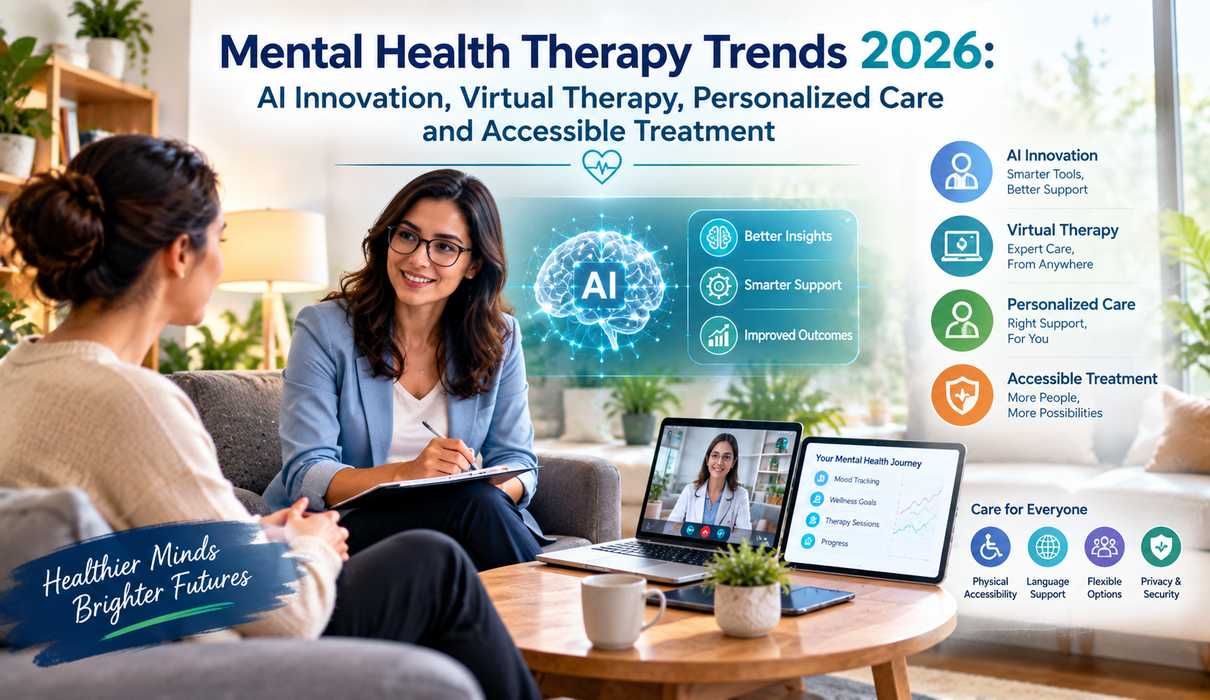
Mental Health Therapy Trends 2026: AI Innovation, Virtual Therapy, Personalized Care and Accessible Treatment
Mental health therapy is changing rapidly in 2026 as technology, research, changing patient expectations, and new models of healthcare reshape how people access psychological support. Traditional face-to-face therapy remains important, but it now exists alongside virtual counseling, digital mental-health platforms, AI-assisted tools, personalized treatment approaches, mobile applications, and flexible care models.
The need for accessible mental-health support remains substantial. The World Health Organization reported in September 2026 that more than one billion people globally live with a mental health condition and emphasized the availability of effective approaches to promote, protect, and restore mental health. At the same time, access to effective care remains limited for many people.
Against this background, the future of therapy is increasingly focused on making support more accessible, personalized, flexible, evidence-informed, and responsive to individual needs.
1. AI Is Becoming an Important Therapy Trend
Artificial intelligence is one of the most significant developments influencing mental-health care in 2026. AI can assist professionals with administrative work, information organization, documentation, research, treatment-support tools, and certain structured therapeutic exercises.
According to the American Psychological Association’s 2025 Practitioner Pulse Survey, 56% of surveyed psychologists had used AI tools in their practices during the previous year, while 29% reported using AI at least monthly. Common uses included writing, content generation, summarization, and note-taking.
AI is also becoming part of conversations between therapists and patients. APA reported in June 2026 that 77% of psychologists said their patients had reported using AI, while more than one-third said patients were using AI as an additional mental-health provider.
However, AI-assisted therapy needs appropriate boundaries. General-purpose chatbots are not equivalent to licensed therapists, and professional organizations have raised concerns about accuracy, privacy, crisis handling, and inappropriate responses. AI is therefore increasingly being considered as a supporting technology rather than a replacement for professional care.
2. Virtual Therapy Continues to Expand
Virtual therapy has become an established part of modern mental-health care. Video sessions, secure messaging, telephone counseling, and other remote services can allow people to connect with professionals without travelling to a physical clinic.
This model can be particularly useful for people who live far from specialist providers, have mobility limitations, have demanding schedules, or prefer receiving therapy from a familiar environment.
Virtual therapy can also make it easier for patients to maintain continuity when travelling or relocating, depending on applicable professional and legal requirements.
The development of virtual care does not mean that every therapy session should be online. Some patients may benefit more from face-to-face interaction, while others may prefer remote sessions. The broader trend is toward giving people more appropriate options rather than relying on a single delivery model.
3. Personalized Mental Health Treatment
Personalized care is another major therapy trend in 2026. Instead of assuming that one treatment approach works equally well for everyone, researchers and clinicians are increasingly interested in matching interventions to individual characteristics.
Personalized mental-health care can consider factors such as symptoms, treatment history, lifestyle, environmental circumstances, preferences, and response to previous interventions.
Research into precision mental health is also exploring how information such as brain imaging, genetics, health history, and lifestyle factors could eventually contribute to more individualized treatment decisions.
In practice, personalization does not necessarily require advanced technology. It can also mean adjusting therapy goals, communication styles, session frequency, homework, therapeutic approaches, and support strategies according to the individual.
4. Digital Mental Health Tools Are Becoming More Diverse
Smartphones and connected devices are creating additional ways for people to engage with mental-health resources.
Digital tools may provide mood tracking, journaling, reminders, psychoeducation, structured exercises, relaxation activities, sleep-support features, or appointment management. Some platforms can also help patients monitor patterns between professional sessions.
These tools can be useful when they have clearly defined purposes and are appropriately integrated into care.
Research published in 2026 suggests that the evidence for AI and digital mental-health interventions varies considerably by use case. Some structured chatbot interventions have shown modest improvements in certain symptoms and engagement, but current evidence does not establish autonomous psychotherapy as a replacement for conventional professional treatment.
This distinction is important for consumers. A mental-health app should not automatically be considered equivalent to evidence-based therapy simply because it uses sophisticated technology.
5. Therapy Is Becoming More Accessible
Accessibility is one of the most important priorities for mental-health services in 2026.
Traditional therapy can be difficult to access because of cost, geographical location, provider shortages, waiting lists, transportation, work schedules, stigma, or lack of appropriate specialists.
Digital and flexible treatment models may help reduce some of these barriers.
Single-session interventions are another example. APA describes these as structured programs intentionally designed around one clinical encounter. They can be relevant because some people seek only limited support or face barriers that make long-term therapy difficult.
Accessibility can also involve language, disability accommodations, culturally responsive services, flexible scheduling, and different communication formats.
The future of mental-health treatment is therefore not simply about making therapy digital. It is about creating more pathways into appropriate care.
6. AI-Assisted Therapy Homework and Between-Session Support
Another emerging area is the use of AI between therapy sessions.
A therapist might, where appropriate and with suitable safeguards, help a client use technology for structured activities such as organizing thoughts, tracking emotions, practicing a previously taught exercise, or preparing topics to discuss during the next session.
This approach can potentially make therapy more continuous rather than limiting therapeutic work to the scheduled appointment.
However, the distinction between structured support and autonomous therapy remains important. APA guidance in 2026 emphasizes that clinicians should discuss patients’ AI use and help them distinguish potentially useful applications from situations where AI-generated advice may be unsafe or unreliable.
The strongest model is therefore likely to involve technology working within a treatment plan developed with a qualified professional.
7. Mental Health Monitoring and Digital Tracking
Digital monitoring is another area receiving increasing attention.
Mobile devices and wearable technologies can potentially collect information about sleep, activity, routines, or other behavioral patterns. In research settings, these signals may help identify changes that could be relevant to mental health.
This field is sometimes associated with passive sensing or digital phenotyping.
However, collecting information does not automatically mean that it can accurately predict a person’s mental state. Researchers continue to examine whether digital signals can be translated into reliable clinical interventions.
Privacy is also a major concern. People should understand what information is collected, where it is stored, who can access it, and how it may be used.
8. Human Therapists Remain Central
Despite rapid technological development, human relationships remain at the heart of psychotherapy.
Therapy often involves empathy, trust, communication, contextual understanding, professional judgment, ethical responsibility, and the ability to respond to complex individual circumstances.
AI can process information quickly, but it does not remove the need for human clinical responsibility.
APA’s 2026 guidance stresses that AI should not be considered a safe or effective substitute for qualified mental-health providers. The organization has also highlighted concerns about AI-generated advice and possible psychological harms for vulnerable users.
This is why the likely direction of therapy is not simply “AI versus therapists.” Instead, technology is increasingly being explored as a tool that can support clinicians while keeping humans responsible for important clinical decisions.
9. Better Therapist Training With AI
AI may also influence the education and professional development of therapists.
Training programs are exploring how AI tools can provide simulated scenarios, feedback opportunities, structured learning exercises, and additional educational resources.
APA reported in September 2026 that psychologists are exploring AI to help address limitations in clinical training and supervision, particularly where trainees have limited opportunities to receive intensive feedback.
Used appropriately, such tools could help professionals practice communication and clinical reasoning in controlled educational environments.
However, AI-generated feedback still needs qualified human review. Training systems must avoid reinforcing inaccurate information, bias, or inappropriate clinical practices.
10. Privacy and Cybersecurity Are Becoming Essential
As therapy becomes increasingly digital, privacy is becoming a central issue.
Mental-health information can be highly sensitive. Digital platforms therefore need appropriate security practices, transparent privacy policies, responsible data management, and clear explanations of how information is handled.
AI creates additional questions because users may enter highly personal information into conversational systems without fully understanding how that information is processed.
APA’s 2026 practitioner research found that 67% of psychologists remained concerned about potential data breaches related to AI.
Future mental-health platforms will need to balance convenience and personalization with strong privacy and security protections.
11. Responsible AI and Mental Health Safety
Responsible AI is becoming one of the defining themes of mental-health technology.
The World Health Organization emphasized in March 2026 that AI interacting with people during emotionally vulnerable moments needs strong attention to safety, accountability, ethics, and human well-being.
Safety concerns include incorrect information, excessive reassurance, inappropriate responses to crises, privacy problems, biased outputs, and the possibility that vulnerable users may interpret an AI system as a qualified professional.
APA has also reported emerging concerns about cases where chatbot interactions may reinforce or amplify problematic beliefs in vulnerable individuals.
These issues make clinical oversight, responsible design, clear boundaries, and appropriate referral or escalation mechanisms increasingly important.
12. Integrated Mental Health Care
Another important trend is the integration of mental-health services with broader healthcare.
Mental health does not exist separately from physical health, sleep, chronic disease, social circumstances, work, relationships, and lifestyle.
Integrated care can bring psychologists, physicians, psychiatrists, social workers, and other professionals into coordinated treatment models when appropriate.
Technology can support this integration by improving communication, scheduling, documentation, measurement, and access to information.
The goal is not simply to add more technology but to create more connected systems in which patients can receive appropriate support across different parts of healthcare.
13. Focus on Prevention and Early Support
Therapy trends are also increasingly moving beyond crisis response toward prevention and early intervention.
Digital education, mental-health awareness, workplace programs, school-based support, self-management resources, and early screening can help people recognize concerns and seek professional assistance sooner.
Early support does not replace clinical treatment when treatment is needed. Instead, it can create additional opportunities for people to access appropriate resources before difficulties become more severe.
This approach is particularly relevant as mental-health services attempt to manage demand while expanding access.
14. What the Future of Mental Health Therapy May Look Like
The future of therapy is likely to combine human expertise with carefully selected technology.
A patient may have a traditional video or in-person appointment with a therapist, use a secure digital platform between sessions, complete structured exercises, track selected information, and receive personalized educational resources.
Meanwhile, therapists may use AI to reduce administrative work, organize information, support research, prepare educational materials, and improve certain parts of clinical workflows.
The key principle will be appropriate use. Technology should solve genuine problems without creating unnecessary privacy, safety, or clinical risks.
The World Health Organization’s broader digital-health work emphasizes people-centered and ethically grounded digital transformation, reinforcing the idea that innovation should ultimately serve better health outcomes rather than technology adoption for its own sake.
Conclusion
Mental Health Therapy Trends 2026 show an industry moving toward greater personalization, digital accessibility, flexible treatment models, and carefully managed AI integration.
AI-assisted tools, virtual therapy, digital mental-health platforms, personalized treatment, single-session interventions, remote monitoring, and integrated care are creating new possibilities for patients and professionals.
At the same time, technology introduces important responsibilities. Privacy, evidence, cybersecurity, clinical oversight, transparency, accessibility, and patient safety must remain central to the development of modern therapy.
The most meaningful future for mental-health care is therefore unlikely to be technology replacing therapists. Instead, it is a model where qualified professionals use appropriate digital tools to make care more accessible, personalized, efficient, and responsive while maintaining human judgment and therapeutic relationships.
As mental-health technology continues to develop throughout 2026 and beyond, the combination of AI innovation, virtual therapy, personalized care, and responsible human oversight is likely to remain one of the most important areas shaping the future of mental-health support.
SEO Keywords: mental health therapy trends 2026, therapy trends 2026, AI therapy, virtual therapy, digital mental health, personalized mental health care, online therapy, AI mental health tools, mental health technology, accessible mental health treatment, future of therapy, digital counseling.