

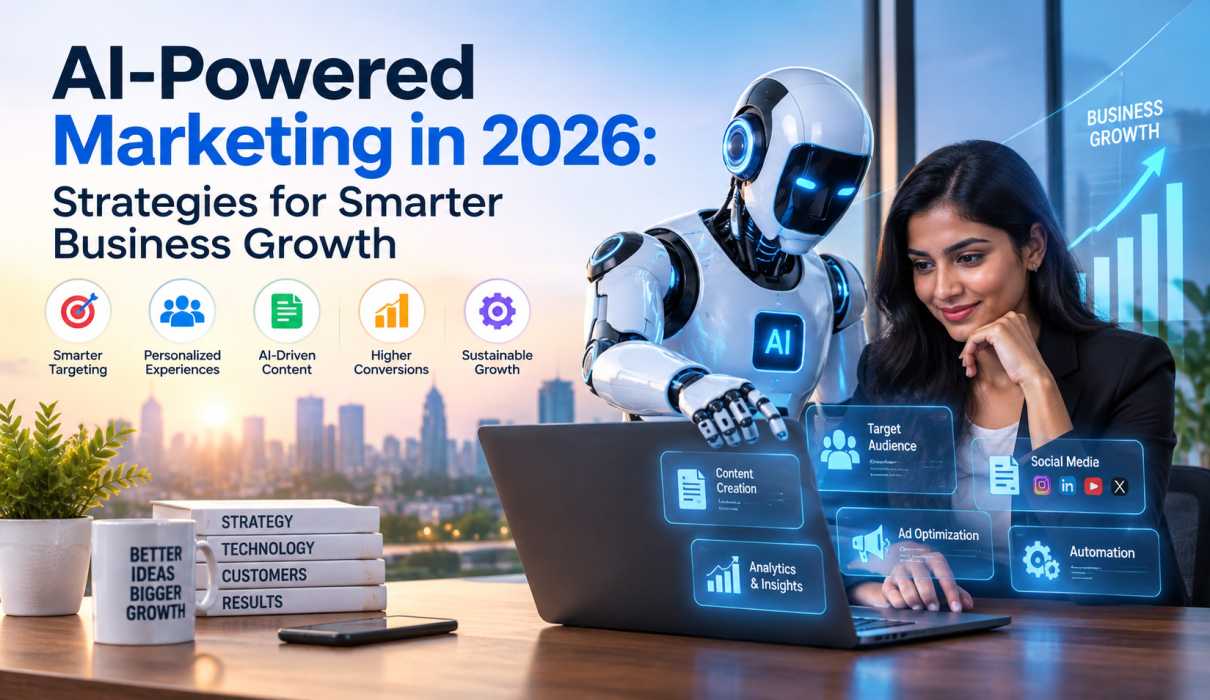
AI-Powered Marketing in 2026: Strategies for Smarter Business Growth
Artificial intelligence has moved from being an emerging technology to becoming an important part of modern marketing. In 2026, businesses are using AI to understand customers, create content, personalize experiences, optimize advertising, automate repetitive tasks, and make faster strategic decisions.
The biggest change is not simply that marketers have access to better technology. AI is changing how businesses understand and communicate with their audiences. Instead of relying only on broad customer segments and traditional campaigns, companies can increasingly use data and AI to deliver more relevant messages at the right time and through the right channel.
According to HubSpot’s 2026 State of Marketing research, AI-powered personalization is one of the leading marketing trends, while marketers are also adapting their SEO strategies for AI-powered search.
For businesses looking to compete in a crowded digital marketplace, understanding AI-powered marketing strategies in 2026 can provide a significant advantage.
What Is AI-Powered Marketing?
AI-powered marketing refers to the use of artificial intelligence, machine learning, predictive analytics, automation, generative AI, and intelligent customer-data systems to improve marketing activities.
Traditional marketing often depends on manual research, fixed customer segments, scheduled campaigns, and historical performance data. AI-powered marketing can analyze large amounts of information much faster and identify patterns that may be difficult for humans to recognize.
Businesses can use AI for:
- Customer and audience analysis
- Content creation
- Marketing automation
- Personalized recommendations
- Email marketing
- Advertising optimization
- Predictive analytics
- Customer service
- Social media management
- Search optimization
- Lead scoring
- Sales forecasting
- Campaign performance analysis
The goal is not to remove human marketers from the process. Instead, AI can handle repetitive and data-heavy activities while marketers focus on creativity, positioning, strategy, storytelling, and customer relationships.
Why AI Marketing Matters in 2026
The marketing environment has become increasingly competitive. Consumers encounter advertisements, videos, social posts, emails, product recommendations, and search results across numerous platforms every day.
As a result, generic marketing messages are becoming less effective.
Customers increasingly expect brands to understand their needs and provide relevant information quickly. Salesforce’s 2026 research found that marketers are seeing growing demand for personalized, two-way conversations, while disconnected customer data remains a major obstacle to delivering those experiences.
AI can help businesses respond to this changing environment.
For example, an online retailer can use AI to analyze browsing and purchasing behavior and recommend relevant products. A service company can use AI to identify high-intent leads. A content team can use AI to develop multiple content variations for different audience groups.
This makes marketing more responsive, measurable, and scalable.
1. Use AI for Smarter Customer Personalization
Personalization is one of the most important applications of AI marketing in 2026.
Customers do not necessarily want more marketing messages. They want more relevant marketing messages.
AI can analyze customer behavior, purchase history, interests, engagement patterns, location data where appropriately available, and interactions with a brand to help create more relevant experiences.
For example, an e-commerce business could personalize:
- Product recommendations
- Email campaigns
- Website content
- Promotional offers
- Follow-up messages
- Shopping suggestions
- Customer-service interactions
The advantage is scale. Instead of manually creating a different campaign for every customer segment, AI can help marketers produce and deliver variations efficiently.
HubSpot’s 2026 research identifies AI-assisted personalized content as the top marketing trend among the marketers surveyed, while 93.2% reported that personalized or segmented experiences had generated more leads and purchases.
However, personalization should feel useful rather than intrusive. Businesses should use customer data responsibly and provide genuine value rather than simply inserting a customer’s name into an automated message.
2. Create Better Content With Generative AI
Generative AI has become a powerful assistant for content marketing.
Marketing teams can use AI to brainstorm topics, create outlines, develop first drafts, write advertising variations, summarize research, generate social-media ideas, and adapt content for different platforms.
It can also help businesses repurpose one piece of content into multiple formats.
For example, a detailed blog post could become:
- A LinkedIn article
- Several social-media posts
- A short video script
- An email newsletter
- An infographic outline
- Frequently asked questions
- Short-form video concepts
This can dramatically improve content efficiency.
However, simply publishing large amounts of AI-generated material is not a winning strategy. As AI-generated content becomes more common, original experience, expertise, brand voice, accuracy, and human creativity become increasingly important.
HubSpot’s 2026 research similarly emphasizes the importance of authentic human perspectives while businesses adopt AI for greater efficiency.
The smartest approach is therefore AI-assisted content, not AI-only content.
3. Optimize for AI Search and Answer Engines
Search behavior is changing rapidly.
People are increasingly using AI-powered search experiences and conversational tools to research products, compare services, answer questions, and discover businesses.
This creates a new opportunity for marketers: optimizing content so that it can be understood and referenced by AI-powered search systems.
This area is often associated with Answer Engine Optimization (AEO) and Generative Engine Optimization (GEO).
Traditional SEO remains important, but businesses should also consider whether their content provides clear, trustworthy answers that AI systems can understand.
Effective AI-search content should include:
- Clear answers to common questions
- Helpful headings
- Structured information
- Original insights
- Reliable facts
- Relevant examples
- Natural language
- Strong topical authority
- Clear explanations
According to HubSpot’s 2026 marketing research, updating SEO strategies for changing search experiences is one of the leading marketing priorities.
Businesses should therefore think beyond simply ranking a webpage. The broader goal is to become a trusted source of information across traditional search and AI-driven discovery.
4. Improve Advertising With AI
Digital advertising generates enormous amounts of performance data.
AI can analyze this information and help marketers identify which audiences, creatives, messages, placements, and campaigns are producing stronger results.
AI can support:
- Audience targeting
- Budget allocation
- Creative testing
- Campaign optimization
- Conversion prediction
- Ad copy variations
- Performance forecasting
- Customer segmentation
Instead of waiting until the end of a campaign to determine what worked, marketers can use automated systems to identify performance changes and adjust campaigns more quickly.
This is particularly useful for businesses managing campaigns across multiple platforms.
However, marketers should not completely surrender advertising decisions to automation. Human oversight is still necessary to protect brand positioning, evaluate creative quality, monitor customer sentiment, and prevent inappropriate targeting.
5. Build Conversational Marketing Experiences
One-way communication is gradually becoming less attractive to modern customers.
People increasingly expect brands to answer questions and provide useful information during the buying process.
AI-powered chatbots, virtual assistants, and conversational systems can help businesses provide immediate support.
For example, an online customer might ask:
“Which product is best for a small business?”
Instead of searching through several pages, an AI-powered assistant could ask relevant questions and provide suitable options.
Conversational marketing can support:
- Product discovery
- Lead qualification
- Customer support
- Appointment scheduling
- Frequently asked questions
- Order assistance
- Personalized recommendations
Salesforce’s 2026 India research found that 92% of marketers surveyed said customers increasingly expect two-way conversations with brands.
This highlights an important shift: marketing is becoming less about simply broadcasting messages and more about creating useful customer conversations.
6. Use AI for Predictive Marketing
One of the biggest advantages of AI is its ability to identify patterns in historical and real-time data.
Predictive marketing uses these patterns to estimate what customers may do next.
Businesses can use predictive analytics to identify:
- Customers likely to purchase
- Customers at risk of leaving
- High-value leads
- Products likely to become popular
- Optimal campaign timing
- Potential demand
- Customer lifetime value
For example, if an online store identifies customers who regularly purchase during a particular period, AI can help predict when they may be ready for another purchase.
This allows marketers to become more proactive instead of simply reacting to previous campaign results.
7. Automate Repetitive Marketing Tasks
Marketing teams spend considerable time performing repetitive activities.
AI-powered automation can reduce this workload.
Tasks that can potentially be automated include:
- Email scheduling
- Lead qualification
- Customer segmentation
- Reporting
- Social-media scheduling
- Data analysis
- Content repurposing
- Campaign alerts
- Customer follow-ups
HubSpot’s 2026 research reports extensive AI use across content creation, media creation, advertising optimization, administrative automation, brainstorming, and strategic planning.
Automation does not mean removing humans from marketing. It means allowing marketers to spend more time on activities where human judgment has greater value.
8. Make Customer Data the Foundation
AI marketing is only as effective as the data supporting it.
A business may have sophisticated AI tools, but if its customer data is inaccurate, outdated, duplicated, or scattered across disconnected systems, personalization will suffer.
This is one of the major challenges facing marketers in 2026.
Salesforce’s India research found that fragmented and irrelevant data remains a major barrier to AI-powered personalization.
Businesses should therefore focus on building a strong data foundation.
Important steps include:
- Keep customer information accurate.
- Reduce unnecessary data duplication.
- Connect relevant marketing and sales systems.
- Establish clear data-governance practices.
- Protect customer information.
- Use data only for appropriate and transparent purposes.
Good data allows AI to produce better insights. Poor data can simply help businesses make bad decisions faster.
9. Combine AI With Human Creativity
The future of marketing is unlikely to be purely artificial intelligence or purely human creativity.
The strongest strategy combines both.
AI is excellent at:
- Processing information
- Finding patterns
- Automating repetitive work
- Generating variations
- Analyzing performance
- Supporting personalization
Humans remain essential for:
- Brand storytelling
- Emotional understanding
- Creative direction
- Strategic judgment
- Ethical decisions
- Cultural context
- Original ideas
A successful marketing team in 2026 should therefore treat AI as a strategic assistant, rather than a complete replacement for human expertise.
10. Measure AI Marketing by Business Results
Using AI does not automatically mean marketing is successful.
Businesses should measure whether AI-powered initiatives actually improve performance.
Important metrics may include:
- Website conversions
- Qualified leads
- Customer acquisition cost
- Return on advertising spend
- Customer lifetime value
- Email engagement
- Sales revenue
- Customer retention
- Conversion rate
- Marketing-generated pipeline
The focus should move from “How much AI are we using?” to “What business result is AI helping us achieve?”
This distinction is important because adding more tools can increase complexity without necessarily improving performance.
Common Challenges of AI-Powered Marketing
Although AI provides major opportunities, businesses should also understand its limitations.
Data privacy
Companies must handle customer information responsibly and comply with relevant privacy requirements.
Inaccurate content
AI can produce incorrect or misleading information. Human review remains essential for important content.
Brand consistency
Automated content may sound generic if it is not guided by strong brand standards.
Over-automation
Too much automation can make customer interactions feel impersonal.
Skill gaps
Marketing teams need to learn how to use AI tools effectively and evaluate their outputs.
Fragmented systems
Disconnected data and marketing platforms can limit the effectiveness of AI.
These challenges do not mean businesses should avoid AI. They mean AI adoption should be strategic, controlled, and customer-focused.
A Practical AI Marketing Strategy for 2026
Businesses do not need to transform everything at once.
A practical approach can begin with five steps.
Step 1: Identify repetitive tasks.
Find marketing activities that consume significant time but require limited creative judgment.
Step 2: Choose high-value AI applications.
Start with areas such as content assistance, customer segmentation, analytics, advertising optimization, or customer support.
Step 3: Improve your data foundation.
Make sure the information used by AI is accurate, relevant, secure, and accessible.
Step 4: Keep humans involved.
Use marketers to review important content, customer interactions, strategic recommendations, and brand communications.
Step 5: Measure results.
Compare performance before and after implementing AI and focus on measurable business outcomes.
This approach reduces unnecessary complexity while allowing businesses to learn and improve gradually.
The Future of AI-Powered Marketing
AI-powered marketing is moving toward a more connected and intelligent model.
In the coming years, businesses are likely to use AI not just to create individual pieces of content but to coordinate broader customer journeys.
AI agents may increasingly assist with campaign planning, audience analysis, personalization, customer conversations, optimization, and reporting.
At the same time, AI-powered search will continue changing how consumers discover brands and information.
This means marketers will need to think beyond traditional channels. Strong digital visibility will increasingly depend on a combination of search optimization, brand authority, useful content, customer experience, social presence, and trustworthy information.
The competitive advantage will not necessarily belong to businesses with the largest number of AI tools. It will belong to businesses that know where AI can create genuine customer and business value.
Conclusion
AI-Powered Marketing in 2026 is about much more than automation. It represents a fundamental shift toward smarter, more personalized, data-driven, and conversational marketing.
Businesses can use AI to create better content, personalize customer experiences, optimize advertising, analyze behavior, automate repetitive tasks, improve search visibility, and predict future opportunities.
However, technology alone is not enough. Businesses need accurate data, clear goals, strong brand values, responsible AI practices, and human creativity.
The most effective marketing strategy for 2026 is therefore not AI versus humans. It is AI plus human intelligence.
Businesses that combine artificial intelligence with authentic storytelling, useful content, customer understanding, and strategic thinking can build stronger relationships and achieve more sustainable growth.
As AI continues to reshape the marketing landscape, the key question for businesses is no longer whether they should use AI. The more important question is how they can use AI intelligently to serve customers better and grow smarter.