

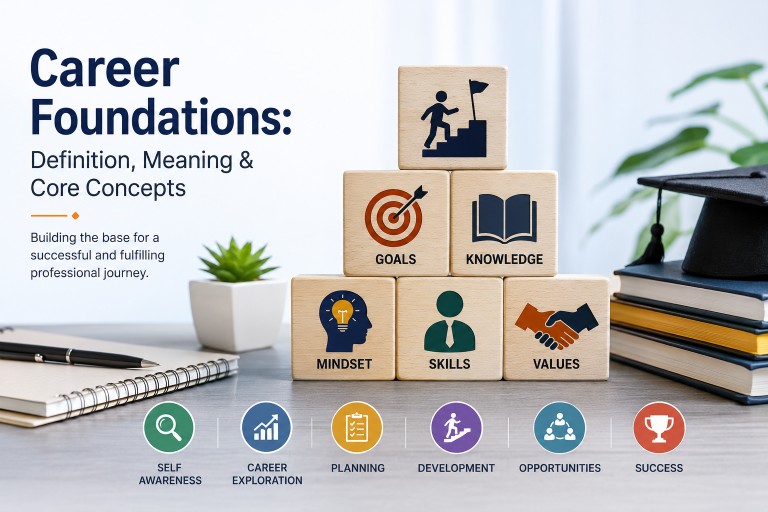
Career Foundations: Definition, Meaning & Core Concepts
A career is more than simply having a job. It is a long-term journey shaped by education, skills, interests, experiences, values, goals, and professional choices. Understanding the definition of career and its core concepts can help students, graduates, working professionals, and career changers make more informed decisions about their professional future.
In today’s competitive job market, people have more career options than ever before. Traditional employment, entrepreneurship, freelancing, remote work, specialized professions, and emerging digital careers have created multiple pathways to professional success. However, having many options can also make career planning challenging.
This is why understanding the foundations of a career is important. Career foundations provide a framework for identifying what you want to achieve, understanding your strengths, developing relevant skills, and choosing opportunities that align with your long-term goals.
What Is a Career?
A career can be defined as the long-term progression of a person’s professional and work-related experiences. It includes the different jobs, roles, responsibilities, education, training, achievements, and professional development activities that a person experiences throughout their working life.
A career does not necessarily follow a straight path. Someone may begin in an entry-level position, move into management, change industries, start a business, return to education, or develop an entirely new specialization. Each experience can contribute to the person’s overall career journey.
For example, a person interested in technology might begin as a junior software developer, become a senior developer, move into project management, specialize in artificial intelligence, and eventually become a technology consultant. These different roles form part of one broader career.
Therefore, a career is a journey rather than a single position or job title.
Career vs. Job: Understanding the Difference
The terms “career” and “job” are often used interchangeably, but they have different meanings.
A job is a specific position or employment opportunity that provides income and responsibilities. A career represents the broader professional direction a person follows over time.
For example, working as a marketing assistant is a job. Building a professional path in marketing that includes experience in digital marketing, brand management, content strategy, and marketing leadership represents a career.
The key differences include:
- Job: Usually refers to a specific employment position.
- Career: Refers to long-term professional development and progression.
- Job: May be temporary or short-term.
- Career: Often develops over many years.
- Job: Focuses primarily on current responsibilities and income.
- Career: Includes skills, experience, education, goals, achievements, and future opportunities.
A job can therefore be considered one part of a much larger career journey.
Why Are Career Foundations Important?
Strong career foundations help individuals make better professional decisions. Without a clear understanding of their interests, abilities, goals, and opportunities, people may choose careers based mainly on external pressure or short-term benefits.
Career foundations help create clarity in several areas.
1. Self-Awareness
Understanding yourself is one of the first steps in career development. Self-awareness involves identifying your interests, strengths, weaknesses, personality traits, values, and preferences.
For example, someone who enjoys solving complex problems may find technical or analytical careers appealing, while someone who enjoys communication and relationship-building may prefer careers in sales, public relations, teaching, or human resources.
2. Career Direction
Career foundations provide direction. Instead of applying randomly for different jobs, individuals can identify professional areas that match their abilities and long-term objectives.
Having direction does not mean planning every detail of your working life. It means having a general understanding of where you want to go and what you need to do to move forward.
3. Skill Development
Modern careers require continuous learning. Technology, business practices, and industry expectations change constantly.
A strong career foundation encourages people to identify the skills required for their desired roles and develop them through education, training, projects, certifications, mentoring, and practical experience.
4. Better Decision-Making
Career decisions often involve education, location, compensation, work environment, specialization, and advancement opportunities.
Understanding your career priorities makes it easier to evaluate these choices and select opportunities that support your long-term goals.
Core Concepts of Career Development
Career development is a continuous process rather than a one-time decision. Several core concepts form the foundation of effective career planning.
1. Interests
Career interests describe the activities, subjects, and professional areas that naturally attract your attention.
Someone who enjoys working with numbers might explore accounting, finance, data analysis, economics, or financial planning. A person who enjoys creative work might consider design, writing, advertising, media, or content creation.
Interests can provide useful clues when exploring potential career options.
However, interest alone is not enough. A successful career usually requires a combination of interest, ability, opportunity, and commitment.
2. Skills
Skills are the abilities people develop through learning and experience. They are essential components of career success.
Skills can generally be divided into two broad categories:
Technical skills are specific abilities required for particular roles. Examples include programming, accounting, graphic design, data analysis, engineering, machine operation, or medical procedures.
Soft skills are transferable abilities that support professional effectiveness. Examples include communication, teamwork, leadership, problem-solving, adaptability, organization, and time management.
Developing both technical and soft skills can make professionals more competitive in the employment market.
3. Values
Career values are the principles and priorities that influence what a person expects from work.
Some people prioritize financial security, while others value flexibility, creativity, social impact, professional recognition, independence, work-life balance, or opportunities for advancement.
Understanding career values can help individuals choose workplaces and roles that provide greater professional satisfaction.
For example, someone who highly values flexibility may prefer remote or hybrid work, freelancing, or a role with flexible scheduling. Someone who values leadership may actively seek positions offering management responsibilities.
4. Personality
Personality can influence how individuals interact with people, solve problems, respond to challenges, and perform in different work environments.
Some people prefer highly structured environments, while others thrive in flexible and unpredictable settings. Some enjoy working independently, whereas others perform best as part of collaborative teams.
Personality should not be treated as a strict limitation. People can adapt and develop throughout their careers. Nevertheless, understanding personal preferences can help when exploring career environments.
5. Education and Qualifications
Education provides knowledge and can create access to specific professional opportunities. Depending on the career, qualifications may include school education, university degrees, diplomas, professional certifications, vocational training, apprenticeships, or specialized courses.
Not every career requires the same educational pathway. Some professions require advanced degrees or licenses, while others place greater emphasis on practical experience, portfolios, technical skills, or industry certifications.
The best educational choice is therefore one that supports the requirements of the desired career pathway.
6. Experience
Experience is one of the most valuable components of career development. It allows individuals to apply theoretical knowledge in real-world situations.
Experience can come from many sources, including:
- Full-time and part-time employment
- Internships
- Apprenticeships
- Freelance projects
- Volunteer work
- Academic projects
- Entrepreneurship
- Temporary assignments
- Industry training
Early career experience can help individuals understand what they enjoy, develop professional confidence, and build evidence of their capabilities.
7. Career Goals
Career goals define what a person wants to accomplish professionally. They provide direction and help turn general ambitions into actionable plans.
Career goals can be short-term or long-term.
A short-term goal might be completing a certification, improving a specific skill, securing an internship, or obtaining an entry-level position.
A long-term goal might involve becoming a department leader, establishing a business, becoming a specialist, reaching a particular professional level, or transitioning into a new industry.
Effective career goals should be realistic, measurable, and flexible enough to adapt to changing circumstances.
Career Planning: Turning Foundations Into Action
Understanding career concepts is useful, but career planning turns that knowledge into practical action.
A basic career planning process can include several stages.
Assess Yourself
Begin by evaluating your interests, skills, values, personality, education, experience, and strengths.
Ask yourself:
- What activities do I enjoy?
- What skills do I already have?
- What am I good at learning?
- What type of work environment suits me?
- What matters most to me in a career?
- What professional problems would I enjoy solving?
These questions can help establish a personal career profile.
Explore Career Options
Once you understand yourself better, research careers that align with your profile.
Consider job responsibilities, required qualifications, essential skills, earning potential, career growth, industry trends, working conditions, and future demand.
Career exploration should involve more than looking at job titles. Two roles with similar titles can have very different responsibilities depending on the organization and industry.
Identify Skill Gaps
Compare your current abilities with the requirements of your target career.
If a desired position requires skills you do not yet have, create a development plan. This could include online learning, formal education, practical projects, professional training, or mentorship.
Gain Relevant Experience
Practical experience can strengthen your résumé and help you understand the realities of a profession.
Students can consider internships, projects, volunteering, and campus activities. Professionals can pursue cross-functional projects, certifications, leadership responsibilities, or assignments that expose them to new areas.
Build Professional Connections
Networking is another important career foundation. Professional relationships can provide knowledge, mentorship, referrals, industry insights, and opportunities.
Networking does not simply mean asking people for jobs. It involves building genuine professional relationships and learning from people with relevant experience.
Career Success Is More Than Salary
Salary is an important factor in career decisions, but it is not the only measure of career success.
A successful career may also involve:
- Professional satisfaction
- Continuous learning
- Meaningful work
- Career advancement
- Financial stability
- Work-life balance
- Recognition
- Independence
- Positive workplace relationships
- Opportunities to make an impact
Different people define career success differently. Therefore, individuals should develop a personal definition of what professional success means to them.
The Importance of Lifelong Learning
One of the most important principles of modern career development is lifelong learning.
Industries evolve, new technologies emerge, and employers’ expectations change. Skills that are highly valuable today may become less important in the future, while new skills can rapidly become essential.
Professionals who continue learning can respond more effectively to these changes.
Lifelong learning may involve formal degrees, short courses, certifications, workshops, industry events, professional communities, reading, practical projects, or self-directed study.
The objective is not to collect qualifications unnecessarily. It is to maintain relevant knowledge and remain capable of adapting to new professional demands.
Common Career Mistakes to Avoid
Building a career can involve uncertainty, but several common mistakes can be avoided with thoughtful planning.
Choosing a career solely because of salary: High income does not automatically guarantee job satisfaction or long-term success.
Following someone else’s expectations: Family, friends, teachers, and colleagues can provide valuable advice, but career decisions should ultimately reflect your own abilities and goals.
Ignoring skill development: A career can stagnate when professionals stop learning.
Being afraid of change: Career changes are increasingly common. Moving into a new role or industry can sometimes create better opportunities for growth.
Focusing only on job titles: Responsibilities, skills, culture, growth opportunities, and working conditions can matter more than a title.
Waiting for the perfect career: Career clarity often develops through experience. You do not necessarily need to know your entire professional future before taking your first step.
The Future of Careers
The modern concept of a career continues to evolve. Remote work, automation, artificial intelligence, digital platforms, entrepreneurship, freelancing, and new industries are changing how people build professional lives.
As a result, career paths may become increasingly flexible. Professionals may move between companies, industries, employment models, and specializations throughout their working lives.
Adaptability is therefore becoming an important career skill. People who can learn new technologies, communicate effectively, solve problems, and adjust to changing professional environments may be better prepared for future opportunities.
Conclusion
Understanding career foundations is the first step toward making informed professional decisions. A career is not simply a job or a source of income; it is a long-term journey involving education, skills, experience, interests, values, goals, and continuous development.
The core concepts of career development—including self-awareness, interests, skills, values, personality, education, experience, and goal setting—provide a framework for building that journey.
There is no single definition of a successful career. For one person, success may mean becoming a senior professional. For another, it may mean starting a business, achieving financial independence, pursuing meaningful work, or maintaining flexibility and balance.
The most effective career strategy is therefore personal and adaptable. By understanding your strengths, exploring opportunities, developing relevant skills, gaining experience, and regularly reviewing your goals, you can create a career path that evolves with your ambitions and the changing world of work.
Ultimately, career development is an ongoing process. The decisions you make today can create opportunities for tomorrow, but you should remain open to learning, change, and new directions along the way.