

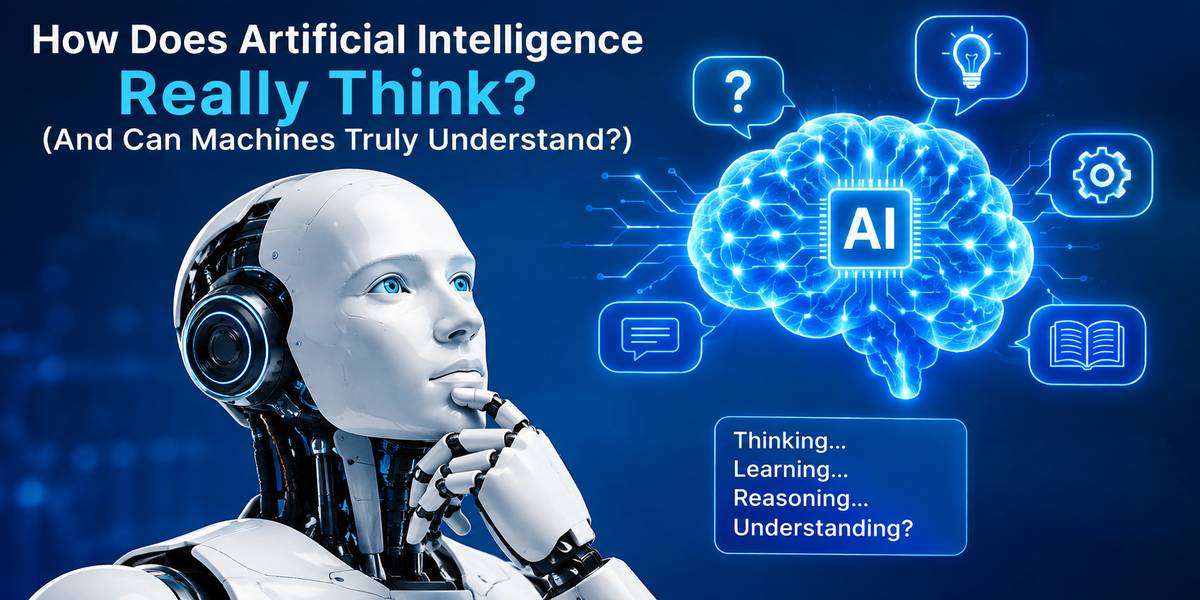
How Does Artificial Intelligence Really Think? (And Can Machines Truly Understand?)
Artificial intelligence has become part of everyday life. From chatbots and voice assistants to recommendation systems, self-driving technology, and AI-powered search tools, machines are increasingly performing tasks that once seemed possible only for humans.
But this raises a fascinating question: How does artificial intelligence really think?
When an AI system answers a question, recognizes an image, writes an article, or recommends a movie, it can look as though it is thinking in the same way a person does. However, the reality is quite different.
AI does not have a human brain, emotions, personal experiences, or consciousness. Instead, artificial intelligence uses algorithms, data, mathematical models, and computing power to identify patterns and produce useful outputs.
So, can machines truly understand what they are doing? The answer depends on what we mean by “understanding.”
Let’s explore how AI appears to think, what happens inside an AI system, and whether machines can ever truly understand the world like humans do.
What Does “Thinking” Mean for Artificial Intelligence?
Before understanding how AI thinks, we need to define what thinking actually means.
For humans, thinking involves many complicated processes. We can remember experiences, understand language, recognize emotions, imagine possibilities, make decisions, and connect new information with things we already know.
Artificial intelligence approaches these tasks differently.
When people say that an AI is “thinking,” they usually mean that the system is processing information, recognizing patterns, making predictions, and generating an output based on its training and instructions.
For example, if you ask an AI chatbot, “What is the capital of France?” it does not consciously remember Paris in the same way you might remember learning it in school. Instead, the system processes your input and uses patterns learned during training to generate the most appropriate response.
In simple terms:
Human thinking: experience + reasoning + memory + emotions + awareness
AI processing: data + algorithms + learned patterns + computation + probability
This distinction is important because AI can produce remarkably intelligent-looking results without necessarily possessing human-like thought.
How Does Artificial Intelligence Actually Work?
At a basic level, artificial intelligence works by combining data, algorithms, models, and computing power.
The process can be simplified into several stages.
1. AI Learns From Data
Data is one of the most important ingredients in modern AI.
Depending on its purpose, an AI system may be trained using text, images, audio, video, numbers, sensor readings, or other forms of information.
For example, an image-recognition system designed to identify cats may be trained using large numbers of images containing cats and other objects.
The system examines these examples and gradually learns patterns that help it distinguish one category from another.
It isn’t simply memorizing every picture. Instead, the underlying model adjusts its internal mathematical parameters during training so that it becomes better at recognizing relevant patterns.
2. Algorithms Find Patterns
An algorithm is essentially a set of mathematical or computational instructions used to process information.
Machine learning algorithms allow systems to identify relationships within data and improve their performance based on examples.
Imagine showing an AI thousands of photographs of handwritten numbers. Over time, the system can learn patterns associated with different digits.
When it later receives a new handwritten “7,” it can compare the characteristics of that image with patterns represented inside its model and predict that the image is probably a 7.
This ability to recognize patterns is one of the foundations of artificial intelligence.
3. Models Make Predictions
After training, an AI model can process new information.
Rather than simply looking up an answer from a traditional database, many modern AI systems calculate likely outputs based on patterns represented within the model.
For example, when a language model receives the beginning of a sentence, it estimates which words or tokens are most appropriate to continue the sequence.
This happens extremely quickly, often involving billions of mathematical calculations.
The result can look like reasoning or understanding because the model has learned complex relationships within its training data.
Does AI Understand Language?
Language is one of the most impressive areas of modern artificial intelligence.
AI systems can translate languages, summarize documents, answer questions, write stories, analyze text, and hold conversations that can feel surprisingly natural.
But does an AI actually understand language?
This is where things become complicated.
Modern language models learn statistical and semantic relationships between words, phrases, concepts, and contexts. Through training, they develop internal representations that allow them to associate different pieces of information.
For example, an AI can learn that the words “doctor,” “hospital,” “patient,” and “medicine” are often related.
It can also learn more complicated relationships involving grammar, context, facts, and concepts.
However, this does not necessarily mean that the AI experiences the meaning of those concepts.
A human understands what it means to be sick partly through physical experience, emotions, memories, and interaction with the world.
An AI doesn’t have a body that can become sick. It doesn’t experience pain or fear.
Therefore, AI can demonstrate sophisticated functional understanding without necessarily having the subjective understanding humans experience.
How Do AI Systems Make Decisions?
AI decision-making can seem mysterious, but the basic concept is relatively straightforward.
An AI system receives an input, processes it through its model, evaluates possible patterns or outcomes, and generates an output.
Consider a recommendation system.
You watch several science-fiction movies. The system analyzes your viewing behavior and compares it with patterns from millions of other users. If people with similar viewing histories frequently watch certain movies, the system may predict that you will enjoy those movies too.
The AI isn’t thinking:
“This person loves science fiction, so I personally believe they should watch this film.”
Instead, it is calculating relationships and probabilities based on available information.
This can produce excellent recommendations, but it can also produce mistakes.
AI decisions are influenced by the quality of the data, the design of the model, the instructions it receives, and the limitations of the information available to it.
Why Does AI Sometimes Sound Like a Human?
One reason people often believe AI is thinking like a person is its ability to communicate naturally.
Advanced AI systems can use conversational language, explain concepts, tell jokes, summarize information, and adapt their responses to context.
This creates a powerful illusion of human-like thought.
But fluent communication doesn’t automatically prove consciousness or genuine understanding.
Consider a calculator. A calculator can perform a complicated mathematical operation much faster than most people, but we don’t assume that it understands mathematics emotionally or philosophically.
AI is much more sophisticated than a calculator, but the principle is similar: producing an intelligent result does not necessarily mean experiencing the process like a human.
The difference is that modern AI systems operate across vastly more complex patterns.
Can Machines Truly Understand?
This is one of the biggest questions in artificial intelligence.
There is no universally accepted answer because “understanding” can mean different things.
If understanding means being able to process information, identify relationships, answer questions, and use knowledge appropriately, then AI systems clearly demonstrate forms of understanding.
For example, an AI can explain how photosynthesis works, compare two programming languages, or summarize a scientific paper.
But if understanding means having conscious awareness of meaning, emotions, experiences, and existence, there is currently no strong evidence that today’s AI systems possess that kind of understanding.
This distinction is sometimes described as the difference between functional intelligence and conscious experience.
An AI can perform a task intelligently without necessarily having an inner experience of performing it.
Does AI Have Consciousness?
Consciousness is different from intelligence.
A system can potentially perform intelligent tasks without being conscious.
Humans are conscious beings. We have subjective experiences: we feel pain, enjoy music, remember personal experiences, and have an ongoing sense of self.
Current AI systems do not have scientifically established evidence of comparable subjective experience.
They process inputs and generate outputs, but there is no reliable scientific basis for claiming that today’s AI systems are secretly experiencing thoughts, feelings, or awareness in the human sense.
This is an important distinction when discussing artificial general intelligence and the future of AI.
A machine becoming better at solving problems does not automatically mean that it will become conscious.
AI vs. Human Thinking: What’s the Difference?
The differences between artificial intelligence and human intelligence become clearer when we compare how each handles information.
| Human Intelligence | Artificial Intelligence |
|---|---|
| Learns from relatively few experiences | Often requires large amounts of training data |
| Has emotions and subjective experiences | No established human-like emotions or experiences |
| Uses common-sense knowledge from living in the world | Learns patterns from training and interaction |
| Can form personal goals | Usually operates according to programmed or provided objectives |
| Has a biological body and senses | Depends on available digital or physical inputs |
| Can understand experiences personally | Can model and describe experiences without necessarily experiencing them |
This doesn’t mean humans are always better.
AI can process enormous amounts of information, perform calculations quickly, detect patterns at scale, and operate continuously.
Humans, meanwhile, are exceptionally good at adapting to unfamiliar situations, understanding social context, drawing on lived experience, and combining knowledge with physical and emotional experiences.
The most powerful future may involve humans and AI working together rather than simply competing against each other.
Why Does AI Make Mistakes If It Is So Intelligent?
AI can be extremely capable and still make mistakes.
This happens for several reasons.
First, AI models learn from data, and data can contain errors, gaps, biases, or conflicting information.
Second, AI systems may encounter situations that differ significantly from what they learned during training.
Third, some AI systems generate outputs based on probabilities rather than retrieving verified facts from a reliable source.
Language models can sometimes produce confident-sounding statements that are incorrect. This phenomenon is commonly called an AI hallucination.
For this reason, important AI-generated information should be checked against trustworthy sources, especially in areas such as medicine, law, finance, science, and safety.
AI should be treated as a powerful tool—not an unquestionable authority.
What Is the Future of AI Thinking?
Artificial intelligence is developing rapidly.
Future systems may become better at reasoning, planning, using external tools, remembering context, understanding images and audio, and interacting with the physical world.
Researchers are also working toward artificial general intelligence (AGI)—a concept referring broadly to AI with much more general and flexible capabilities than today’s specialized systems.
However, predicting exactly when or whether machines will achieve human-level general intelligence or consciousness remains highly uncertain.
One thing is clear: AI will continue becoming more capable.
The important question may therefore shift from:
“Can AI think like a human?”
to:
“What kinds of thinking can machines perform, and how should humans use those capabilities responsibly?”
The Bottom Line: Is AI Really Thinking?
So, how does artificial intelligence really think?
The simplest answer is that AI doesn’t think exactly like humans.
It processes information using mathematical models, algorithms, learned patterns, and computational systems. Modern AI can recognize complex relationships, generate language, make predictions, solve problems, and perform tasks that can appear remarkably intelligent.
But appearing intelligent is not necessarily the same as being conscious.
Today’s AI systems can demonstrate impressive forms of functional intelligence, yet there is no established evidence that they experience the world with human-like awareness, emotions, or subjective consciousness.
Understanding this difference helps us appreciate AI without either underestimating or exaggerating what it can do.
Artificial intelligence is not simply a digital version of the human brain. It is a fundamentally different approach to processing information—one that is becoming increasingly powerful.
And perhaps the most interesting part isn’t whether machines think exactly like us.
It’s discovering what intelligence can look like when it doesn’t come from a biological brain at all.