

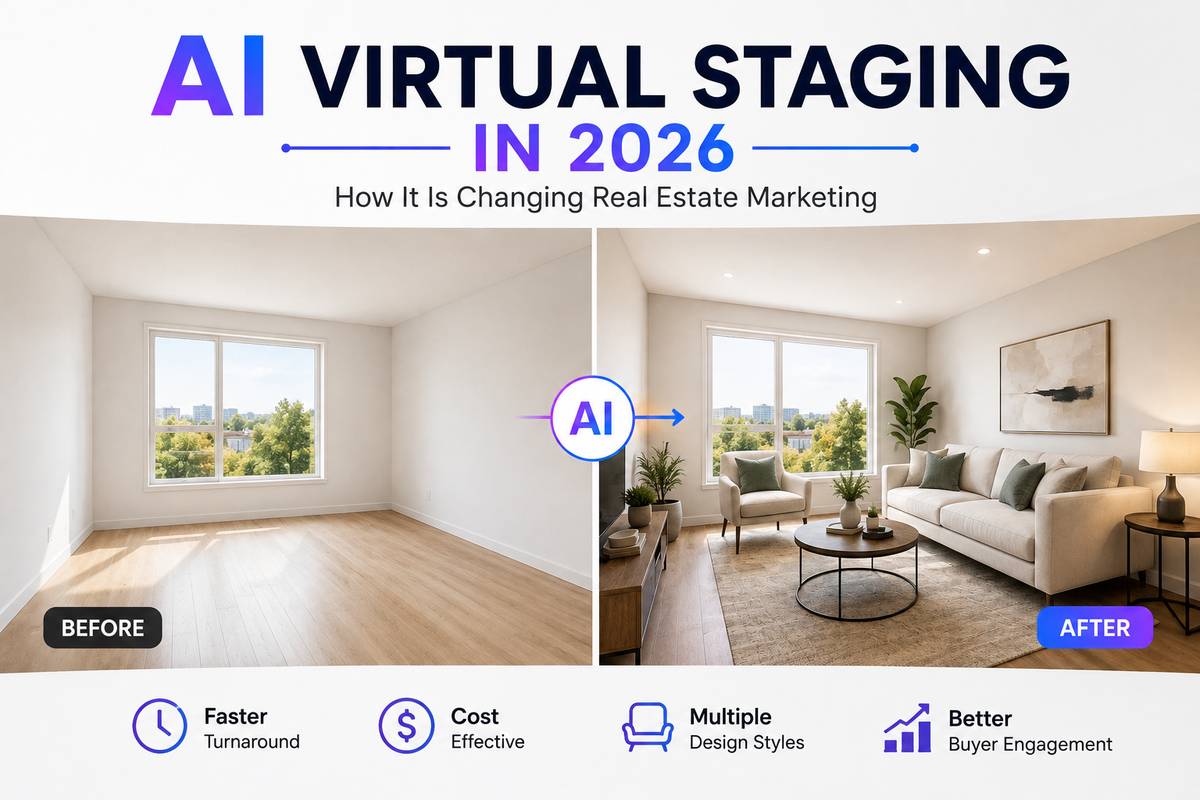
AI Virtual Staging in 2026
Real estate marketing is becoming increasingly visual, and buyers now expect property listings to provide more than basic photographs and descriptions. In 2026, AI virtual staging is helping real estate agents, property marketers, photographers, and homeowners create attractive property visuals without the time and expense traditionally associated with physical staging.
Instead of renting furniture, hiring a staging company, transporting items, and preparing a property for a photoshoot, AI-powered platforms can digitally furnish an empty room within minutes. Users can upload a property photograph, select a preferred interior style, and generate a realistic furnished version of the space.
This technology is changing how properties are presented online and giving sellers more flexible ways to showcase the potential of an empty or outdated property.
What Is AI Virtual Staging?
AI virtual staging uses artificial intelligence to digitally add furniture, décor, lighting, colors, and other interior elements to property photographs.
For example, an empty living room can be digitally furnished with a sofa, coffee table, rug, artwork, plants, and lighting. The AI attempts to maintain the original room’s walls, windows, flooring, doors, and architectural structure while adding realistic furnishings.
Unlike traditional staging, the furniture does not physically exist inside the property. It is added digitally to the photograph.
Modern virtual staging software can generate different styles from the same image, allowing agents to create multiple listing visuals without physically changing the property.
Why AI Virtual Staging Is Growing in 2026
The growth of online property searches has made photography and visual presentation extremely important in real estate marketing. Buyers often browse dozens of listings before deciding which properties deserve closer attention.
An empty room can sometimes make it difficult for buyers to understand its size, purpose, or potential. A professionally staged image can help them imagine how the space could be used.
AI makes this process faster and more accessible.
Real estate professionals can now:
- Stage empty rooms digitally
- Generate multiple furniture styles
- Redesign outdated interiors
- Create lifestyle-focused property images
- Prepare listing photos faster
- Test different design concepts
- Create marketing images for social media
- Produce visuals for property websites
- Present renovation possibilities
The result is a more flexible approach to real estate marketing with AI.
How AI Virtual Staging Works
Most AI staging platforms follow a relatively simple process.
Step 1: Upload the Property Photo
The user uploads a photograph of an empty or furnished room. A good-quality image with clear walls, flooring, windows, and room proportions generally produces better results.
Step 2: Select a Room Type
Depending on the platform, users may identify the room as a living room, bedroom, dining room, office, kitchen, or another space.
Step 3: Choose a Design Style
The user can select a style such as modern, contemporary, Scandinavian, minimalist, traditional, industrial, luxury, or coastal.
Step 4: Generate the Design
The AI analyzes the photograph and creates a digitally furnished version. Advanced platforms can recognize room geometry and perspective to place furniture more naturally.
Step 5: Review and Refine
Users can generate additional versions or adjust the style to find the most appropriate presentation for the property.
This workflow can turn a basic empty-room photograph into a marketing-ready visual in a short amount of time.
AI Virtual Staging vs Traditional Home Staging
Traditional home staging involves physically furnishing a property before photographs are taken. It can create highly realistic results because the furniture actually exists in the room, but it can also involve significant costs and logistics.
AI staging works differently.
| Traditional Staging | AI Virtual Staging |
|---|---|
| Requires physical furniture | Furniture is digitally added |
| Furniture delivery may be required | No physical delivery |
| Can take days to organize | Can take minutes |
| Higher logistical costs | Generally lower production cost |
| Limited to available furniture | Multiple styles can be tested |
| Physical property is changed temporarily | Original property remains unchanged |
Neither approach is automatically better for every property. Luxury listings, occupied homes, and high-end marketing campaigns may still benefit from professional physical staging. However, AI home staging is particularly useful when speed, flexibility, and cost efficiency are priorities.
Benefits of AI Virtual Staging for Real Estate
1. Faster Property Marketing
Speed is one of the biggest advantages. Instead of waiting for furniture delivery and staging appointments, agents can prepare digitally staged images quickly.
This can be particularly useful when a property needs to go live on listing platforms immediately.
2. Lower Staging Costs
Physical staging can involve furniture rental, transportation, setup, removal, and storage. AI staging eliminates most of these logistical requirements.
For agents handling multiple properties, the potential savings can be significant.
3. Multiple Design Styles
One empty room can be presented in several different ways.
For example, an agent could create:
- Modern living room
- Scandinavian living room
- Luxury living room
- Minimalist living room
- Family-friendly living room
This allows marketers to select a visual style that matches the property’s target audience.
4. Better Visualization for Empty Properties
Empty rooms can sometimes appear smaller or less inviting in listing photographs. Digital furniture can provide visual context and help potential buyers understand the room’s scale and purpose.
5. Useful for Social Media Marketing
Property marketers need attractive visuals for Instagram, Facebook, Pinterest, websites, email campaigns, and digital advertisements.
AI-generated staging can provide additional images for these channels without requiring another photoshoot.
6. Easy Renovation Visualization
AI can also go beyond furnishing. Some platforms can help visualize different wall colors, flooring, furniture, décor, and interior styles.
This gives buyers an idea of what a property could look like after renovation.
AI Virtual Staging for Different Property Types
AI staging is not limited to residential houses.
Apartments
Apartment listings can benefit from digitally furnished living rooms, bedrooms, dining areas, and balconies.
Luxury Homes
High-end properties can be presented with premium furniture, sophisticated lighting, and elegant décor to communicate a luxury lifestyle.
New Construction
Developers can stage unfinished properties digitally before physical interiors are completed.
Vacant Properties
Empty homes can be furnished virtually to help buyers understand how rooms could be used.
Commercial Properties
Offices, retail spaces, restaurants, and other commercial properties can also be visualized with appropriate furniture and layouts.
AI Interior Design and Virtual Staging
There is some overlap between AI interior design and virtual staging, but they serve different purposes.
AI interior design generally focuses on creating or exploring design concepts. A user may upload a room and ask AI to redesign it with a specific style.
Virtual staging is more specifically focused on preparing property images for marketing.
For example, an interior designer might use AI to experiment with a complete renovation concept, while a real estate agent might use AI virtual staging to furnish an empty room for a property listing.
Some modern platforms combine both capabilities, allowing users to move from simple staging to more comprehensive design visualization.
What Makes Good AI Virtual Staging?
Not all AI-generated property images are equally useful. Professional real estate marketing requires realistic and consistent results.
A good AI staging platform should provide:
Realistic furniture: Furniture should look natural and proportional to the room.
Accurate perspective: Objects should follow the room’s perspective and camera angle.
Natural lighting: Shadows and highlights should match the original photograph.
Architectural preservation: Doors, windows, walls, ceilings, and major structural features should remain consistent.
High-resolution output: Images should be suitable for property websites and marketing platforms.
Style options: Multiple design styles allow agents to target different audiences.
Fast generation: Quick processing is important when several properties need to be prepared.
Important Considerations When Using AI Staging
Although AI virtual staging offers significant benefits, transparency is important.
Digitally staged images should not misrepresent the actual property. Buyers should be able to understand that furniture and décor have been digitally added.
Agents should avoid using AI to hide structural problems or substantially change the property’s actual features.
For example, digitally adding furniture is generally very different from digitally removing a wall, changing room dimensions, or making a small room appear significantly larger.
Ethical use of AI helps protect buyer expectations and supports trust between agents and clients.
The Future of AI Virtual Staging
The technology is likely to become even more advanced throughout 2026 and beyond.
Future AI real estate marketing platforms may combine virtual staging with property floor plans, 3D walkthroughs, renovation visualization, furniture recommendations, and interactive design experiences.
Instead of simply showing buyers an empty property, marketers could provide several versions of the same space based on different lifestyles.
A two-bedroom apartment could be shown as a family home, minimalist residence, home office setup, or luxury urban apartment. This creates a more engaging property marketing experience.
AI may also make it easier for buyers to personalize listings. Instead of viewing only one staged version, they could potentially explore different furniture arrangements and interior styles based on their preferences.
How Real Estate Agents Can Use AI Virtual Staging
Real estate professionals can integrate AI staging into several parts of their marketing workflow.
Start by using high-quality property photographs. Generate one or two realistic staging concepts rather than producing excessive variations. Select a style that fits the property’s architecture and likely buyer demographic.
Use staged images alongside original photographs rather than replacing every real image. This provides buyers with an accurate understanding of the property’s current condition while also showing its potential.
AI staging can also be combined with virtual property marketing, social media campaigns, email marketing, property brochures, and listing presentations.
Conclusion
AI virtual staging in 2026 is becoming an important part of modern real estate marketing. By digitally furnishing empty rooms and creating different interior styles, AI allows agents and property marketers to produce attractive listing visuals faster and with fewer logistical requirements.
The technology does not completely replace traditional staging or professional photography. Instead, it provides another powerful tool for presenting properties and helping potential buyers visualize possibilities.