

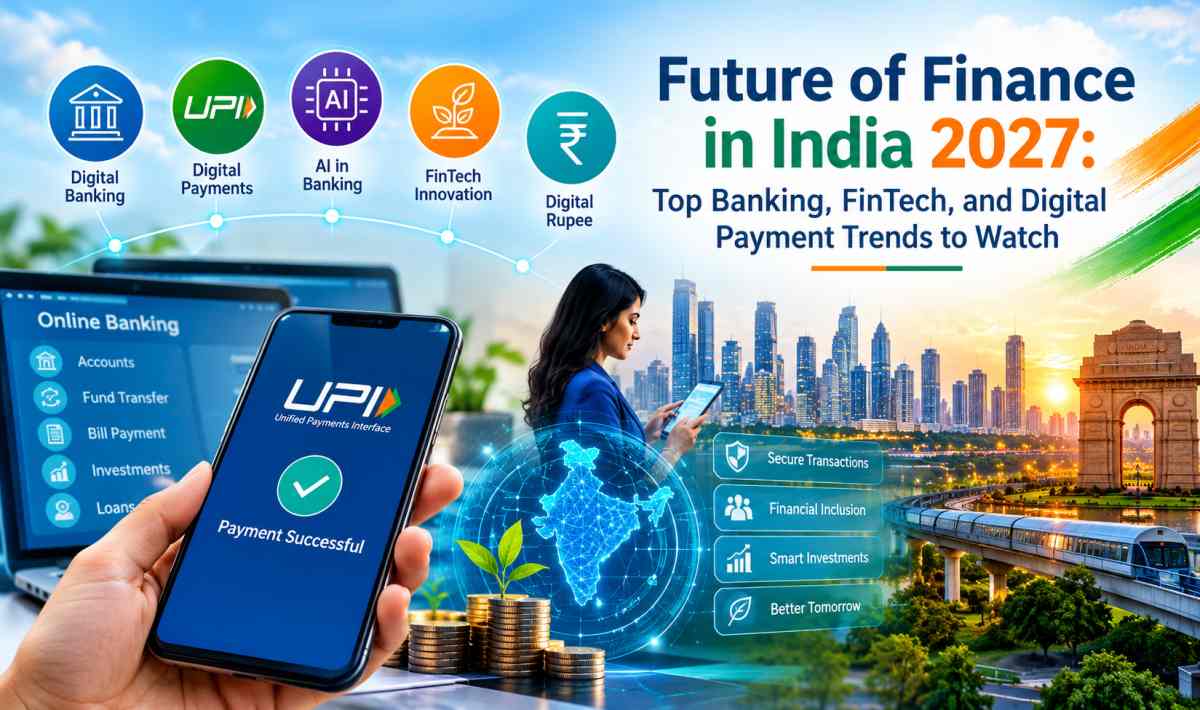
Future of Finance in India 2027: Top Banking, FinTech, and Digital Payment Trends to Watch
India’s financial sector is entering an exciting period of technological transformation. With the rapid growth of digital banking, financial technology, artificial intelligence, and cashless transactions, the future of finance in India in 2027 is expected to look significantly different from traditional banking systems.
Over the past decade, India has established itself as a major digital payments market. Innovations such as the Unified Payments Interface (UPI), mobile banking applications, Aadhaar-enabled services, and digital lending platforms have transformed how individuals and businesses manage money.
As India approaches 2027, financial institutions are increasingly focusing on automation, cybersecurity, financial inclusion, and customer-centric digital services.
The next phase of India’s financial transformation could introduce more intelligent banking solutions, faster payment systems, and accessible financial products.
In this article, we explore the top banking, FinTech, and digital payment trends in India for 2027, highlighting the technologies, opportunities, and challenges likely to influence the country’s financial future.
1. Digital Banking Will Continue to Transform India’s Financial Sector
Digital banking is expected to remain one of the most important financial trends in India in 2027.
Traditional banking services increasingly operate through mobile applications, internet banking platforms, and automated digital systems.
Customers can already open certain bank accounts, transfer money, pay bills, and manage investments without regularly visiting physical branches.
By 2027, banks may expand their digital capabilities through advanced automation and personalized financial services.
Key Digital Banking Trends to Watch
- Mobile-first banking: Financial institutions will continue improving mobile applications for everyday banking.
- Paperless banking: Digital documentation and electronic verification could simplify customer onboarding.
- Automated services: AI-powered systems may handle routine customer requests.
- Personalized banking: Banks could provide financial recommendations based on customer needs and transaction patterns.
- Digital customer support: Chatbots and virtual assistants may offer faster assistance.
However, physical bank branches will remain important for complex financial services and customers who prefer face-to-face interactions.
The future of digital banking in India will likely combine technological convenience with traditional banking support.
2. UPI Will Remain Central to India’s Digital Payment Revolution
The Unified Payments Interface has fundamentally changed how Indians make everyday transactions.
Developed by the National Payments Corporation of India (NPCI), UPI enables instant transfers between participating bank accounts through compatible payment applications.
From small retail stores to large businesses, UPI has become a widely accepted payment method.
As India moves toward 2027, the UPI ecosystem is expected to expand through technological improvements, new payment experiences, and greater international connectivity.
Emerging UPI Trends for 2027
Cross-border payments: International UPI connectivity could make certain overseas transactions more convenient.
UPI Lite: Continued adoption may simplify eligible small-value transactions.
Voice-enabled payments: Conversational payment technologies could improve accessibility.
Merchant payment solutions: Businesses may gain access to improved payment reconciliation and transaction management tools.
Enhanced security: Stronger fraud monitoring could help protect users from suspicious transactions.
UPI’s growth also creates opportunities for small businesses, freelancers, and digital entrepreneurs.
Nevertheless, users must remain alert to payment fraud, phishing attempts, and unauthorized transaction requests.
The future of digital payments in India will depend on balancing convenience, accessibility, reliability, and security.
3. Artificial Intelligence Will Make Banking Smarter
Artificial intelligence is emerging as a major force in financial services.
Indian banks and FinTech companies are exploring AI-powered technologies to improve operational efficiency, customer experiences, and risk management.
By 2027, artificial intelligence could become more deeply integrated into everyday banking operations.
Applications of AI in Banking
Fraud detection: AI systems can analyze transaction patterns and identify potentially suspicious activities.
Customer support: Intelligent chatbots can respond to common banking questions.
Credit assessment: Machine learning models may help financial institutions evaluate credit applications using permitted information.
Financial planning: Digital platforms could provide personalized budgeting insights and spending analysis.
Risk management: Predictive analytics can help institutions identify financial risks.
For example, an AI-enabled banking application might notify customers about unusual spending patterns or upcoming recurring payments.
However, responsible AI adoption requires transparency, data protection, appropriate human oversight, and safeguards against unfair automated decisions.
Financial institutions that implement AI responsibly may improve efficiency while building stronger customer trust.
4. India’s FinTech Industry Will Enter a New Growth Phase
India has developed a dynamic financial technology ecosystem.
FinTech companies operate across digital payments, lending, insurance, wealth management, and financial infrastructure.
As financial services become increasingly technology-driven, the FinTech trends of 2027 may focus on sustainable growth, regulatory compliance, and practical innovation.
Major FinTech Opportunities
Digital lending: Technology may simplify loan applications, documentation, and repayment management.
WealthTech: Investment platforms could make financial education and portfolio monitoring more accessible.
InsurTech: Digital tools may improve insurance distribution, claims processing, and customer support.
RegTech: Regulatory technology could help financial institutions manage compliance requirements.
Embedded finance: Financial services may become integrated into shopping platforms, business software, and other digital ecosystems.
FinTech growth will also depend on consumer protection.
Transparent pricing, responsible lending, secure data handling, and clear product disclosures will remain essential.
Companies that combine innovation with customer trust may be better positioned for long-term success.
5. Digital Rupee Could Influence the Future of Payments
The digital rupee, also known as India’s central bank digital currency (CBDC), represents another important development in the financial sector.
Issued by the Reserve Bank of India (RBI), the digital rupee is a digital form of central bank money.
Unlike decentralized cryptocurrencies, a CBDC is issued and managed within a central bank framework.
India has been exploring digital rupee applications through pilot initiatives.
By 2027, developments in the digital rupee ecosystem could influence how certain individuals, businesses, and institutions make payments.
Potential Benefits of the Digital Rupee
- Digital settlement options backed by central bank money.
- Opportunities for innovative payment services.
- Potential improvements in selected payment and settlement processes.
- Exploration of programmable payment features.
- Additional digital payment choices for consumers and businesses.
However, broader adoption will depend on usability, privacy safeguards, technological infrastructure, regulatory decisions, and consumer awareness.
The digital rupee is unlikely to replace every existing payment method in the near future.
Instead, it may develop as an additional component of India’s expanding digital financial ecosystem.
6. Cybersecurity Will Become a Top Banking Priority
As financial transactions move online, cybersecurity becomes increasingly important.
Digital banking platforms process sensitive customer information, including financial records and transaction details.
Cybercriminals may target users through phishing messages, fraudulent payment requests, impersonation scams, and malicious applications.
Consequently, cybersecurity is expected to become one of the most significant banking trends in India in 2027.
Important Financial Security Developments
Advanced fraud monitoring: Banks may strengthen systems that identify unusual transactions.
Biometric authentication: Secure biometric verification could support selected banking activities.
Multi-factor authentication: Additional verification methods can reduce unauthorized account access.
Real-time alerts: Faster transaction notifications may help customers identify suspicious activity.
Consumer education: Financial institutions may increase awareness campaigns about digital fraud.
Customers should never share their UPI PIN, banking passwords, or one-time passwords with unknown individuals.
Importantly, receiving money through UPI generally does not require entering a UPI PIN.
As financial technology advances, maintaining customer confidence will require continuous investment in cybersecurity.
7. Financial Inclusion Will Reach More Rural Communities
Financial inclusion remains an important priority for India’s economic development.
Although digital financial services have expanded rapidly, some rural and underserved communities continue to face challenges involving internet connectivity, digital literacy, and access to suitable financial products.
By 2027, improvements in financial infrastructure could help bridge these gaps.
Government initiatives, banking correspondents, digital payment networks, and financial technology companies may contribute to broader access.
Financial Inclusion Trends
Rural digital banking: Mobile-based financial services could reduce dependence on distant bank branches.
Regional language interfaces: Multilingual applications may help customers understand financial products.
Microfinance technology: Digital systems could improve the delivery and management of small loans.
Digital insurance: Technology may simplify access to suitable insurance products.
Financial literacy: Educational initiatives could help people make informed financial decisions.
Greater inclusion can support entrepreneurship, household financial management, and economic participation.
However, access alone is insufficient.
Financial products must also be affordable, understandable, secure, and appropriate for customers’ needs.
8. Open Banking and Account Aggregators Will Improve Financial Connectivity
India’s Account Aggregator framework is an important development in consent-based financial data sharing.
Account Aggregators enable customers to authorize the secure sharing of supported financial information between participating institutions.
This framework can help financial service providers access relevant information with customer permission.
By 2027, wider participation could support more connected financial experiences.
Potential Applications
Faster loan processing: Lenders may evaluate authorized financial information more efficiently.
Improved financial planning: Customers could access consolidated insights across supported accounts.
Simplified documentation: Consent-based data sharing may reduce repetitive paperwork.
Business finance: Eligible businesses could use verified financial records when applying for financial services.
Personalized products: Institutions may develop services based on information customers choose to share.
Privacy and informed consent will remain central to this ecosystem.
Customers should understand what information they authorize, who receives it, and how consent can be managed.
The expansion of open financial infrastructure could make India’s banking ecosystem more connected without requiring customers to surrender control over their financial information.
9. Digital Lending Will Focus on Transparency and Responsible Credit
Digital lending has made credit applications more convenient for many consumers and businesses.
Online platforms allow eligible borrowers to submit applications, complete verification, and receive lending decisions digitally.
However, rapid digital lending growth has also raised concerns about misleading charges, aggressive recovery practices, and misuse of personal information.
By 2027, responsible lending practices are likely to become increasingly important.
Digital Lending Trends to Watch
Transparent loan pricing: Borrowers will increasingly expect clear information about interest rates, fees, and repayment obligations.
Digital verification: Secure electronic processes may reduce paperwork.
AI-assisted assessments: Lenders could use advanced analytical tools while maintaining fair lending practices.
Small-business financing: Digital platforms may improve credit access for eligible MSMEs.
Consumer protection: Regulatory oversight and grievance mechanisms will remain important.
Borrowers should compare the total cost of credit rather than focusing only on monthly instalments.
They should also verify the lender’s identity and carefully review loan agreements.
The long-term success of digital lending will depend on responsible innovation rather than simply faster loan approvals.
10. Embedded Finance Will Transform Online Shopping and Business Services
Embedded finance refers to the integration of financial services into non-financial digital platforms.
For example, an online marketplace may offer payment services or financing options through regulated financial partners.
Similarly, business management software may integrate payment collection, invoicing, or financial reporting features.
By 2027, embedded finance could become more common across India’s digital economy.
Examples of Embedded Finance
- Payment services integrated into e-commerce platforms.
- Insurance options offered during eligible purchases.
- Business financing available through merchant platforms.
- Automated payment collection within accounting software.
- Financial management tools integrated into business applications.
These solutions can make financial services more convenient by reducing the need to switch between multiple platforms.
For small businesses, integrated payment and accounting tools may improve operational efficiency.
However, providers must ensure that customers understand the financial products being offered, including applicable fees, risks, and contractual terms.
11. Sustainable Finance and Green Banking Will Gain Importance
Sustainable finance is another area likely to attract attention in 2027.
As India pursues its energy transition and environmental objectives, financial institutions may play an increasing role in supporting sustainable projects.
Banks and investors are exploring financing opportunities related to renewable energy, energy-efficient buildings, electric mobility, and environmentally responsible infrastructure.
Emerging Green Finance Trends
Green bonds: Financial instruments designed to raise capital for eligible environmental projects.
Renewable energy financing: Loans and investment products supporting clean energy development.
Green home loans: Financing products that may encourage energy-efficient housing.
Sustainable business lending: Financial support for eligible environmentally responsible activities.
Climate risk assessment: Greater attention to environmental risks affecting financial institutions and borrowers.
Green finance could create opportunities for infrastructure development and technological innovation.
Nevertheless, transparent reporting and credible environmental standards will be necessary to reduce greenwashing risks.
The future of sustainable finance in India will depend on measurable outcomes, regulatory development, and responsible capital allocation.
12. Personal Finance Apps Will Become More Intelligent
Personal finance management is becoming increasingly digital.
Mobile applications already help users monitor expenses, create budgets, track investments, and organize financial goals.
By 2027, these applications may incorporate more sophisticated automation and artificial intelligence.
Personal Finance Technology Trends
Automated budgeting: Applications may categorize expenses and provide spending summaries.
Savings reminders: Digital tools could encourage consistent saving habits.
Financial goal tracking: Users may monitor progress toward education, housing, or emergency savings goals.
Investment dashboards: Platforms could provide consolidated views of supported investment accounts.
Subscription monitoring: Applications may identify recurring payments and help users review expenses.
These technologies can support financial awareness, but automated recommendations should not replace informed decision-making.
Users should review application permissions, data-sharing policies, and the credentials of financial service providers.
Effective financial planning still requires realistic goals, appropriate risk management, and an understanding of individual circumstances.
13. Cross-Border Digital Payments Could Become Easier
International payment connectivity is another promising development for India’s financial sector.
Traditional cross-border transactions can involve processing delays, currency conversion costs, and multiple financial intermediaries.
Digital payment partnerships may simplify selected international transactions.
India’s UPI ecosystem has already demonstrated opportunities for international payment connectivity.
By 2027, additional partnerships could improve payment convenience for eligible travelers, businesses, and individuals.
Potential Developments
International merchant payments: More overseas merchants may support compatible Indian payment systems.
Remittance improvements: Payment infrastructure partnerships could simplify selected international transfers.
Faster settlements: Modern financial networks may reduce processing times.
Greater transparency: Digital platforms could provide clearer information about transaction charges.
Business opportunities: Improved payment connectivity may support cross-border commerce.
However, international payment availability will continue to depend on participating institutions, regulatory requirements, foreign exchange rules, and country-specific arrangements.
14. Challenges Facing India’s Financial Sector in 2027
Despite promising developments, India’s financial transformation will face several challenges.
Cybersecurity threats: Increasing digital activity creates more opportunities for financial fraud.
Digital literacy gaps: Some consumers may struggle to understand complex financial applications.
Data privacy concerns: Financial institutions must protect sensitive customer information.
Regulatory compliance: FinTech companies and banks must adapt to evolving requirements.
Technology infrastructure: Reliable connectivity and resilient payment systems are essential.
Consumer trust: Customers need transparent, dependable, and accessible financial services.
Addressing these challenges will require cooperation between regulators, banks, technology providers, businesses, and consumers.
Innovation alone cannot guarantee a successful financial ecosystem.
Security, fairness, accessibility, and accountability must remain equally important.
15. What Will the Future of Finance in India Look Like Beyond 2027?
Looking beyond 2027, India’s financial services industry could become more connected, automated, and customer-focused.
Artificial intelligence may support more personalized banking experiences, while digital payment infrastructure could continue expanding across domestic and international markets.
FinTech companies may increasingly collaborate with established financial institutions to deliver specialized services.
Meanwhile, developments involving the digital rupee, Account Aggregators, cybersecurity, and financial inclusion could influence the next generation of financial products.
The most successful financial innovations will likely be those that solve practical customer problems while maintaining transparency and security.
For consumers, this transformation could mean more convenient access to financial services.
For businesses, it may create opportunities to improve payment processing, financing, and financial management.
For financial institutions, it will require continuous investment in technology, regulatory compliance, and customer protection.
Conclusion
The future of finance in India in 2027 is likely to be shaped by digital banking, UPI innovation, artificial intelligence, financial technology, and stronger financial infrastructure.
Emerging developments such as the digital rupee, embedded finance, consent-based data sharing, and green banking could introduce new opportunities for individuals and businesses.
At the same time, cybersecurity, responsible lending, data privacy, and financial inclusion will remain essential priorities.
India’s financial transformation is not simply about replacing traditional banking with digital applications. It is about building a more efficient, accessible, secure, and inclusive financial ecosystem.
As 2027 approaches, consumers, businesses, and financial institutions that understand these trends will be better prepared to navigate the changing financial landscape.
The coming years could establish India as an increasingly influential market for responsible financial innovation.
Frequently Asked Questions (FAQs)
1. What is the future of finance in India in 2027?
India’s financial sector is expected to become more digital, with continued developments in UPI payments, AI-powered banking, FinTech services, cybersecurity, and financial inclusion.
2. What are the biggest banking trends in India for 2027?
Major trends include mobile-first banking, artificial intelligence, digital customer onboarding, stronger cybersecurity, consent-based financial data sharing, and personalized financial services.
3. Will UPI continue growing in India in 2027?
UPI is expected to remain an important digital payment system. Its future development may include improved merchant services, international connectivity, accessibility features, and enhanced fraud prevention.
4. How will artificial intelligence change banking in India?
AI could improve fraud detection, customer support, financial analysis, credit assessment, and operational efficiency. Responsible implementation will require appropriate privacy and fairness safeguards.
5. What is the role of FinTech in India’s financial future?
FinTech companies help develop digital payment solutions, lending platforms, insurance technology, wealth management tools, and financial infrastructure that can improve access to financial services.
6. Will the digital rupee replace UPI?
The digital rupee and UPI serve different purposes. The digital rupee is central bank digital money, while UPI is a payment interface. They may coexist within India’s digital payment ecosystem.
7. Is digital banking safe in India?
Digital banking can be secure when financial institutions implement strong safeguards and customers follow safe banking practices. Users should protect their credentials, verify payment requests, and use trusted banking applications.