

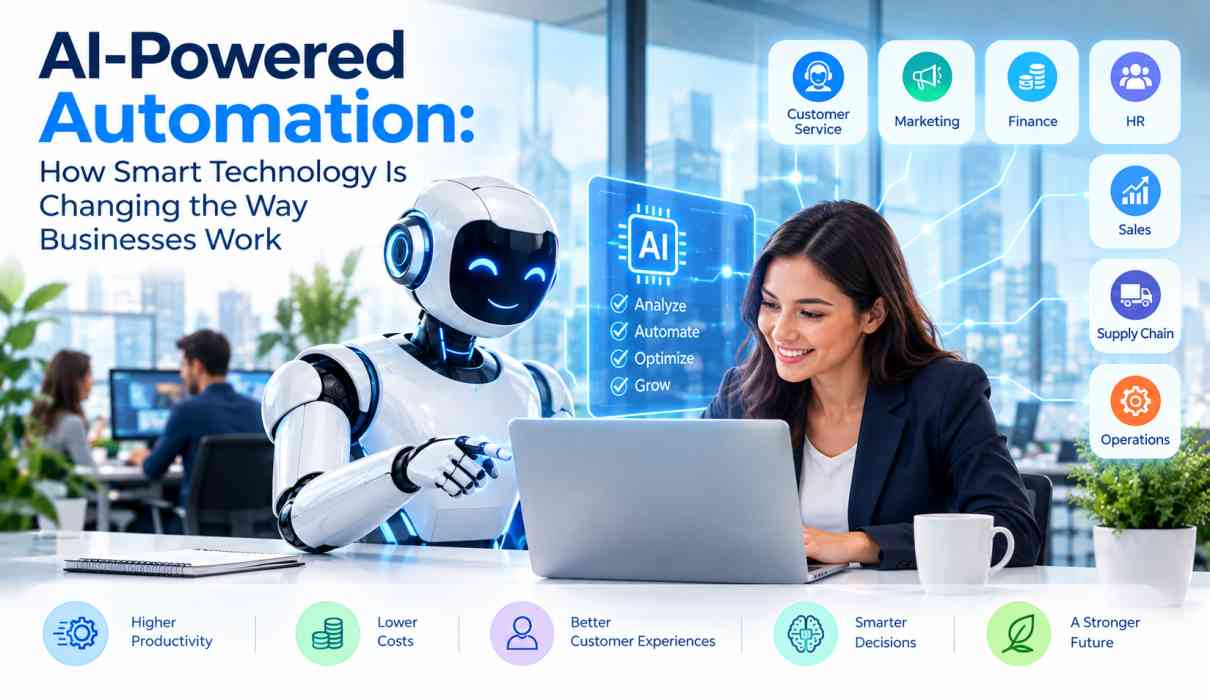
AI-Powered Automation: How Smart Technology Is Changing the Way Businesses Work
Artificial intelligence is rapidly changing the way businesses operate. What once required hours of manual work, spreadsheets, repetitive emails and multiple software systems can increasingly be handled with intelligent automation. From customer service and marketing to finance, human resources and supply chain management, AI-powered automation is becoming an important part of modern business strategy.
The growth of generative AI and AI agents is accelerating this transformation. Stanford’s 2026 AI Index reports that organizational AI adoption reached 88% in 2025, while generative AI was being used in at least one business function by 70% of organizations.
Unlike traditional automation, which generally follows fixed rules, AI-powered automation can analyze information, understand language, identify patterns, make recommendations and adapt its actions according to changing circumstances.
This creates an opportunity for businesses to automate not only repetitive tasks but also increasingly complex workflows.
What Is AI-Powered Automation?
AI-powered automation combines artificial intelligence, machine learning, natural language processing and automation technologies to perform business tasks with limited human intervention.
Traditional automation works according to predefined instructions. For example, a system might automatically send an email whenever a customer submits a form.
AI-powered automation can go further. It can understand the customer’s message, determine what the customer needs, retrieve relevant information, generate a personalized response and escalate the issue to a human employee when necessary.
AI automation can therefore support both task automation and intelligent decision-making.
Common technologies include:
- Generative AI
- AI agents
- Machine learning
- Natural language processing
- Robotic process automation
- Intelligent document processing
- Predictive analytics
- Computer vision
- Workflow automation
- AI-powered business software
Together, these technologies are creating smarter and more connected business processes.
Why Businesses Are Adopting AI Automation
Businesses operate in an increasingly competitive environment where speed, efficiency and customer experience matter.
Employees often spend significant amounts of time on repetitive activities such as entering data, preparing reports, responding to routine questions, scheduling meetings and processing documents.
AI-powered automation can reduce this administrative workload and allow employees to focus on activities requiring creativity, strategic thinking and human judgment.
The economic investment behind this transformation is also substantial. Stanford’s 2026 AI Index found that global corporate AI investment more than doubled in 2025, reaching a record $581.69 billion across private investment, mergers and acquisitions and other categories.
However, successful adoption is not simply about purchasing an AI tool. Businesses need to identify valuable use cases, improve their data foundations and establish appropriate governance.
1. AI Automation Is Transforming Customer Service
Customer service is one of the most visible applications of AI-powered automation.
AI chatbots and virtual assistants can answer common questions, provide product information, check order status and help customers navigate services at any time of day.
Modern systems can also understand natural language rather than requiring customers to use specific commands.
For example, instead of selecting several options from a traditional automated menu, a customer could simply write:
“My order hasn’t arrived yet. Can you check its status?”
An AI system can understand the request, retrieve relevant information and provide an answer.
AI automation can also analyze customer conversations to identify complaints, detect sentiment and determine when a human agent should become involved.
The result can be faster responses while allowing human customer-service teams to concentrate on complicated cases.
2. AI Is Automating Marketing and Content Workflows
Marketing teams are also using AI to automate many parts of the content and campaign process.
AI tools can help businesses research audiences, generate content ideas, write initial drafts, summarize market information, personalize communications and analyze campaign performance.
AI-powered systems can also segment customers according to behavior and automatically deliver more relevant messages.
For example, an online retailer could identify customers who have viewed a particular product several times but have not purchased it. An automated marketing workflow could then send personalized information or an appropriate offer.
Human marketers remain important because brand strategy, creativity, accuracy and customer understanding require judgment. However, AI can significantly reduce the amount of repetitive work involved in executing campaigns.
3. Finance and Accounting Are Becoming More Automated
Financial departments deal with large amounts of structured information, making them an important area for intelligent automation.
AI-powered systems can assist with:
- Invoice processing
- Expense categorization
- Payment reconciliation
- Fraud detection
- Financial reporting
- Cash-flow forecasting
- Document extraction
- Accounts payable workflows
Instead of manually entering information from invoices, intelligent document-processing systems can extract relevant data and send it into accounting software.
AI can also identify unusual transactions and highlight them for review.
This does not mean financial decisions should be completely automated. Sensitive transactions, compliance matters and major financial decisions still require appropriate human oversight.
4. AI Agents Are Taking Automation Further
One of the biggest developments in business automation is the rise of AI agents.
Traditional AI tools generally respond to individual prompts. AI agents can be designed to pursue a goal through multiple steps.
For example, an AI agent supporting a sales team might research a prospect, summarize company information, prepare a personalized email, update a customer relationship management system and create a follow-up task.
This represents a shift from AI that simply generates information to AI that can participate in workflows.
However, agentic AI is still developing. Gartner reported in 2026 that only 17% of organizations had deployed AI agents, while more than 60% expected to do so within the following two years. Gartner also emphasized that most current deployments remain relatively narrow and that fully autonomous agents are not yet ready for the majority of enterprise use cases.
Businesses therefore need to approach AI agents strategically rather than assuming every process should become autonomous.
5. Human Resources Is Becoming More Efficient
Human resources departments manage many repetitive administrative processes.
AI automation can help with employee onboarding, document management, scheduling, internal questions, training recommendations and workforce analytics.
For example, when a new employee joins an organization, an automated workflow can coordinate account creation, training materials, policy documents, equipment requests and introductory meetings.
AI assistants can also help employees find information about company policies and benefits.
Recruitment is another potential application. AI can assist with organizing applications, identifying relevant qualifications and scheduling interviews. However, organizations must carefully manage bias, transparency and privacy when AI is used in employment decisions.
6. AI Is Improving Sales Operations
Sales teams spend considerable time researching prospects, updating customer records and following up with leads.
AI-powered automation can reduce this administrative burden.
AI systems can analyze customer interactions, identify promising leads, summarize meetings and recommend follow-up actions. They can also help sales representatives prepare for meetings by bringing together relevant customer information.
Automated workflows can ensure that leads do not disappear because someone forgot to follow up.
The goal is not to replace sales professionals. Instead, AI can allow salespeople to spend more time building relationships and negotiating while technology handles repetitive administrative tasks.
7. Supply Chains Are Becoming More Intelligent
AI-powered automation is also transforming supply-chain management.
Businesses can use AI to analyze demand, monitor inventory, predict potential disruptions and improve logistics planning.
Predictive systems can identify patterns in historical sales and other business data to help companies determine how much inventory they may need.
AI can also help businesses identify potential delivery delays and recommend alternative solutions.
PwC’s 2026 operations survey found that 83% of surveyed operations leaders believed AI agents and automation would accelerate the breakdown of traditional functional silos. At the same time, the research showed that poor data quality remains a major obstacle to achieving value from digital initiatives.
This highlights an important lesson: intelligent automation depends on reliable business data.
8. AI Is Changing the Workplace
AI automation is not only changing business processes. It is changing how employees work.
Instead of spending most of the day completing repetitive tasks, employees can increasingly use AI as a digital assistant.
Microsoft’s 2026 Work Trend Index describes this shift as AI and agents taking on more execution while people gain more room to direct work, make decisions and take responsibility for outcomes.
This creates a new model of collaboration between humans and technology.
Employees will increasingly need skills such as AI literacy, critical thinking, communication, problem-solving and the ability to evaluate AI-generated information.
Businesses that invest in employee training alongside technology adoption may be better positioned to benefit from automation.
9. AI Automation Can Improve Business Productivity
One of the biggest reasons companies invest in AI automation is productivity.
AI can operate continuously, process large volumes of information and complete repetitive tasks much faster than manual workflows.
The greatest benefits often appear in structured tasks where outcomes can be measured clearly. Stanford’s 2026 AI Index notes that productivity gains from AI are particularly strong in structured, measurable work.
However, productivity should not be measured only by how many tasks AI completes.
Businesses should also consider:
- Time saved
- Error reduction
- Customer satisfaction
- Employee experience
- Revenue growth
- Operating costs
- Response times
- Quality improvements
The real value of automation comes from improving the entire workflow rather than simply automating individual tasks.
10. Data and Security Are Critical
AI automation creates opportunities, but it also introduces new risks.
AI systems may have access to customer records, financial information, employee data and confidential business documents. Organizations therefore need strong security and access controls.
Businesses should determine:
- What information AI systems can access
- Which tasks AI can perform independently
- When human approval is required
- How AI decisions are recorded
- How sensitive information is protected
- How AI performance is monitored
Governance is becoming increasingly important as AI systems become more autonomous.
Gartner’s October 2026 analysis argues that the enterprise AI challenge is shifting from simply building AI capabilities toward accountability—understanding what AI systems do, what they cost and how they should be governed.
Challenges of AI-Powered Business Automation
Despite its potential, AI automation is not a guaranteed solution to every business problem.
One major challenge is data quality. If business data is incomplete, inaccurate or inconsistent, AI systems may produce unreliable results.
Cost is another consideration. Advanced AI systems can require computing resources, software subscriptions, integration work and ongoing monitoring.
Employee adoption can also be difficult. Workers may be concerned about job security or may not understand how new systems should be used.
There are also concerns around AI bias, privacy, cybersecurity and incorrect outputs.
For these reasons, businesses should adopt AI automation gradually, beginning with well-defined processes where benefits can be measured.
How Businesses Can Successfully Implement AI Automation
A successful AI automation strategy should begin with the business problem rather than the technology.
Companies can follow several practical steps:
Identify repetitive processes
Find tasks that consume significant employee time but do not require constant human creativity or judgment.
Measure the existing workflow
Establish baseline figures for time, cost, errors and performance.
Select appropriate AI tools
Choose technology based on the specific business requirement rather than adopting AI simply because it is trending.
Start with a controlled pilot
Test automation on a limited workflow before expanding it throughout the organization.
Keep humans involved
Create approval points for sensitive, expensive or high-impact decisions.
Monitor performance
Track accuracy, cost, productivity and customer outcomes after implementation.
Train employees
Help workers understand how to use AI effectively and how to verify AI-generated results.
This approach can reduce risk while making it easier to demonstrate return on investment.
The Future of AI-Powered Automation
The future of business automation will likely be increasingly intelligent, connected and autonomous.
AI agents may coordinate multiple business applications and complete longer workflows. Multimodal AI will allow systems to work with text, images, audio, video and structured data. AI-powered software will increasingly become integrated directly into everyday business platforms.
Businesses may eventually operate with networks of specialized AI agents supporting sales, finance, marketing, customer service, operations and human resources.
However, greater automation will also make governance more important.
Stanford’s 2026 AI Index reports that documented AI incidents increased to 362, compared with 233 in 2024, demonstrating why responsible AI practices need to develop alongside AI capabilities.
The most successful organizations will therefore not necessarily be those that automate everything. They will be the businesses that understand where AI creates genuine value and where human judgment remains essential.
Conclusion
AI-powered automation is changing the way businesses work by combining artificial intelligence with intelligent workflows, digital assistants, predictive analytics and increasingly capable AI agents.
From customer service and marketing to finance, HR, sales and supply chains, organizations can use AI to reduce repetitive work, improve productivity and create faster, more personalized experiences.
At the same time, businesses need to recognize that automation brings responsibilities. Data quality, cybersecurity, privacy, employee training, governance and human oversight are essential for sustainable AI adoption.
The future of work is unlikely to be simply humans versus machines. Instead, it will increasingly involve humans working alongside intelligent digital systems.
Businesses that successfully combine AI automation with human creativity, strategic thinking and responsible decision-making can build more efficient and adaptable organizations.
AI-powered automation is therefore more than a technology trend. It is becoming a fundamental part of how modern businesses operate, compete and grow.