

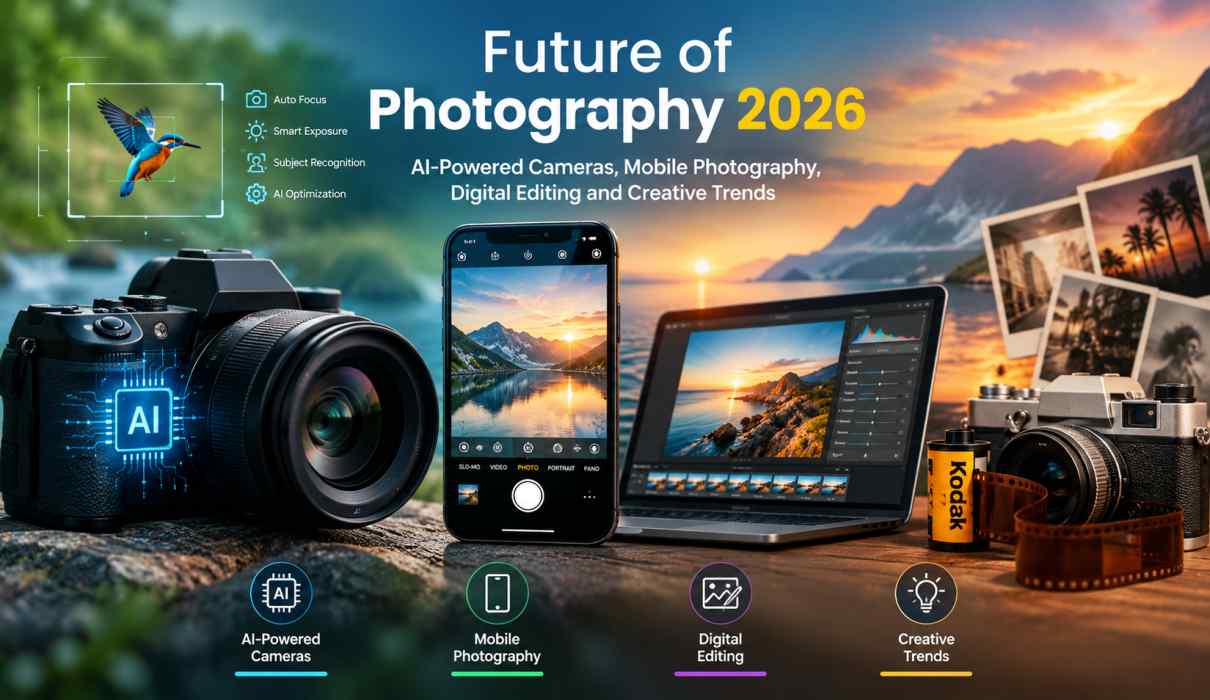
Future of Photography 2026: AI-Powered Cameras, Mobile Photography, Digital Editing and Creative Trends
Photography is entering an exciting new era in 2026. The way people capture, edit, share, and experience images is changing rapidly as artificial intelligence, computational photography, smartphones, advanced cameras, and creative software become increasingly connected. Photography is no longer simply about pressing a shutter button at the right moment. It now combines technology, creativity, storytelling, and intelligent digital tools.
From AI-powered cameras that can recognize subjects to smartphones capable of producing professional-quality images, photographers have access to more creative possibilities than ever before. At the same time, digital editing tools are becoming easier to use, allowing beginners and professionals to improve photographs quickly without requiring extensive technical knowledge.
The future of photography is therefore not about replacing creativity with technology. Instead, emerging tools are giving photographers new ways to express ideas, capture moments, and develop distinctive visual styles.
AI-Powered Cameras Are Transforming Photography
Artificial intelligence is one of the most important photography trends in 2026. Modern cameras and smartphones increasingly use AI to analyze scenes, identify subjects, improve exposure, and optimize image quality.
AI-powered autofocus systems can recognize people, animals, vehicles, and other subjects with impressive accuracy. This makes it easier to maintain focus when photographing moving subjects, sports, wildlife, weddings, and street scenes.
Intelligent exposure systems can also analyze lighting conditions and automatically adjust camera settings. Instead of manually determining every parameter, photographers can allow the camera to make technical adjustments while concentrating on composition and timing.
Another growing area is computational image processing. Cameras and smartphones can combine multiple frames to produce photographs with improved dynamic range, reduced noise, better detail, and more balanced lighting.
These developments are particularly useful for photographers who want high-quality results without spending considerable time adjusting complicated settings.
Mobile Photography Continues to Grow
Smartphone photography remains one of the most influential developments in the modern photography industry. Almost everyone carries a capable camera in their pocket, making photography more accessible than ever.
In 2026, mobile cameras continue to improve through better sensors, optical stabilization, computational photography, multiple focal lengths, and AI-assisted processing. Smartphones can capture detailed images in difficult lighting conditions while automatically improving colors, contrast, sharpness, and exposure.
Portrait photography has also benefited from mobile technology. Software can identify subjects and create depth effects that simulate the appearance of larger camera systems. Night photography, panorama modes, HDR imaging, and advanced zoom capabilities have similarly expanded the creative possibilities of smartphones.
Mobile photography is especially important for travel, social media, journalism, lifestyle content, and everyday storytelling. Users can capture an image, edit it, and publish it within minutes.
The smartphone is therefore becoming more than a camera. It is an entire photography and publishing platform.
Computational Photography Becomes More Important
Traditional photography depends heavily on the physical characteristics of a camera, lens, and sensor. Computational photography adds another layer by using software and algorithms to improve the final image.
Instead of relying on a single exposure, modern devices can capture several frames and combine information from them. This can help produce clearer shadows, controlled highlights, reduced noise, and greater detail.
Computational photography is particularly valuable for small smartphone sensors, where software can compensate for some physical limitations.
Features such as HDR, portrait modes, AI noise reduction, image stacking, scene recognition, and computational zoom demonstrate how photography is increasingly becoming a combination of hardware and software.
This trend is likely to continue as processors become faster and image-processing algorithms become more sophisticated.
AI-Powered Digital Editing
Digital editing has always played an important role in photography, but AI is making the process faster and more accessible.
Modern editing applications can automatically select subjects, remove unwanted objects, improve lighting, reduce noise, sharpen details, and make other adjustments. Tasks that once required careful manual masking can now often be completed with a few clicks.
AI-based editing can also help photographers organize large image collections. Software can analyze photographs and identify faces, locations, subjects, and visual characteristics, making it easier to search through thousands of images.
For professional photographers, these tools can reduce repetitive work and create more time for creative decisions.
However, editing should still support the photographer’s vision. Automated tools may produce technically impressive results, but artistic judgment remains important when deciding how an image should look and what story it should communicate.
Generative AI and Creative Photography
Generative AI is creating new possibilities as well as new discussions within photography.
AI tools can assist with background generation, image expansion, creative compositions, concept development, and visual experimentation. Photographers can use these technologies to explore ideas that would otherwise require expensive locations, sets, or production teams.
For example, a photographer working on a conceptual project may use AI-assisted tools to test different backgrounds or visual environments before completing a final shoot.
At the same time, generative AI raises important questions about authenticity, authorship, copyright, disclosure, and the distinction between photography and digitally generated imagery.
As these technologies develop, photographers, platforms, and audiences will continue to establish different approaches to identifying AI-assisted or AI-generated content.
The Revival of Film Photography
Although digital technology continues to dominate the market, film photography has experienced renewed interest.
Many photographers and younger creators are attracted to film because of its distinctive appearance, slower workflow, and physical nature. Film encourages photographers to think carefully before taking a picture because each exposure has a cost and limited number of frames.
The visual characteristics of different film stocks can also contribute to a recognizable aesthetic. Grain, color response, contrast, and natural imperfections are often considered part of the creative appeal.
Film photography is particularly popular in portraiture, fashion, wedding photography, street photography, and personal projects.
The continued interest in film demonstrates an important point about the future of photography: technological progress does not necessarily eliminate older creative methods. Instead, traditional and modern approaches can exist alongside each other.
Authenticity and Imperfection
One interesting photography trend in 2026 is the growing appreciation for authentic and less-perfect imagery.
Highly polished photographs remain important for advertising and commercial campaigns, but audiences are also engaging with natural moments, genuine expressions, documentary-style images, and behind-the-scenes content.
Social media has contributed to this shift. People increasingly share photographs that feel personal rather than overly produced.
This does not mean professional photography is becoming less relevant. Instead, photographers are exploring a wider range of visual styles, from carefully constructed commercial images to spontaneous documentary photographs.
Authenticity can become a powerful creative tool when it reflects the photographer’s genuine perspective.
Cinematic Photography and Visual Storytelling
Photography is increasingly influenced by cinema, television, advertising, and digital video.
Cinematic photography often uses controlled lighting, carefully selected colors, dramatic compositions, atmospheric environments, and storytelling techniques. Photographers are experimenting with wide compositions, unusual perspectives, shadows, movement, and color grading to create images that feel like scenes from a larger story.
This trend is especially visible in fashion photography, travel content, weddings, portraits, and social media campaigns.
Rather than creating a single attractive image, photographers are increasingly thinking about visual narratives. A collection of photographs can communicate a journey, personality, event, or brand identity.
Storytelling therefore remains one of the most valuable skills in photography, regardless of how advanced the technology becomes.
Social Media Is Influencing Photography Styles
Platforms built around visual content continue to influence how photographs are created.
Photographers now consider vertical formats, thumbnails, short-form video, carousel posts, stories, and other digital presentation methods while planning their shoots.
This has changed composition. Images may need to work both as standalone photographs and as part of a broader social media sequence.
The rise of creator culture has also increased demand for visually consistent personal branding. Photographers, influencers, businesses, and content creators often develop recognizable color palettes, compositions, editing styles, and visual identities.
Photography is consequently becoming closely connected with digital marketing and personal branding.
Photography for E-Commerce and Business
Businesses are also benefiting from developments in photography technology.
High-quality product photography is essential for online shopping because customers cannot physically examine products before purchasing them. Better smartphone cameras, affordable lighting equipment, AI editing, and automated background removal have made professional-looking product photography accessible to smaller businesses.
AI-assisted workflows can help businesses create consistent product images, resize photographs for different platforms, and prepare visual content for websites and social media.
Real estate, hospitality, tourism, food, fashion, automotive, and retail industries are similarly dependent on strong photography.
As online competition increases, visually appealing and trustworthy images can play an important role in communicating product quality and brand identity.
The Growth of High-Resolution and Advanced Cameras
Professional cameras continue to evolve despite the popularity of smartphones.
High-resolution sensors, advanced autofocus, improved low-light performance, faster continuous shooting, electronic viewfinders, stabilization, and sophisticated video capabilities are becoming increasingly common in modern camera systems.
Mirrorless cameras remain particularly important for professional photography because they combine advanced imaging capabilities with relatively compact designs.
However, the choice between a professional camera and smartphone increasingly depends on the photographer’s needs. A professional system may offer greater lens flexibility, control, and performance, while a smartphone provides convenience and portability.
The future is therefore likely to include both specialized cameras and increasingly capable mobile devices.
Photography and Video Are Becoming More Connected
The boundary between photography and video continues to become less distinct.
Many modern cameras are designed to capture both high-quality still images and professional video. Photographers working in commercial, wedding, fashion, and social media environments often need both skills.
Short-form video has also changed expectations. Clients may request photographs alongside reels, behind-the-scenes clips, and other video content.
Learning basic video principles such as framing, movement, lighting, and sound can therefore provide photographers with additional creative and professional opportunities.
Sustainability in Photography
Sustainability is becoming another consideration within the photography industry.
Photographers and manufacturers are increasingly thinking about equipment longevity, repairability, energy consumption, packaging, travel emissions, and responsible production.
Digital workflows can reduce some physical requirements, while photographers may also choose durable equipment that can be used for many years rather than frequently replacing devices.
For travel and commercial photographers, efficient digital workflows can also help reduce unnecessary equipment transportation.
Sustainable photography does not require abandoning technology. Instead, it encourages more thoughtful decisions about equipment, production, travel, and consumption.
Skills Photographers Need in 2026
Technology is changing photography, but fundamental creative skills remain valuable.
Photographers can benefit from developing strong knowledge of composition, lighting, perspective, color, storytelling, and visual communication. Understanding camera settings is still important for people who want greater creative control.
At the same time, modern photographers can benefit from learning AI-assisted editing, photo organization, mobile photography, social media presentation, and basic content production.
The most adaptable photographers are likely to combine technical knowledge with creative thinking.
Rather than competing against technology, photographers can use technology as part of their creative workflow.
What Is the Future of Photography?
The future of photography will likely be defined by collaboration between humans and intelligent technology.
Cameras will continue becoming smarter. Smartphones will continue improving computational imaging. Editing software will automate more repetitive tasks. AI will provide new creative possibilities, while film and traditional photography will continue to attract people seeking physical and authentic experiences.
However, technology alone cannot determine what makes a photograph meaningful.
A powerful image can come from an expensive professional camera, a smartphone, a film camera, or an unconventional creative process. What matters is the photographer’s ability to recognize a moment, communicate an idea, and create an emotional or visual connection with the audience.
The future of photography is therefore likely to be diverse rather than dominated by one technology.
Conclusion
The future of photography in 2026 is being shaped by AI-powered cameras, mobile photography, computational imaging, advanced digital editing, generative technology, cinematic storytelling, and renewed interest in film.
These developments are making photography more accessible while giving experienced photographers new creative tools. Smartphones are bringing high-quality imaging to more people, AI is reducing repetitive editing work, and advanced cameras are providing professional photographers with greater control and performance.
At the same time, authenticity, storytelling, creativity, and human perspective remain central to successful photography.
The most important trend may therefore be the combination of technology and creativity. As photography continues to evolve, photographers who understand both emerging tools and timeless visual principles will have more opportunities to create distinctive, meaningful, and engaging images.
In 2026 and beyond, photography is not simply becoming more technological. It is becoming more flexible, intelligent, accessible, and creatively diverse.