

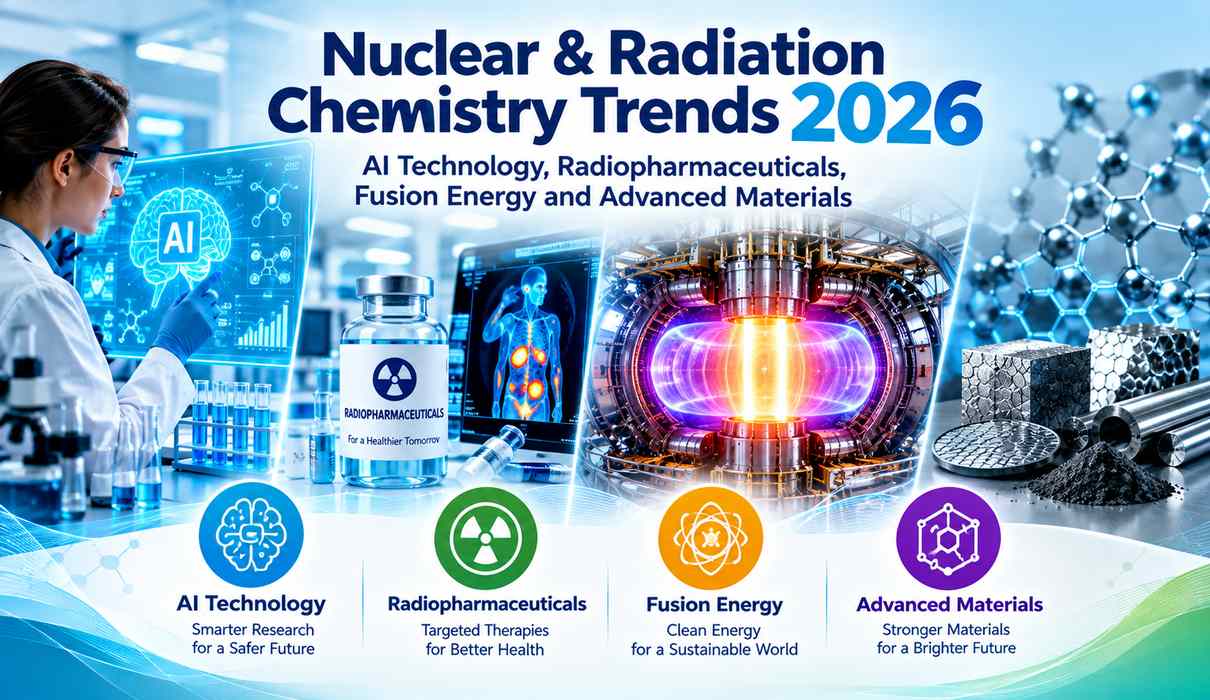
Nuclear & Radiation Chemistry Trends 2026: AI Technology, Radiopharmaceuticals, Fusion Energy and Advanced Materials
Nuclear and radiation chemistry is entering an increasingly technology-driven era in 2026. Advances in artificial intelligence, radiopharmaceuticals, fusion energy, radiation-resistant materials and computational modeling are expanding the role of nuclear science across healthcare, energy, manufacturing, environmental research and advanced materials development.
Traditionally, nuclear chemistry has focused on radioactive elements, nuclear transformations, isotope production and the chemical behavior of materials exposed to nuclear processes. Radiation chemistry, meanwhile, studies the chemical changes produced when ionizing radiation interacts with matter. These disciplines remain fundamental, but modern research is connecting them with artificial intelligence, precision medicine, high-performance computing and next-generation energy systems.
Recent research describes AI as an increasingly important tool across nuclear medicine workflows, including image acquisition, reconstruction, segmentation, biomarker extraction and treatment planning. At the same time, AI is being explored in radiopharmaceutical development and fusion research.
In 2026, several major trends are shaping the future of nuclear and radiation chemistry.
1. AI Is Transforming Nuclear and Radiation Science
Artificial intelligence is becoming one of the most significant technological developments in nuclear science.
Large datasets generated by nuclear experiments, radiation detectors, medical imaging systems and computational simulations can be difficult to analyze using conventional methods alone. Machine learning can help identify patterns, automate repetitive tasks and support complex predictions.
In nuclear medicine, AI applications include image reconstruction, image enhancement, automated segmentation, quantitative analysis and treatment planning. Researchers are also exploring AI for radiopharmaceutical discovery and molecular imaging.
In radiation chemistry, AI and machine learning can potentially assist researchers in understanding complex reaction pathways, predicting material behavior and analyzing experimental data.
The important point is that AI does not replace scientists. Instead, it can provide computational assistance that allows researchers to investigate larger datasets and more complicated systems.
2. AI-Assisted Radiopharmaceutical Development
Radiopharmaceuticals are becoming one of the most important areas connecting chemistry, nuclear physics and medicine.
A radiopharmaceutical combines a radioactive isotope with a molecule designed to interact with a particular biological target. Depending on the isotope and molecular design, radiopharmaceuticals can be used for imaging, diagnosis or targeted therapy.
AI is now being investigated throughout this development process. Research reviews describe applications including target identification, ligand design, pharmacokinetic prediction, image reconstruction and quantitative molecular imaging.
Machine-learning approaches can analyze chemical and biological information to help researchers identify promising molecular structures. This could eventually shorten some stages of research and improve the ability to design more selective compounds.
However, radiopharmaceutical development remains highly complex. Chemistry, isotope availability, biological behavior, radiation dose, manufacturing, safety and regulatory requirements all need to be considered.
3. Radiopharmaceuticals and Precision Nuclear Medicine
One of the most important nuclear chemistry trends in 2026 is the growth of precision radiopharmaceutical therapy.
Traditional cancer treatments can affect both healthy and diseased tissues. Targeted radiopharmaceutical therapy aims to deliver radiation more selectively by attaching radioactive isotopes to molecules that recognize specific biological targets.
This has helped strengthen the concept of theranostics, in which diagnostic imaging can help identify suitable targets and therapeutic radiopharmaceuticals can subsequently be used for treatment.
Current research is exploring increasingly sophisticated approaches to targeted therapy, including alpha-emitting radionuclides and patient-specific dosimetry. A 2026 review describes radiopharmaceutical therapy as an expanding area of precision oncology, while also highlighting the importance of isotope production, supply chains, clinical infrastructure and regulation.
The field is therefore moving toward a more personalized model of nuclear medicine.
4. New Developments in Medical Isotopes
Medical isotopes remain central to nuclear medicine.
Important radionuclides used in diagnostic and therapeutic applications include technetium-99m, fluorine-18, carbon-11 and iodine-131, among others. Research is also expanding into additional therapeutic isotopes and new combinations of radionuclides with targeting molecules.
A 2026 review of nuclear medicine highlights continued developments involving radiotracers, radiopharmaceutical production, computational modeling and AI, with particular attention to major medical isotopes and their diagnostic and therapeutic applications.
Reliable isotope production is essential. Some radionuclides have short half-lives, making production, processing and transportation particularly challenging.
Consequently, future progress in radiopharmaceutical chemistry will depend not only on discovering new compounds but also on building reliable production and distribution systems.
5. AI and Computational Nuclear Medicine
Modern nuclear medicine is increasingly computational.
Advanced imaging systems produce enormous quantities of information. AI can help convert these images into quantitative data that clinicians and researchers can use.
Emerging applications include:
- Automated tumor segmentation
- Image reconstruction
- Image enhancement
- Quantitative PET and SPECT analysis
- Radiation-dose estimation
- Treatment-response prediction
- Radiomics
- Personalized dosimetry
Research published in 2026 also discusses the development of computational approaches such as AI-supported digital twins for nuclear medicine. These systems aim to integrate patient-specific biological, imaging and treatment information to improve modeling and personalization.
However, clinical AI requires careful validation. Accuracy, bias, explainability, privacy and regulatory oversight remain important considerations.
6. Fusion Energy Becomes a Major Research Priority
Fusion energy is another major trend influencing nuclear science in 2026.
Fusion attempts to generate energy by combining light atomic nuclei under extreme conditions. The scientific challenge is not simply producing a fusion reaction; researchers must develop materials, fuel systems, plasma technologies and engineering systems capable of operating reliably.
In June 2026, the U.S. Department of Energy released a finalized Fusion Science and Technology Roadmap designed to accelerate progress toward fusion pilot plants and commercial fusion power in the mid-2030s.
This growing focus is creating new opportunities for chemistry and materials science.
7. Advanced Materials for Fusion Reactors
Materials are among the most difficult challenges facing future fusion systems.
Fusion environments can expose components to extreme temperatures, high-energy neutrons and intense radiation. These conditions can alter the structure and properties of materials over time.
The 2026 U.S. fusion roadmap specifically identifies radiation-related materials degradation as a major technical challenge and emphasizes the need to understand material performance and lifetime under fusion-relevant irradiation.
Researchers are therefore investigating materials that can tolerate extreme environments while maintaining mechanical strength, thermal performance and chemical stability.
Potential research areas include:
- Advanced steels
- Ceramic materials
- Silicon-carbide-based systems
- Tungsten and other refractory materials
- Radiation-resistant composites
- Advanced coatings
- Novel structural materials
Materials chemistry will play a critical role in determining which technologies can eventually operate inside commercial fusion plants.
8. Radiation Chemistry and Material Degradation
Radiation does not simply pass through materials without consequences.
Ionizing radiation can break chemical bonds, generate reactive species and change molecular structures. In polymers, for example, irradiation can cause processes such as chain scission or cross-linking depending on the material and radiation conditions.
Understanding these chemical changes is essential for designing radiation-resistant materials.
Radiation chemistry therefore has applications far beyond nuclear reactors. It contributes to research involving medical equipment, spacecraft materials, sterilization, polymers, electronics and industrial processing.
In advanced nuclear systems, understanding radiation-induced chemical and structural changes can help engineers predict component lifetimes and improve reliability.
9. High-Performance Computing and Radiation Modeling
Computer simulation is becoming increasingly important in nuclear and radiation chemistry.
Researchers can use computational models to study radiation interactions, molecular behavior, isotope production and radiation dose distributions.
Tools such as Monte Carlo simulations can model how radiation moves through complex environments. In nuclear medicine, computational methods are being combined with physical models and human-body simulations to improve radiation dosimetry.
The combination of high-performance computing and AI is particularly promising.
Instead of relying exclusively on expensive physical experiments, researchers can use simulations to narrow the range of possibilities before laboratory testing.
This can reduce research time and help scientists investigate scenarios that would otherwise be difficult or expensive to reproduce experimentally.
10. Radiation Chemistry in Environmental Applications
Radiation chemistry also has an important role in environmental science.
Ionizing radiation can initiate chemical reactions that modify pollutants and other contaminants. Research into radiation-based treatment methods has investigated applications involving water purification, industrial waste and environmental remediation.
Radiation chemistry can help scientists understand how contaminants react under irradiation and whether harmful compounds can be transformed into less problematic substances.
At the same time, nuclear industries must carefully manage radioactive waste and contaminated materials.
Future environmental applications will increasingly combine radiation science with advanced separation technologies, chemical analysis and computational modeling.
11. Nuclear Waste and Advanced Chemical Processing
Managing radioactive waste remains one of the long-term challenges associated with nuclear technologies.
Nuclear chemistry contributes to waste treatment through processes involving separation, immobilization, chemical stabilization and materials development.
Scientists continue to investigate ways to isolate radioactive elements and safely contain them for appropriate periods.
Advanced materials can contribute through engineered barriers and waste forms designed to remain stable under challenging chemical and radiation conditions.
The future of nuclear chemistry is therefore not only about creating new technologies. It is also about developing safer methods for managing the materials produced throughout the nuclear lifecycle.
12. Radiation Applications in Industry
Radiation chemistry has applications across several industrial sectors.
Controlled radiation can be used for sterilization, polymer modification, material processing and certain manufacturing applications.
Radiation-based techniques can alter the physical and chemical properties of materials without requiring conventional chemical processing in every case.
This creates opportunities for specialized polymers, medical products, packaging and industrial materials.
As material science advances, researchers are increasingly interested in controlling radiation-induced reactions with greater precision.
13. Nuclear Chemistry and the Circular Economy
Another emerging area is the relationship between nuclear technology and resource efficiency.
Advanced nuclear systems require specialized materials, fuels and components. Recovering valuable elements and improving recycling processes can reduce waste and strengthen supply chains.
Nuclear chemistry can contribute to the separation and purification of elements, while radiation chemistry can help characterize how materials change during repeated exposure and processing.
This creates a broader research direction focused on efficient resource use, waste reduction and advanced material recovery.
14. Digital Twins and Predictive Nuclear Science
Digital twins are another emerging technology with potential applications in nuclear science.
A digital twin is a computational representation of a physical system that can be updated using data from experiments, sensors or simulations.
In nuclear medicine, researchers are exploring digital-twin approaches for personalized treatment modeling. In fusion research, computational models can help scientists understand reactor conditions and predict system behavior.
The long-term objective is to move from simply observing systems toward predicting how they will behave under different conditions.
This could improve research efficiency, maintenance planning and safety analysis.
15. Safety, Regulation and Responsible Innovation
As nuclear and radiation technologies become more sophisticated, safety remains essential.
AI systems must be validated before being used in high-stakes environments. Radiopharmaceuticals must meet rigorous quality and regulatory standards. Fusion materials must undergo extensive testing before being considered for reactor environments.
Research into AI for nuclear medicine also highlights concerns involving interpretability, data bias and regulatory issues.
Innovation therefore needs to progress alongside responsible governance.
The objective is not simply to develop faster technologies but to develop technologies that are safe, reliable, explainable and scientifically validated.
16. The Future of Nuclear & Radiation Chemistry
The future of nuclear and radiation chemistry will increasingly depend on collaboration between traditionally separate scientific disciplines.
Chemists, physicists, materials scientists, engineers, medical researchers, computer scientists and data specialists are increasingly working together.
Several major areas are likely to remain important:
- AI-assisted nuclear research
- Precision radiopharmaceuticals
- Targeted radionuclide therapy
- Fusion energy
- Radiation-resistant materials
- Advanced nuclear materials
- Computational dosimetry
- Digital twins
- Radiation-based environmental technologies
- Nuclear waste management
- Advanced isotope production
This interdisciplinary approach can accelerate discoveries while creating new solutions to complex problems.
Conclusion
Nuclear & Radiation Chemistry Trends 2026 show how rapidly nuclear science is evolving. AI technology is expanding computational and imaging capabilities, radiopharmaceutical research is supporting increasingly personalized medicine, fusion energy is driving research into extreme environments, and advanced materials are becoming essential for future nuclear systems.
The biggest opportunity lies in bringing these technologies together. AI can accelerate research and data analysis. Nuclear chemistry can support isotope production and radiopharmaceutical development. Radiation chemistry can explain material and molecular changes under irradiation. Materials science can help create components capable of surviving demanding environments.
At the same time, scientific progress must be supported by rigorous testing, safety standards, regulatory oversight and responsible implementation.
As research continues, nuclear and radiation chemistry will remain an important foundation for healthcare, clean-energy research, advanced materials and emerging technologies. The innovations developing in 2026 could shape how radiation is used not only in laboratories, but also in hospitals, energy systems, manufacturing and environmental applications for years to come.