

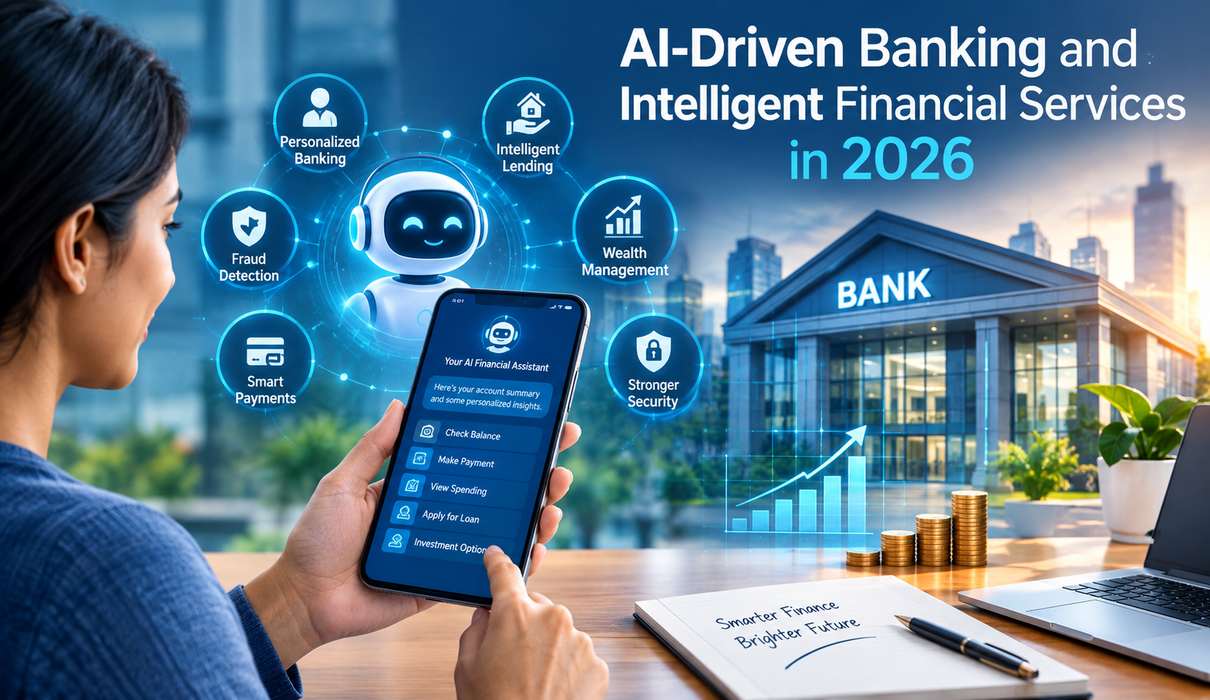
AI-Driven Banking and Intelligent Financial Services in 2026
The financial industry is entering a new era in 2026 as artificial intelligence (AI) moves beyond basic automation and becomes an important part of banking, payments, lending, investment management, fraud prevention, and customer service. Banks and financial institutions are increasingly using AI to analyze enormous amounts of data, personalize financial products, identify suspicious transactions, automate routine processes, and support faster decision-making.
The rise of generative AI and AI-powered agents is also changing how customers interact with financial services. Instead of simply receiving information from a banking application, customers may increasingly use intelligent systems to complete financial tasks, compare products, manage payments, monitor spending, and receive personalized recommendations.
This transformation is creating new opportunities for financial institutions while also introducing challenges involving cybersecurity, privacy, regulation, transparency, and responsible use of customer data.
What Is AI-Driven Banking?
AI-driven banking refers to the use of artificial intelligence, machine learning, generative AI, predictive analytics, and intelligent automation to improve banking products and services.
Traditional banking systems often depend on predefined rules and manual processes. AI-driven systems can analyze patterns in real time and use historical and current information to support more dynamic decisions.
For example, an AI-powered banking platform can analyze a customer’s transaction history, identify unusual spending behavior, predict upcoming financial needs, and provide relevant alerts or recommendations.
AI can support many areas of banking, including:
- Customer service and virtual assistants
- Fraud detection and prevention
- Credit scoring and lending
- Personal financial management
- Risk assessment
- Investment services
- Payment processing
- Compliance monitoring
- Cybersecurity
- Back-office automation
The goal is not simply to make banking more automated. The larger objective is to make financial services faster, more personalized, efficient, and responsive.
Why AI in Banking Is Becoming More Important in 2026
Financial institutions operate with enormous amounts of structured and unstructured data. Every payment, account interaction, loan application, investment decision, and customer service request can create valuable information.
AI provides tools for processing this information at a scale that would be difficult to achieve through manual analysis alone.
At the same time, customers increasingly expect digital financial services to be available instantly. People want faster payments, personalized recommendations, immediate support, simple loan applications, and secure digital transactions.
Competition among traditional banks, fintech companies, payment platforms, and digital financial providers is also encouraging institutions to invest in intelligent technologies.
In 2026, AI is therefore becoming an important component of the broader digital transformation of the financial sector.
AI-Powered Customer Service
One of the most visible applications of AI in banking is customer service.
AI-powered virtual assistants can answer common questions, explain transactions, help customers navigate banking applications, and provide information about products and services.
Generative AI can make these interactions more conversational. Instead of navigating multiple menus, customers may be able to describe what they need using natural language.
For example, a customer could ask an intelligent banking assistant to explain recent spending, identify recurring subscriptions, or help understand why a payment was declined.
AI can also help human customer-service employees by summarizing customer histories, suggesting appropriate responses, and automatically retrieving relevant information.
This combination of AI and human expertise can reduce response times while allowing employees to focus on more complicated customer issues.
Intelligent Fraud Detection and Financial Security
Fraud prevention is another major area where AI can create significant value.
Traditional fraud detection systems often depend on predefined rules. AI systems can analyze transaction patterns and identify unusual behavior that may indicate fraud.
For example, an AI model could consider factors such as transaction amount, location, device information, transaction frequency, and historical behavior when assessing whether a payment appears suspicious.
Machine learning systems can continuously learn from new patterns, potentially helping financial institutions respond to increasingly sophisticated fraud techniques.
However, the rise of AI also creates new cybersecurity challenges. Criminals can use AI to create convincing phishing messages, automate scams, manipulate identities, and develop sophisticated social-engineering attacks.
As a result, banks will need to use AI not only to improve financial services but also to strengthen their defenses against AI-assisted threats.
AI and Smarter Lending
Lending is another area undergoing transformation.
Banks traditionally evaluate borrowers using credit scores, income information, repayment histories, and other financial indicators. AI can analyze larger datasets and identify patterns that may help lenders assess risk more efficiently.
AI-powered lending platforms can potentially speed up application processing, automate document analysis, and identify applications that require additional human review.
Alternative data may also provide additional insights in certain lending environments, although its use must be carefully controlled to prevent unfair or discriminatory outcomes.
Responsible AI is especially important in lending because automated decisions can have significant effects on people’s financial lives.
Financial institutions therefore need strong governance systems, transparent decision-making processes, and appropriate human oversight when AI is used for credit decisions.
Personalized Financial Services
One of the biggest opportunities created by AI-driven banking is personalization.
Traditional banking products are often designed for broad customer segments. AI makes it possible to analyze individual financial behavior and provide more customized services.
An intelligent financial platform could analyze income, spending patterns, savings behavior, recurring expenses, and financial goals to provide personalized insights.
For example, an AI system might identify that a customer is spending more than usual on subscriptions or suggest increasing savings based on changes in monthly cash flow.
Banks could also use AI to recommend relevant products, such as savings accounts, insurance options, credit products, or investment services.
However, personalization should be based on customer consent, appropriate data usage, and transparent practices. Convenience should not come at the expense of privacy.
The Rise of AI Agents in Banking
One of the most interesting developments in 2026 is the growing focus on AI agents.
Unlike traditional chatbots that primarily answer questions, AI agents are designed to perform multi-step tasks based on a user’s instructions.
In finance, this could eventually mean an AI assistant that helps customers manage several related activities.
For example, a customer might ask an AI financial assistant to review upcoming bills, identify available funds, schedule eligible payments, and provide a summary of the expected account balance.
Agentic banking could make financial management more proactive and automated.
However, financial AI agents require strong security controls. Any system capable of initiating payments, changing account settings, or performing other financial actions needs authentication, authorization, transaction limits, monitoring, and clear customer confirmation mechanisms.
The future of agentic banking will therefore depend not only on AI capability but also on trust and safety.
AI and Digital Payments
Digital payments are becoming increasingly intelligent.
AI can help payment providers identify suspicious transactions, improve authorization rates, detect account takeover attempts, and personalize payment experiences.
AI may also support more automated financial workflows in which software systems communicate with payment platforms and complete authorized transactions.
The combination of AI agents, digital wallets, real-time payment networks, and open financial APIs could create a more connected financial ecosystem.
For consumers, this could mean fewer manual steps when managing routine financial tasks. For businesses, intelligent payment systems could improve cash-flow management, reconciliation, fraud monitoring, and customer experiences.
AI in Investment and Wealth Management
Investment management is also being influenced by artificial intelligence.
AI-powered platforms can analyze market information, financial statements, economic indicators, news, and historical data. These systems can help investors organize information and identify patterns.
Robo-advisory platforms can use algorithms to construct and rebalance portfolios according to predefined objectives and risk preferences.
Generative AI can also make financial information easier to understand by explaining complicated concepts in simpler language.
However, investors should not assume that AI can reliably predict financial markets. Markets are influenced by unpredictable economic, political, technological, and behavioral factors.
AI can be a useful analytical tool, but investment decisions still require careful consideration of risk, objectives, time horizon, diversification, and professional advice where appropriate.
Intelligent Compliance and Risk Management
Financial institutions face extensive regulatory and compliance requirements.
AI can help automate parts of compliance operations by monitoring transactions, analyzing documents, identifying anomalies, and supporting reporting processes.
Machine learning can help detect patterns that may require investigation, while generative AI can assist employees with document review and information retrieval.
Risk management can also benefit from predictive analytics. Banks can use AI models to monitor potential changes in credit risk, liquidity conditions, operational risks, and other financial indicators.
Human oversight remains important because financial regulations and risk decisions often involve context that automated systems may not fully understand.
Challenges of AI-Driven Banking
Despite its potential, AI-driven banking has significant challenges.
Data Privacy
Financial institutions manage extremely sensitive information. Banks must ensure that customer data is collected, stored, processed, and shared responsibly.
Algorithmic Bias
AI models can reproduce biases present in their training data. This can create unfair outcomes, particularly in areas such as lending, insurance, and financial access.
Lack of Transparency
Some advanced AI systems can be difficult to explain. Customers and regulators may need to understand why an automated system reached a particular conclusion.
Cybersecurity
AI systems can become targets for cyberattacks. Financial institutions need strong security controls to protect models, data, applications, and customer accounts.
Regulatory Uncertainty
AI regulation continues to evolve globally. Financial institutions must keep their AI systems aligned with changing legal and regulatory expectations.
Human Oversight
Not every financial decision should be completely automated. High-impact decisions often require human review and accountability.
The Future of Intelligent Financial Services
The future of banking is likely to involve closer integration between AI, cloud computing, real-time payments, digital identity, blockchain-based infrastructure, and open financial ecosystems.
AI assistants could become a common interface between customers and financial institutions. Instead of opening multiple applications, customers may increasingly interact with a single intelligent financial assistant.
Banks may also move from reactive services to proactive financial management. Rather than waiting for customers to ask questions, intelligent systems could identify potential problems and provide timely alerts.
For businesses, AI could automate financial administration, including invoice processing, cash-flow forecasting, reconciliation, fraud monitoring, and payment management.
The financial institution of the future may therefore look very different from the traditional bank. It could operate as a technology-driven financial platform where intelligent systems work continuously in the background.
Conclusion
AI-driven banking and intelligent financial services are becoming major forces shaping the financial industry in 2026. Artificial intelligence is transforming customer service, fraud detection, lending, payments, investment management, compliance, risk assessment, and personal financial planning.
The emergence of AI agents could take this transformation even further by allowing customers and businesses to delegate authorized financial tasks to intelligent digital systems.
However, technological capability alone will not determine the success of AI in finance. Trust, security, transparency, privacy, regulatory compliance, and responsible human oversight will be equally important.
For banks and financial institutions, the opportunity is to use AI to build faster, smarter, and more personalized financial experiences without compromising customer protection.
For consumers and businesses, understanding how AI-powered financial services work will become increasingly important. As intelligent technologies become embedded into everyday financial activities, AI is likely to move from being a behind-the-scenes banking tool to becoming a central part of how people interact with money.
In 2026 and beyond, the future of finance will not simply be digital. It will increasingly be intelligent, automated, personalized, and AI-driven.